How to Report Crypto Income from Invoices at Tax Time
Tax guide for reporting USDC and crypto invoice income — FMV at receipt, record keeping, 1099 rules, Schedule C, international reporting, and export workflows for merchants.
Do this next
Accept crypto for your own sales
- Tax the supply in local currency at the tax point.
- Licensing usually follows custody, not invoicing.
- Keep a per-invoice fiat figure at settlement.
TL;DR
Crypto invoice payments are taxable income at fair market value when received — for USDC, that is typically the USD invoice amount on the payment date. Keep invoice PDFs, platform exports with tx hashes, and payment timestamps. Aggregate paid invoices for the year; report on Schedule C, 1120, or equivalent in your jurisdiction. This is not tax advice — consult a CPA. Export records from Settlematic Collect; see accountant reconciliation guide.
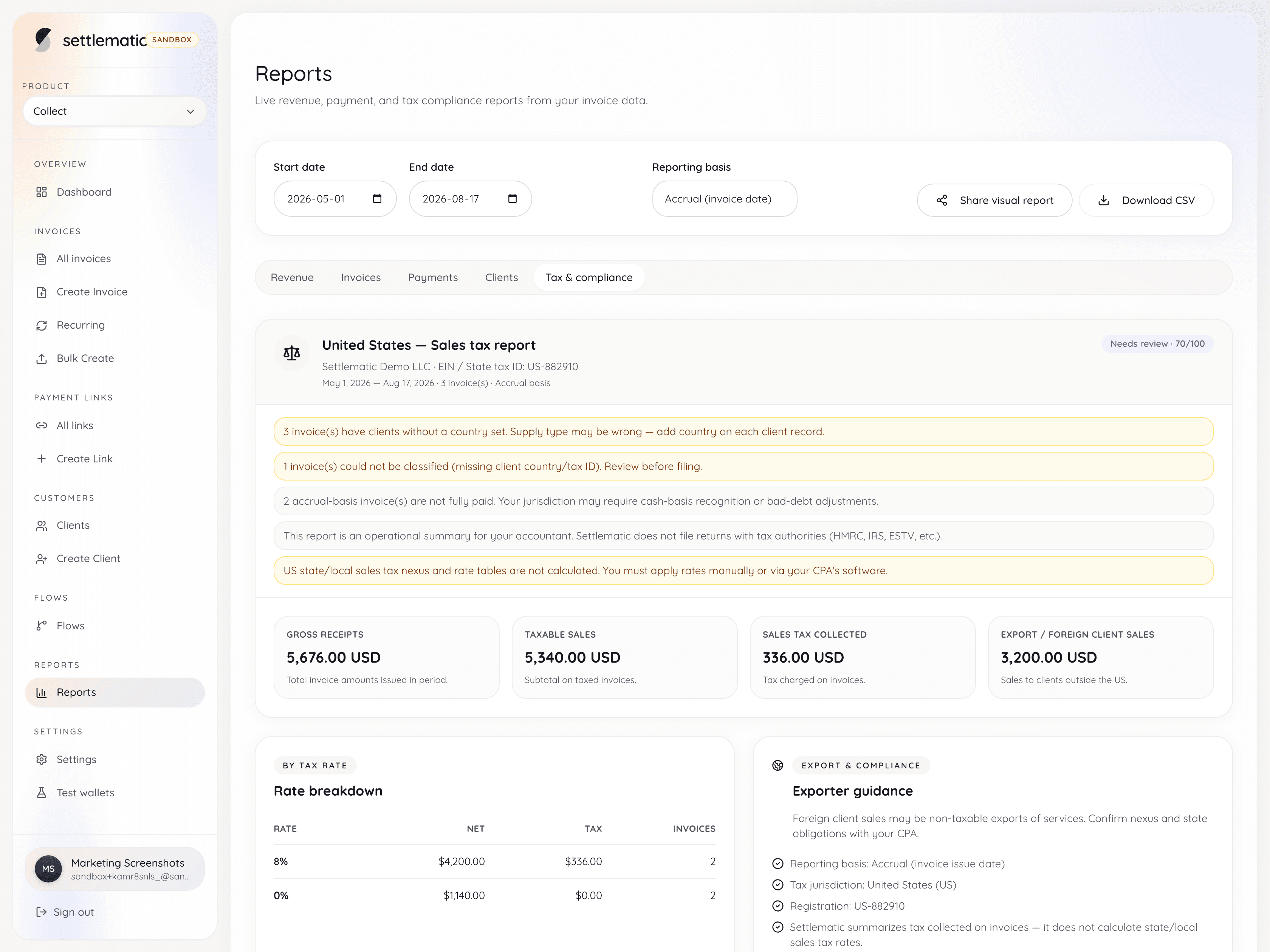
Tax season panic hits when the spreadsheet has 47 transaction hashes and no invoice numbers. Crypto invoicing does not create a new tax asset class — it creates a new proof format for the same service income you always owed taxes on.
This guide explains how merchants, freelancers, and finance teams aggregate crypto invoice income for annual reporting, what records auditors expect, and how stablecoins simplify FMV compared to Bitcoin invoicing.
Disclaimer: Tax law varies by jurisdiction and changes frequently. This article is educational, not professional tax advice. Work with a qualified CPA or tax advisor for your situation.
Fundamental rule: income when received
Most jurisdictions tax receipt of payment for services or goods, not label on payment rail:
| Event | US tax treatment (general) |
|---|---|
| Invoice issued | Accrual taxpayers may recognize earlier |
| USDC received for services | Ordinary income at FMV on receipt date |
| USDC held afterward | Potential separate gain/loss only on disposal if FMV changed materially |
| USDC sold to USD at bank | May trigger capital event depending on basis |
Stablecoin invoice income often maps 1:1 to USD invoice amount — simplest case.
Why invoice records beat explorer dumps
Block explorer CSV shows transfers to your wallet. It does not show:
- Which transfer was client payment vs internal treasury move
- Which invoice was satisfied
- Service description for audit
- Client identity for 1099
Platform exports link invoice number ↔ tx hash ↔ client ↔ service description. That is what tax prep requires.
Required archive per payment:
- Invoice PDF at time of issue
- Paid invoice export row (amount, date, hash)
- Explorer screenshot optional — hash in export sufficient
What is a crypto invoice defines fields your records should contain.
US reporting overview by entity type
| Entity | Typical form | Crypto invoice income line |
|---|---|---|
| Sole proprietor / LLC disregarded | Schedule C | Gross receipts |
| Partnership | Form 1065 | Ordinary business income |
| S-Corp / C-Corp | 1120-S / 1120 | Gross revenue |
Crypto payment method does not change form selection — gross receipts from services include USDC invoice payments at FMV.
Schedule C example (freelancer)
Each USDC payment adds to Line 1 at USD value on payment date. If all invoices quoted USD and paid USDC 1:1, sum paid invoice fiat amounts from export.
Form 1099-NEC (US clients you paid)
If you paid US contractors $600+ during year, issue 1099-NEC — whether you paid wire or USDC. Your receipt of income from clients may trigger them issuing 1099 to you — provide legal name and TIN during client onboarding.
Form 8949 / Schedule D
Required when you dispose of crypto — sell USDC for USD, swap USDC for ETH, etc. Pure receipt of USDC for services with immediate stable value may not require 8949 line until disposal — but Treasury reporting rules evolve. Confirm with CPA for 2026 filing requirements including potential digital asset question on Form 1040.
Fair market value (FMV) determination
| Asset | FMV source |
|---|---|
| USDC | Invoice USD amount; backup: Coinbase/Circle rate at timestamp |
| EURC | ECB rate or invoice EUR amount |
| BTC/ETH (if invoiced volatile) | Exchange rate at confirmation timestamp |
Document FMV methodology once in accounting policy; apply consistently.
Payment timestamp in Settlematic Collect export = FMV date for cash-basis taxpayers.
Monthly rhythm prevents April disaster
| Month-end task | Tax benefit |
|---|---|
| Export all paid invoices | Continuous gross receipts tally |
| Reconcile to wallet inflows | Catch personal transfers mislabeled |
| File export in /2026/08/ folder | Audit trail |
| Note open AR separately | Accrual vs cash clarity |
Share exports with CPA quarterly if available — accountant guide.
International considerations
UK: Self Assessment — crypto income as trading/self-employment income; record GBP value at receipt (HMRC guidance on exchange rates).
EU: VAT on services independent of crypto payment — invoice PDF must show VAT where registered. Income tax on net business profit.
Canada: Business income in CAD at receipt; keep Bank of Canada rates if converting USDC USD amounts.
Australia: ATO treats crypto payment as ordinary income at AUD value when received.
Cross-border clients paying USDC do not exempt you from local tax residency obligations.
Recurring invoices and retainers
Recurring crypto invoices generate 12 payments/year — export sums cleanly if each cycle has unique invoice number. Do not aggregate mentally; sum export amount_fiat column.
Partial payments and refunds
| Situation | Reporting |
|---|---|
| Two partial USDC payments one invoice | One income event when fully paid (cash) OR two receipts (if policy treats each partial) — CPA call |
| Refund USDC to client | Reduce income or expense depending on timing and method |
| Credit memo next invoice | Net against future gross receipts |
Platform status partially_paid flags need CPA interpretation under your accounting method.
Expense deductions related to crypto invoicing
Deductible business expenses (US Schedule C examples):
- Settlematic subscription
- Accountant fees
- Home office, software, contractor costs
- On-chain gas if you paid gas for business sends (usually small)
Gas paid by client on invoice payment — not your expense.
Audit defense package
If revenue agency inquires:
Auditor picks random invoice → matches PDF to hash on chain → confirmed.
Hashes on public chain are tamper-evident — stronger than some bank records.
Common tax mistakes
- Assuming crypto is tax-free — it is not
- Reporting only fiat withdrawn to bank — income at receipt, not conversion
- Using explorer total inflows — includes non-income transfers
- Missing Q4 payments received Jan 1 UTC — watch timezone on timestamp
- No invoice numbers — cannot defend gross receipts line
- Mixing personal wallet — contaminated records
Stablecoin vs volatile crypto tax complexity
| Invoicing style | Tax complexity |
|---|---|
| USD invoice, USDC payment | Low |
| USD invoice, ETH payment with live quote | Medium — FMV at receipt |
| BTC denominated invoice | High — volatility + FMV disputes |
Recommend clients invoice USD, settle USDC — how to invoice USD get paid crypto.
State and local taxes
US state income tax follows federal gross receipts in most states — include crypto invoice income in state returns. Local business taxes apply per municipality rules.
Sales tax on services — jurisdiction-specific; payment rail irrelevant.
Year-end checklist
- [ ] Export all paid invoices Jan 1 – Dec 31 (functional timezone defined)
- [ ] Sum gross receipts; compare to P&L draft
- [ ] Wallet tie-out Dec 31 USDC balance
- [ ] List open AR for accrual clients
- [ ] Gather 1099s received from clients
- [ ] Issue 1099s to contractors you paid
- [ ] Document any USDC→USD conversions with dates and amounts
- [ ] Deliver package to CPA by agreed deadline
Software helpers
- Settlematic export — primary source
- CoinTracker / Koinly — supplement for disposal events if you trade USDC
- QuickBooks — manual journals from export if no native integration
Reconciliation automation: webhooks → database → year-end SQL sum.
Quarterly estimated taxes (US freelancers)
US freelancers paying quarterly estimated tax (Form 1040-ES) should sum Q1–Q4 crypto invoice exports separately:
| Quarter | Export filter | 1040-ES input |
|---|---|---|
| Q1 | Jan–Mar paid invoices | Q1 gross receipts |
| Q2 | Apr–Jun | Q2 gross |
| Q3 | Jul–Sep | Q3 gross |
| Q4 | Oct–Dec | Q4 gross |
Waiting until April to discover Q2 underpayment triggers penalties — monthly export habit supports accurate estimates.
State nexus and crypto income
Remote freelancers receiving USDC from out-of-state clients may trigger state tax nexus questions independent of payment rail. Crypto does not change nexus analysis — physical presence, economic nexus thresholds, and client location still govern. Document client billing addresses from invoice PDFs for state apportionment discussions with CPA.
Cryptocurrency as foreign account reporting
US persons holding USDC may have FBAR/FATCA questions if held on foreign exchange — self-custody USDC in US-controlled wallet typically differs from foreign financial account. Complex area — CPA determines if Form 8938 applies based on aggregate foreign asset thresholds.
Audit timeline walkthrough
Month audited: August 2026
- IRS requests August gross receipts support
- You provide 2026-08-paid-invoices.csv + PDFs for rows 12, 47, 91 (sample)
- Auditor verifies tx hash 0x... on BaseScan matches 5,000 USDC to invoice INV-0088
- Matches Schedule C line — case closed on sample expansion to full month
Hash-verifiable records shorten audit cycles vs bank statement gaps.
Record retention automation
Automate export archival on the 1st of each month:
Immutable storage beats local Downloads folder when IRS requests three-year-old August detail.
Side-by-side: crypto invoice vs 1099-K from platform
Some payment platforms issue 1099-K; non-custodial invoicing platforms typically do not — merchant reports gross receipts directly. Confirm with CPA whether client-issued 1099-NEC covers relationship or merchant must aggregate from exports regardless.
January filing rush prevention
Schedule December 28 export pull — catch payments received Dec 29–31 before books close. Crypto payments at year boundary follow UTC timestamps on-chain; align export timezone policy with CPA before first tax year.
Working with your CPA on first-year crypto invoice income
The first tax year with material crypto invoice revenue requires a CPA conversation before December, not after. Bring: sample paid invoice export with tx hashes, your FMV policy document, wallet tie-out spreadsheet, and list of clients who paid in crypto versus wire. Ask specifically: cash or accrual for your entity, how to treat partially paid invoices at year-end, whether USDC held December 31 triggers separate reporting, and if any state nexus thresholds changed due to crypto-paying client locations.
CPAs unfamiliar with crypto often default to explorer CSV totals — push back with invoice-linked exports. Offer to walk through one paid invoice from PDF to block explorer in a fifteen-minute screen share. That demonstration converts skepticism into confidence and prevents CPAs from reclassifying crypto income incorrectly. If your CPA insists on manual reconciliation you already automated, share accountant guide as a starting reference.
Multi-entity and partnership reporting
Partnerships and multi-member LLCs must allocate crypto invoice income per operating agreement — payment rail does not change allocation mechanics. If Partner A's client paid USDC to a wallet controlled by Partner B due to configuration error, fix the records before tax filing, not after. Each entity in a group structure should maintain separate Settlematic organizations with distinct exports; consolidating at parent level for tax requires explicit intercompany elimination entries.
S-Corps with shareholder-employees: crypto invoice income flows through K-1 like any service revenue. W-2 wages and distributions remain separate from gross receipts reporting. Document board minutes approving crypto as accepted payment method if corporate governance requires — some conservative CPAs request this for first-year crypto adoption.
Digital asset tax form evolution and documentation burden
US tax forms referencing digital assets change frequently. Form 1040 digital asset question, potential broker reporting rules, and corporate disclosure requirements may expand reporting beyond what invoicing platforms provide. Merchants should not assume Settlematic replaces tax form filing — it replaces chaotic record assembly. Maintain a tax calendar reminder for: Q estimated payments, annual export archive, 1099-NEC issuance to contractors you paid in USDC, and 1099-NEC/1099-MISC received from clients.
For EU merchants, crypto invoice income joins annual accounts and corporate tax returns; VAT returns remain separate periodic filings. UK Making Tax Digital may require digital links between invoice records and VAT returns — crypto payment method does not exempt digital record-keeping. Archive exports in formats your jurisdiction's tax software accepts (CSV, PDF bundles).
Amended returns and prior-year corrections
Discovering unreported crypto invoice income from a prior year requires amended return (US Form 1040-X or corporate equivalent), not silent inclusion in current year. Gather original invoice PDFs, tx hashes, and corrected gross receipts calculation. Voluntary correction before audit contact generally reduces penalties versus discovery during examination. On-chain permanence means omitted income is discoverable — treat crypto invoice records as high-integrity evidence favoring proactive correction.
If you over-reported due to counting internal wallet transfers as income, amended returns reduce gross receipts with documentation showing transfers were treasury movements, not client payments. Invoice export linkage is the defense — explorer inflows alone cannot distinguish income from internal transfers.
Reporting crypto invoice income at tax time is record-keeping discipline, not blockchain archaeology. Export paid invoices monthly from Settlematic Collect, sum fiat-quoted amounts, archive tx hashes, and hand clean data to your CPA. Start the habit before December — preview exports in demo and review pricing as a deductible business expense.
Frequently asked questions
- Do I pay tax if I have not converted USDC to dollars?
- Generally yes — receipt of payment for services is taxable when received, not when you off-ramp to bank.
- Is every incoming USDC transfer taxable?
- No — only payment for services, refunds from vendors mislabeled, etc. Invoice export identifies taxable business receipts vs internal transfers.
- What if client paid 2025 invoice in January 2026?
- Cash basis: 2026 income. Accrual: possibly 2025 if invoiced 2025 — CPA guidance.
- How do I report Solana vs Base payments?
- Same income total — network is metadata in export, not separate tax category.
- Does Settlematic send tax forms?
- Platform provides records; merchant responsible for tax filing — same as Stripe or bank.
- Can I deduct crypto lost to wrong address?
- Generally not as business loss without theft documentation — prevention cheaper than deduction.
- Where learn more on business crypto tax?
- See also crypto tax for business for broader gateway context.