VAT and GST on Crypto Invoices: Jurisdiction Rules and Export Workflows
EU VAT, UK VAT, India GST, and US sales tax rules for crypto invoices — plus export exemptions, documentation requirements, and reconciliation workflows for B2B merchants.
Do this next
Accept crypto for your own sales
- Tax the supply in local currency at the tax point.
- Licensing usually follows custody, not invoicing.
- Keep a per-invoice fiat figure at settlement.
TL;DR
Crypto invoices are taxed like fiat invoices — the obligation attaches to the supply of goods or services, not the payment rail. EU and UK VAT generally apply at the place of supply rules; India GST distinguishes B2B reverse charge and export of services; US sales tax varies by state and nexus. Document the fiat value at invoice date and settlement date, include tax IDs and line-item breakdowns, and use export workflows when services are delivered outside your jurisdiction. Settlematic Collect captures fiat-quoted amounts and settlement timestamps for audit-ready records.
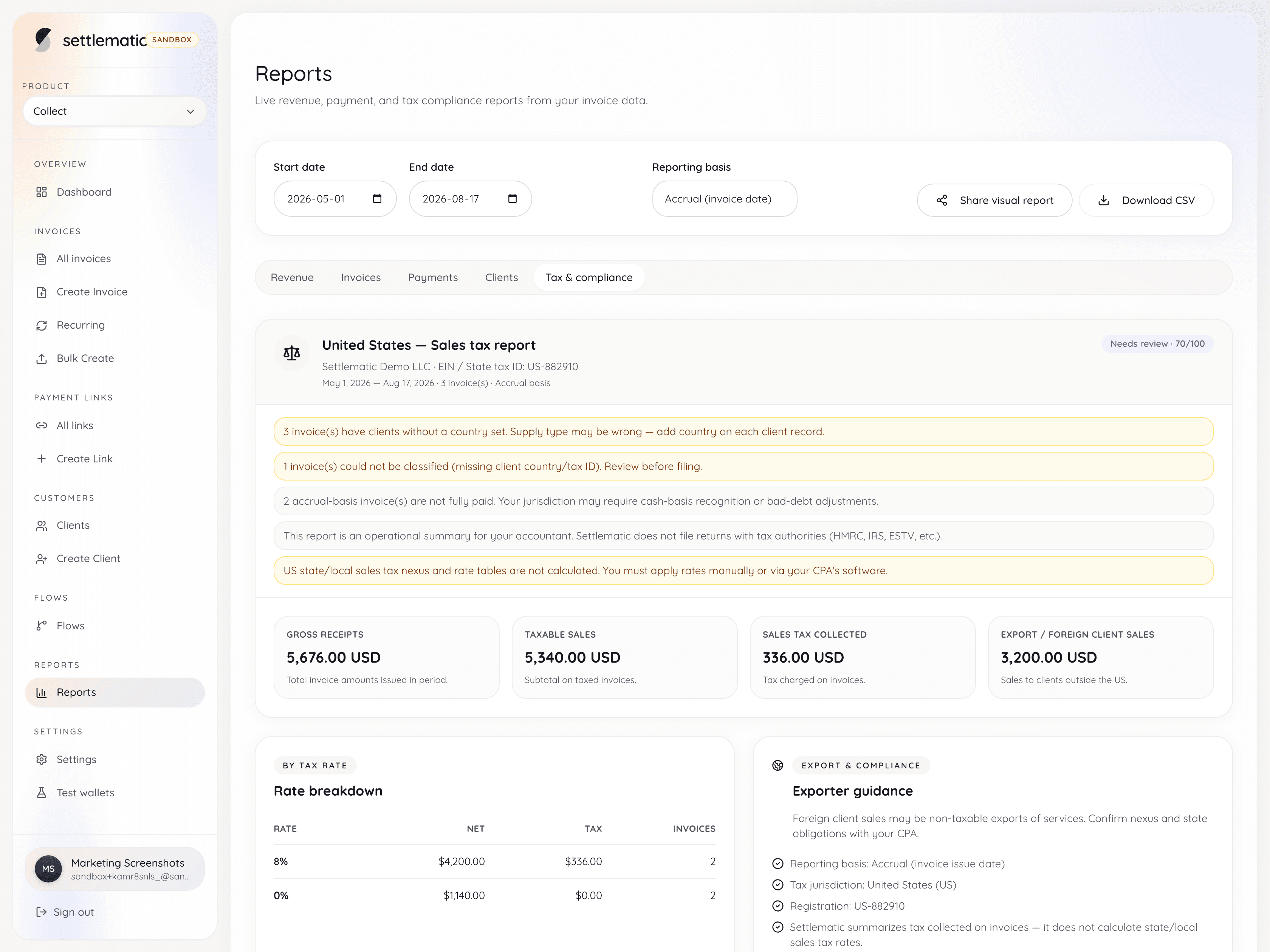
Merchants adopting crypto invoicing often ask whether accepting USDC instead of a bank wire changes their VAT, GST, or sales tax obligations. The short answer: payment method is irrelevant to whether tax applies. Tax authorities assess the underlying commercial transaction — who supplied what, to whom, where, and at what value. Crypto is a settlement mechanism, not a tax exemption.
This guide covers jurisdiction-specific rules for EU VAT, UK VAT, India GST, and US sales tax as they apply to crypto-denominated B2B invoices; export exemption workflows; and documentation your accountant needs at filing time. This is not tax advice — consult a qualified advisor for your facts. Rules below are sourced to primary frameworks and last verified August 2026.
The universal principle: tax follows the supply, not the rail
Whether a client pays by wire, card, or on-chain stablecoin, the taxable event is the provision of goods or services. Regulators have been explicit:
- EU: VAT applies to the supply; crypto payment does not alter the taxable amount or place-of-supply rules (ECJ and national implementations consistent with VAT Directive 2006/112/EC).
- UK: HMRC treats crypto as an intangible for payment purposes; VAT on the supply is calculated in sterling at the tax point.
- India: GST applies to the supply of services or goods; crypto receipt is a mode of payment — invoice must still show GSTIN, HSN/SAC, and applicable rate.
- US: Sales tax (where applicable) is on the sale of tangible personal property or certain services — not on the currency of payment.
The operational challenge is valuation and documentation: you must record the fiat equivalent at the correct tax point, prove export status where claimed, and retain on-chain settlement evidence alongside the invoice PDF.
EU VAT: place of supply and B2B reverse charge
EU VAT is governed by the place-of-supply rules in the VAT Directive. For B2B services, the general rule (Article 44) is that services are taxed where the customer is established — often triggering reverse charge on the customer, not VAT on your invoice.
B2B services to EU business customers
When you supply services to a VAT-registered business customer in another EU member state:
- Invoice without charging your local VAT (if reverse charge applies).
- State on the invoice: "Reverse charge — Article 44 VAT Directive" or equivalent national wording.
- Include your VAT ID and the customer's VAT ID.
- Report in your EC Sales List (ESL) and Intrastat where required.
Crypto settlement does not change reverse charge mechanics. The invoice still shows EUR (or local currency) line items and net amounts.
B2C services and MOSS
Business-to-consumer digital services may trigger VAT in the customer's member state via the One-Stop Shop (OSS) or Mini-OSS schemes. MOSS reporting is based on customer location evidence — IP, billing address, payment instrument country — not payment rail.
Tax point and valuation
The tax point is generally the earlier of invoice date or payment receipt. For crypto invoices:
- Invoice date value: Fiat amount quoted on the invoice (e.g., €5,000).
- Payment date value: Confirm whether your jurisdiction requires recalculation if crypto value fluctuates between invoice and payment. For stablecoin settlement (USDC, EURC), variance is minimal — document the 1:1 or ECB-referenced rate used.
Settlematic Collect quotes invoices in EUR (and other fiat) while settling in crypto — the fiat figure on the PDF is your primary tax documentation.
Export of services outside the EU
Services supplied to customers outside the EU are generally outside the scope of EU VAT (export of services). Document:
- Customer address and tax ID outside the EU
- Contract or statement of work showing delivery outside EU
- Proof of payment (tx hash acceptable as supplementary evidence)
- Zero-rated or "outside scope" notation on invoice
Maintain evidence that the customer is not consuming the service within the EU — VPN masking is not sufficient; contractual place of business matters.
| Scenario | VAT treatment | Invoice notation |
|---|---|---|
| B2B service to EU customer | Reverse charge on customer | Article 44 reverse charge |
| B2C digital service to EU consumer | VAT in customer state (OSS) | Local VAT rate per OSS return |
| B2B/B2C service to non-EU customer | Generally outside EU VAT scope | Export / outside scope |
| Goods shipped from EU to non-EU | Zero-rated export with customs evidence | Export zero rate |
UK VAT after Brexit
UK VAT rules mirror EU place-of-supply concepts with UK-specific reporting. Post-Brexit, EU reverse charge and ESL do not apply to UK-EU trade — instead, import VAT and customs procedures may apply to goods; services follow place-of-supply. Merchant setup: accept crypto payments in the UK.
B2B services
UK B2B services to overseas business customers are often outside the scope of UK VAT (place of supply is overseas). UK B2B services to UK customers attract standard or reduced rate as applicable.
Crypto payment documentation
HMRC does not require a different invoice format for crypto payments. Include:
- Sterling value of the supply
- VAT registration number
- Unique invoice reference
- Description of goods/services
Record the on-chain tx hash in your accounting system as payment evidence. Crypto tax for business covers income recognition; this article focuses on indirect tax on the invoice itself.
Northern Ireland
The Windsor Framework creates dual VAT treatment for goods moving between Great Britain and Northern Ireland. Services invoiced in crypto follow the same rules — verify customer location for place-of-supply.
India GST: B2B, exports, and invoice compliance
India's GST regime requires strict invoice format compliance under Rule 46 of the CGST Rules. Crypto payment does not exempt you from e-invoice or GST reporting obligations where thresholds apply.
B2B domestic supplies
Registered suppliers must issue tax invoices with:
- GSTIN of supplier and recipient
- HSN/SAC codes
- Taxable value, CGST/SGST or IGST breakdown
- Place of supply
Payment in crypto is recorded at INR equivalent on the date of supply/payment per CBIC guidance. Use RBI reference rate or agreed conversion methodology consistently.
Export of services (LUT/Bond)
Export of services with payment in foreign exchange (including crypto settled against USD/EUR invoice) may be zero-rated. Requirements include:
- LUT (Letter of Undertaking) or bond filed
- Invoice in foreign currency with export notation
- FIRC or equivalent remittance evidence — for crypto, document tx hash, exchange rate, and INR conversion at settlement
- Reporting in GSTR-1 export table
Crypto export workflows are increasingly accepted when documentation is complete — but field-level GST officer interpretation varies. Maintain full contract, invoice, and on-chain settlement bundle.
Reverse charge
Imports of services (OIDAR from foreign suppliers to Indian businesses) may trigger reverse charge GST on the Indian recipient. If you invoice Indian clients from abroad, they may owe reverse charge — state this clearly in contracts.
| Supply type | Typical GST treatment | Key document |
|---|---|---|
| Domestic B2B service | CGST/SGST or IGST on invoice | GST tax invoice |
| Export of service | Zero-rated with LUT | Export invoice + settlement proof |
| Import of service to India | Reverse charge on recipient | Foreign invoice + FIRC equivalent |
US sales tax and crypto invoices
The US has no federal VAT. Sales tax is state and local, applied to taxable sales of tangible personal property and selected services. Crypto payment does not change nexus or taxability analysis.
Nexus and taxability
Determine:
- Physical or economic nexus in customer states (post-Wayfair thresholds)
- Taxability of your service in each state (SaaS is taxable in some states, exempt in others)
- B2B resale certificates where applicable
Invoice documentation
US B2B invoices typically include:
- Seller legal name and address
- Customer name and address
- Invoice number and date
- Line-item description and amount
- Sales tax line if applicable (or exemption certificate reference)
Record crypto settlement as payment method in your ledger; sales tax remittance is still in USD based on invoice amounts.
1099 and information reporting
US payers may issue Form 1099 for services above thresholds. Crypto settlement does not remove 1099 obligations — see report crypto income from invoices.
Export workflows: a practical checklist
When invoicing foreign clients and claiming export or zero-rating:
- Contract — state place of delivery, governing law, and that services are performed/exported outside your tax jurisdiction where applicable.
- Customer verification — VAT ID validation (EU VIES), GSTIN lookup (India), or business registration for US B2B exemption certificates.
- Invoice — fiat-denominated line items, correct tax notation (reverse charge, export, zero-rated, outside scope).
- Payment — crypto settlement via Settlematic Collect with bound address and automatic detection; retain tx hash.
- FX record — document conversion rate at tax point (invoice date vs payment date per advisor guidance).
- Filing — ESL, OSS, GSTR-1 export, or state sales tax returns as applicable.
- Audit bundle — PDF invoice + payment confirmation + contract + correspondence.
Test the full flow in the demo before production export invoicing.
Fiat quote vs crypto settlement: why it matters for tax
Best practice for B2B crypto invoicing is fiat-quoted, crypto-settled:
- Invoice shows €10,000 + reverse charge notation
- Client pays USDC equivalent at send-time rate
- Platform records fiat value at settlement for your books
This pattern is covered in how to invoice in USD and get paid in crypto. Tax authorities care about the euro (or dollar) figure on the invoice, not whether the client used a bank or a wallet.
Avoid invoicing purely in token amounts without fiat reference — it complicates VAT/GST valuation and client accounting.
Common mistakes on crypto invoices
| Mistake | Consequence | Fix |
|---|---|---|
| No VAT ID on B2B EU invoice | Reverse charge challenged | Collect and validate VAT IDs |
| Missing export notation | Export zero-rating denied | Add statutory wording |
| Token-only invoice amount | Valuation disputes | Fiat quote + crypto settlement |
| No settlement timestamp | Tax point ambiguity | Use platform with on-chain detection |
| Ignoring MOSS for EU B2C digital | Underpaid VAT in customer states | Register OSS or charge local VAT |
| Mixing personal wallet payments | Broken audit trail | Per-invoice deposit addresses |
Non-custodial invoicing improves audit trails: each invoice maps to a unique address and tx hash. See what is a crypto invoice for required fields.
Reconciliation for accountants
Finance teams need exports that tie invoice ID → fiat amount → tax treatment → tx hash → settlement timestamp. Webhook integrations via developers push invoice.paid events into ERP systems with confirmed on-chain data.
Month-end close: reconcile open invoices, partial payments, and credit notes. Partial payments on crypto invoices explains multi-tranche settlement. Accountants appreciate the same CSV structure whether payment was wire or USDC.
For agency clients with multiple jurisdictions, tag invoices by client country at creation — simplifies OSS and ESL batching.
Stablecoins and EURC for EU compliance
EURC (Euro Coin) settlement aligns invoice currency with settlement asset, reducing FX documentation burden for EU-facing invoices. USDC remains dominant for USD-quoted global work. Document which mint and network were used — bridged vs native tokens affect reconciliation but not VAT place-of-supply.
EURC payments for EU businesses covers operational setup.
Platform features that support tax compliance
Evaluate invoicing platforms for:
- Fiat denomination on all invoices
- Client tax ID fields
- Custom invoice notes (reverse charge wording)
- PDF export with legal entity details
- Settlement report with fiat value at payment time
- Multi-currency support (EUR, GBP, USD, INR)
Settlematic Collect implements fiat-quoted invoicing with non-custodial settlement — funds land in wallets you control per security architecture, while invoice metadata satisfies B2B presentation requirements.
Putting it together
VAT, GST, and sales tax on crypto invoices are the same taxes on the same supplies — with extra documentation discipline for valuation and payment evidence. Quote in fiat, settle in crypto, annotate invoices correctly for reverse charge and export, validate customer tax IDs, and retain tx hashes alongside PDFs.
Settlematic Collect produces audit-ready invoice records with automatic on-chain detection. Test export workflows in the demo, integrate webhooks via developers, and review security before production. Work with your tax advisor to map place-of-supply rules to your client geography — the platform provides data; classification remains your responsibility.
Frequently asked questions
- Does accepting crypto make my invoice VAT-exempt?
- No. VAT exemption depends on the type of supply (financial services, education, etc.), not payment method. Crypto is payment, not a supply category.
- Which exchange rate should I use for GST in India?
- CBIC guidance typically references RBI reference rates or consistent methodology documented in your accounting policy. Apply the same method every period.
- Do I charge VAT on the crypto amount or the fiat invoice amount?
- Charge and report VAT on the fiat taxable value shown on the invoice. Stablecoin settlement at par simplifies matching.
- Can I issue a crypto invoice without a tax ID?
- B2B invoices in regulated jurisdictions generally require supplier tax registration. B2C may have simplified invoices below thresholds — jurisdiction-specific.
- How do I prove export of services with crypto payment?
- Contract + export-annotated invoice + evidence customer is outside your jurisdiction + on-chain settlement proof (tx hash) + FX conversion record. LUT filing for India exports.
- Does reverse charge apply when I invoice in USDC to a German GmbH?
- Reverse charge applies based on place of supply and B2B status, not payment asset. Invoice in EUR with reverse charge notation; client pays USDC against the EUR amount.