What Is Non-Custodial Crypto Invoicing? A Complete Guide
Non-custodial crypto invoicing lets you bill clients and receive payments directly to your wallet. Learn how it works, why it matters under MiCA and FinCEN rules, and how to choose a platform.
Do this next
Create a crypto invoice
- Quote the invoice in fiat.
- Client pays USDC, USDT, or EURC.
- Funds settle to a wallet you already control.
Non-custodial crypto invoicing means the invoicing platform generates invoices and payment addresses but never holds or controls your funds. Each address is derived for a wallet you own; the platform watches the chain, confirms payment, and reconciles the invoice. You keep custody, and the platform is never a counterparty to your money.
TL;DR
Non-custodial crypto invoicing is a billing model where payment platforms generate invoices and payment instructions but never hold, control, or route your funds. Clients pay directly to addresses you own; the platform verifies on-chain settlement without touching private keys. This reduces regulatory exposure under MiCA and FinCEN guidance while eliminating hot-wallet counterparty risk.
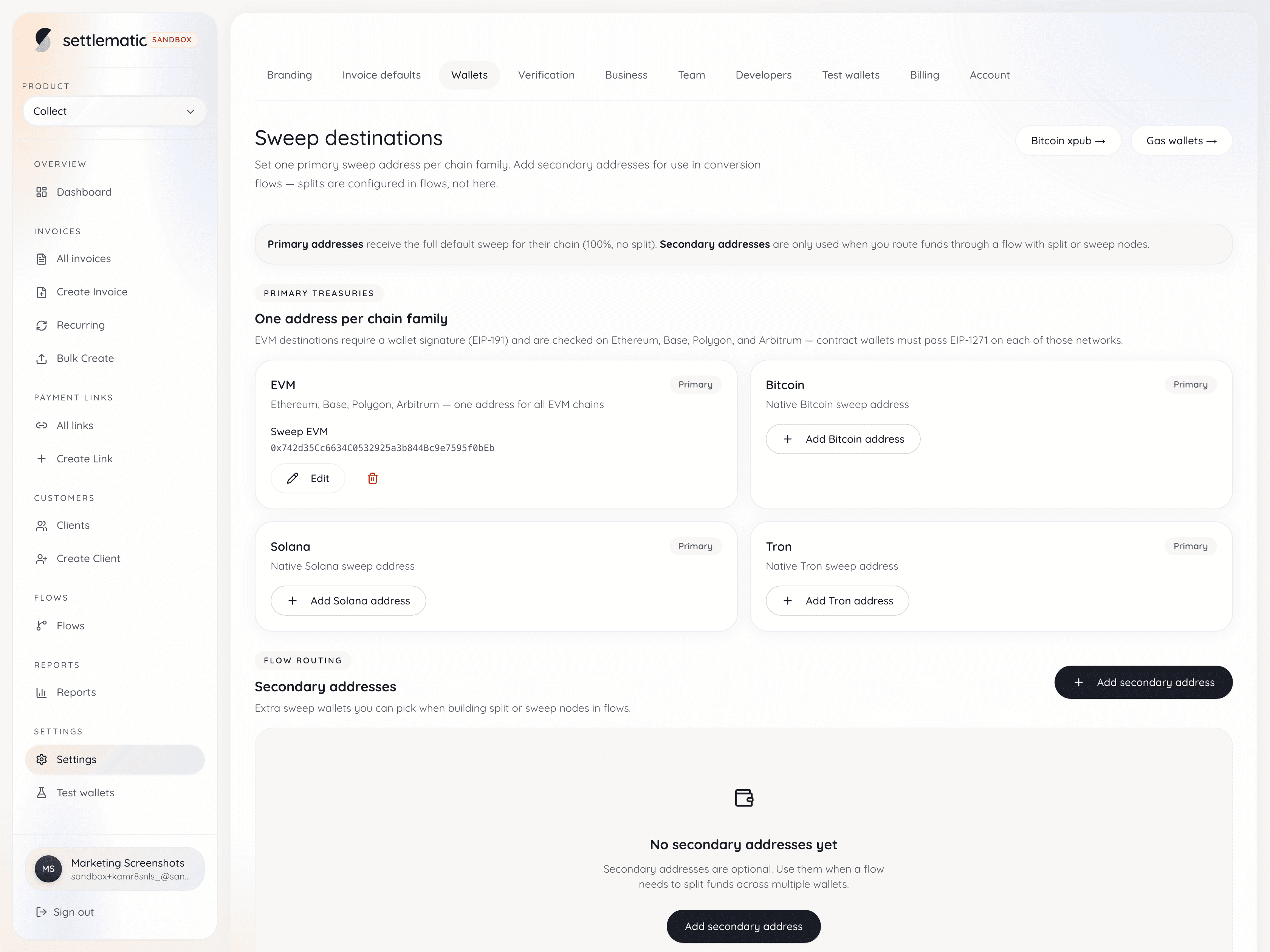
Non-custodial crypto invoicing is a method of creating, sending, and reconciling cryptocurrency payment requests where the invoicing platform never takes custody of merchant or payer funds at any point in the settlement path. Unlike custodial processors that generate temporary wallets, hold incoming payments, and sweep to merchants, a non-custodial system derives unique payment addresses tied to your keys, monitors blockchains for matching transfers, and marks invoices paid when confirmation thresholds are met—all without the platform signing transactions or storing spendable private keys.
Custodial vs Non-Custodial: The Definitional Divide
The distinction is not marketing language. Regulators in the EU and United States assess custody based on control, not merely key storage.
| Dimension | Custodial invoicing | Non-custodial invoicing |
|---|---|---|
| Who holds funds during settlement | Platform (even briefly) | Merchant's wallet only |
| Private keys | Platform generates and uses keys to sweep | Merchant controls keys; platform has none |
| Regulatory posture | Often requires CASP/VASP or money transmitter licensing | Typically software tooling, not custody service |
| Counterparty risk | Platform insolvency or hack affects held funds | Platform outage does not strand settled funds |
| Reconciliation | Easy—funds hit platform wallets first | Requires per-invoice address derivation or tagging |
FinCEN's 2019 guidance on convertible virtual currency evaluates whether an intermediary has "total independent control" over customer value. If your invoicing provider can move funds—even for eleven seconds before forwarding—you are interacting with a custodial service in substance, regardless of footer disclaimers.
How Non-Custodial Invoice Settlement Actually Works
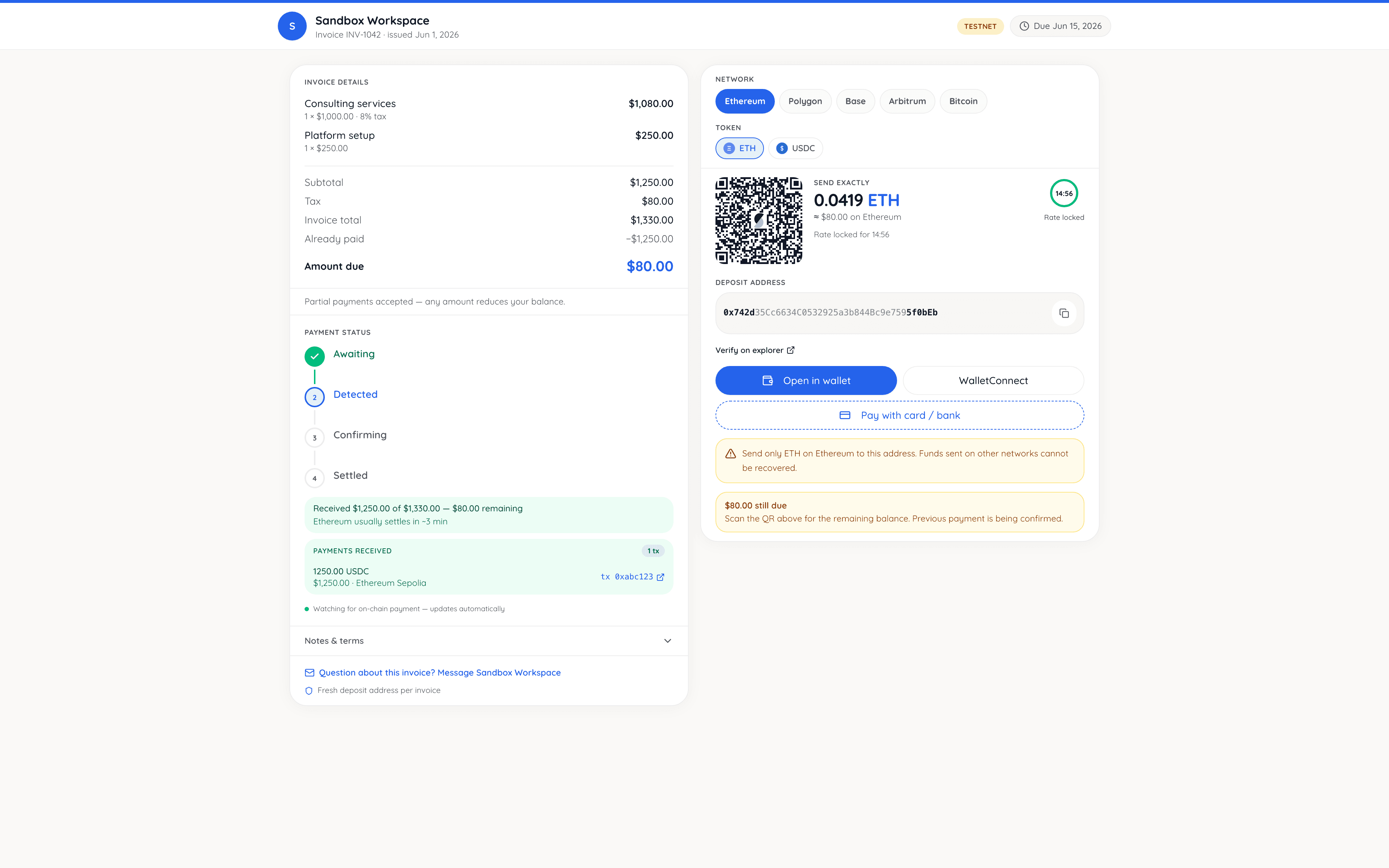
Modern non-custodial platforms solve the reconciliation problem without holding funds. The typical architecture includes four components.
Invoice creation. You specify amount, token, network, client details, and due date. The platform assigns a unique payment destination derived from your wallet configuration—often via deterministic address derivation (BIP-32/BIP-44 style hierarchies) or CREATE2 smart contract patterns on EVM chains.
Client payment. Your client sends the exact token on the specified chain to the invoice address. Payment may occur via hosted page, QR code, or manual wallet transfer.
On-chain verification. The platform monitors blockchain indexers and RPC nodes. When a transfer matching amount, token, and destination confirms, the invoice status updates to paid. Dual-source verification—comparing multiple indexers or RPC responses—reduces false positives from reorgs or indexer lag.
Accounting export. Payment metadata (tx hash, block, amount, timestamp) exports to QuickBooks, Xero, or CSV for month-end close. See how-to-reconcile-crypto-payments-month-end for workflow detail.
Settlematic implements this pattern as a non-custodial invoicing solution: merchants retain full control of funds while gaining automated reconciliation previously available only from custodial gateways.
Why Merchants Choose Non-Custodial Invoicing
Regulatory simplicity
EU's Markets in Crypto-Assets (MiCA) regulation defines crypto-asset service providers (CASPs) including custody and administration of crypto-assets on behalf of clients. Invoicing software that never safekeeps client assets falls outside that bucket. US state money transmitter laws similarly hinge on holding or controlling value for others. Non-custodial architecture keeps you—and your software vendor—on the tooling side of the line.
Security and counterparty risk
Custodial processors concentrate funds in hot wallets attractive to attackers. Non-custodial settlement means your invoice payments land directly in wallets you control with your own security practices—hardware wallets, multisig, institutional custody if you choose.
Philosophical alignment
Many crypto-native businesses adopted digital assets specifically to avoid trusted intermediaries. Custodial invoicing reintroduces the intermediary you were trying to eliminate.
Client trust
Sophisticated clients increasingly ask vendors whether payment flows are custodial. Demonstrating direct-to-merchant settlement can accelerate procurement approval compared to opaque forwarding wallets.
The Reconciliation Challenge and How It's Solved
The reason custodial invoicing became the default is reconciliation: if every invoice shares one merchant wallet address, you cannot tell which payment settles which invoice without manual memo matching—and on-chain memos are unreliable across exchanges.
Non-custodial solutions address this through:
- Unique addresses per invoice derived from merchant-controlled key material
- Smart contract invoice contracts where payment functions tag invoice IDs (limited by exchange withdrawal constraints)
- Amount-based disambiguation (fragile; not recommended at scale)
Unique per-invoice addresses with deterministic derivation are the most practical approach for B2B billing in 2026. Solana's account model and EVM CREATE2 factories both support high-volume address generation without the platform ever holding signing keys.
Non-Custodial Does Not Mean Unregulated
Choosing non-custodial invoicing does not exempt you from tax, AML, or sanctions obligations. You remain responsible for:
- Income recognition and reporting (IRS Form 1099, Schedule C, corporate returns)
- VAT compliance for EU clients
- OFAC sanctions screening where applicable
- Maintaining books and records substantiating each payment
The platform's non-custodial status affects its licensing burden, not yours as the merchant receiving payment. Consult qualified tax and legal advisors for your jurisdiction.
Evaluating Platforms: A Due Diligence Framework
When comparing crypto invoice providers, ask these questions:
- Can the platform move my funds without my signature?
- What happens if the platform shuts down tomorrow—are pending payments recoverable?
- Where are payment addresses derived from—my keys, my contract, or platform-generated keys?
- Does the platform hold key shards or participate in threshold signing?
- Is there a sweep step in the settlement path?
- How does dual-source verification work for payment confirmation?
Any "yes" to platform movement, shard participation, or mandatory sweep should trigger deeper regulatory and security review.
Integration with Existing Business Systems
Non-custodial invoicing fits into broader finance stacks:
- CRM: Push invoice status to HubSpot or Salesforce via webhooks—see webhook-patterns-crypto-billing
- Accounting: Export to QuickBooks and Xero
- Branding: Custom logos and PDFs per custom-branding-crypto-invoices
- Automation: Settlematic MCP vs dashboard workflows for different team roles—covered in settlematic-mcp-vs-dashboard-workflows
Common Misconceptions
"Non-custodial means no KYC." KYC requirements depend on your business activities and jurisdiction, not custody model. Invoicing platforms may still verify merchant identity for fraud prevention.
"All crypto payments are non-custodial if I use my own wallet." True only if no intermediary holds funds. Using a processor that generates forwarding wallets reintroduces custody.
"Smart contracts guarantee non-custodial." Contracts can be custodial if the platform controls upgrade keys, pause functions, or withdrawal routing.
"Non-custodial is only for crypto experts." Modern platforms abstract complexity behind hosted payment pages clients use without understanding derivation paths.
Solana, Ethereum, and Multi-Chain Considerations
Non-custodial invoicing must specify networks explicitly. Solana offers sub-second finality and low fees—attractive for high-volume micro-invoicing. Ethereum L2s (Base, Arbitrum) offer EVM compatibility with lower gas. Each chain has different address formats, confirmation semantics, and indexer ecosystems.
Settlematic supports multi-chain non-custodial invoicing so you can invoice US clients in USDC on Base and EU clients in USDC on Ethereum mainnet or Solana, with per-invoice network assignment and wrong-chain detection guidance.
When Custodial Might Still Make Sense
Honest comparison requires acknowledging tradeoffs. Custodial processors may offer:
- Instant fiat off-ramp without merchant OTC relationships
- Chargeback-like dispute workflows (limited in crypto)
- Simpler UX for merchants who refuse to manage wallets
If you need those features and accept the licensing and counterparty risk, custodial may fit. For most B2B freelancers, agencies, and SaaS companies billing international clients, non-custodial invoicing delivers faster settlement without intermediary risk.
Getting Started with Non-Custodial Invoicing
Practical rollout steps:
- Connect your wallet or configure derivation parameters in Settlematic Collect
- Create a test invoice on testnet or with a small mainnet amount
- Configure branded PDF and payment page templates
- Set up webhook or export integration to accounting software
- Document client-facing instructions for US and EU payers—see get-paid-in-crypto-us-eu-clients
- Train finance team on month-end reconciliation
Review pricing for plan limits on invoice volume and chain support. Schedule a demo if you need enterprise features like multi-user RBAC or API access.
Historical Context: Why Custodial Became the Default
Early crypto merchant tooling (2014–2018) assumed merchants would not manage private keys. Payment processors generated deposit addresses, pooled funds, and paid out weekly—mirroring PayPal's float model. That architecture made sense when wallet UX was poor and stablecoins did not exist. USDC launch on Ethereum in 2018 and explosive growth on Solana and L2s after 2022 changed the calculus: corporate treasuries now hold stablecoins routinely, and invoice reconciliation can use deterministic address derivation without anyone holding customer funds. Regulatory clarity from MiCA and sharpened FinCEN custody tests accelerated merchant demand for architectures that genuinely avoid CASP and money transmitter classification for software vendors. Non-custodial invoicing is the structural response to a decade of accidental custody in billing tools.
Insurance, Audits, and Enterprise Procurement
Enterprise vendors increasingly require SOC 2 reports and insurance certificates from payment software providers. Custodial processors must carry crime insurance covering hot wallet losses—premiums reflect catastrophic tail risk from exchange-style hacks. Non-custodial invoicing platforms shift asset risk to merchants who already insure or self-custody treasury per their own policies. Procurement questionnaires ask: "Does the vendor hold our funds?" A documented "no" with architecture diagrams shortens security review. Auditors sampling revenue substantiation still need tx hashes and invoice linkage—non-custodial platforms that export structured payment proof satisfy sampling without revealing omnibus wallet statements that commingle thousands of merchants' flows.
Address Derivation Deep Dive: BIP-44 and CREATE2
Understanding derivation helps you evaluate any platform's custody claims. BIP-44 hierarchical deterministic wallets derive child addresses from a master extended key: m / purpose' / coin_type' / account' / change / address_index. Invoice platforms map address_index to invoice ID so each bill gets a fresh destination without storing per-invoice private keys in a database—only the merchant's xpub or equivalent public derivation material is required for address generation. On EVM chains, CREATE2 deterministic deploy factories compute contract addresses from deployer, salt (invoice ID), and bytecode hash—enabling counterfactual addresses before deployment while keeping signing keys merchant-controlled. Solana uses ed25519 derivation paths with analogous per-invoice indexing. In all cases, the platform that knows derivation parameters can display addresses but cannot spend without merchant keys—unless it also holds shards or operates sweep contracts with admin roles, which reintroduces custody.
Comparison With Traditional Payment Rails
| Rail | Settlement speed | Merchant custody | Chargebacks | International friction |
|---|---|---|---|---|
| ACH / wire | 1–5 days | Bank custodied | Limited | High FX + fees |
| Card (Stripe) | 2–7 days to payout | Processor custodied | Yes | Medium |
| Custodial crypto | Minutes | Processor custodied | No | Low |
| Non-custodial crypto | Seconds–minutes | Self-custodied | No | Low |
Non-custodial crypto combines wire-like finality (irreversible on-chain) with card-like speed minus interchange—but places key management burden on merchants who prefer that tradeoff over counterparty risk.
Team Training and Operational Runbooks
Rolling out non-custodial invoicing requires finance team literacy: what a tx hash is, how to verify on Solscan, when to escalate wrong-chain cases per crypto-invoice-paid-wrong-chain. Document runbooks linking dashboard workflows, webhook patterns, and month-end reconciliation. Developers integrating Settlematic MCP need separate API credential hygiene training. Quarterly refreshers when you add new chains prevent "we only ever used Base" knowledge gaps when EU clients pay on Ethereum.
Merchant of record vs platform of record
Non-custodial invoicing clarifies that the merchant remains merchant of record for tax, contract, and regulatory purposes — the platform is software facilitating invoice presentation and payment detection. Clients pay the merchant directly; the platform is not an intermediary holding funds or acting as payment agent unless explicitly structured otherwise (which would reintroduce custody). This distinction matters for:
- 1099 and VAT reporting — merchant reports income, not platform
- Contract enforcement — payment disputes are merchant-client, not platform-mediated chargebacks
- Sanctions screening — merchant responsibility for client relationships
- Insurance — platform E&O covers software; merchant covers service delivery
Document merchant-of-record status in client contracts when enterprise legal asks "who is the counterparty in crypto payment flow?"
Transitioning from custodial to non-custodial invoicing
Teams migrating from custodial processors should plan a clean cutover:
- Export full payment history with tx hashes from custodial platform
- Complete pending payouts before disconnecting custodial wallet
- Register settlement wallets on non-custodial platform; verify derivation addresses match expected format
- Notify clients of new payment link format — emphasize unique address per invoice
- Parallel-run one cycle if client base is large
- Close custodial account after confirming zero balance and no open disputes
Historical custodial records remain valid for tax — new invoices use non-custodial flow. Do not commingle custodial payout wallet with non-custodial invoice settlement wallet without reconciliation tagging — month-end becomes intractable.
Non-custodial invoicing for accountants and bookkeepers
Accountants serving crypto-accepting clients should understand non-custodial flow to advise correctly: client pays invoice address → funds appear in merchant wallet → export links tx hash to invoice. No processor statement showing "payout to bank" intermediate step. Reconciliation uses three-way match (platform export, on-chain wallet, GL) per month-end guide.
Advise clients against sharing personal MetaMask with business invoice settlement — dedicated business wallet or derivation path simplifies audit and reduces commingling allegations. Recommend monthly export habit before year-end panic.
Future-proofing: account abstraction and smart wallets
Account abstraction (ERC-4337) and smart contract wallets may improve payer UX without changing non-custodial merchant settlement fundamentals. Merchants should evaluate whether new wallet standards affect client payment success rates — but non-custodial invoice address binding remains valid regardless of whether payer uses EOAs or smart wallets, as long as plain token transfers to invoice addresses succeed. Monitor ecosystem evolution; do not delay non-custodial adoption waiting for perfect wallet UX — current stablecoin + hosted payment page pattern works for majority of B2B payers in 2026.
Frequently asked questions
- Is non-custodial crypto invoicing legal in the US?
- Yes, receiving crypto payments for goods and services is legal. You must report income and comply with applicable federal and state regulations. The invoicing tool's non-custodial design affects the provider's regulatory classification, not your obligation to report revenue.
- How does MiCA affect non-custodial invoicing in the EU?
- MiCA regulates CASPs providing custody, exchange, and related services. Pure invoicing and payment verification software without custody typically falls outside CASP authorization requirements, though merchant obligations for VAT and AML may still apply.
- Can I recover funds if a client pays on the wrong chain?
- Recovery depends on whether you control addresses on both chains and whether the client sent a supported token. See recover-wrong-chain-crypto-invoice-payment for a practical playbook.
- Do I need a separate wallet for invoicing?
- Best practice is a dedicated derivation path or sub-wallet for invoice reconciliation, separate from operational treasury. This simplifies accounting without giving the platform custody.
- What's the difference between non-custodial invoicing and a payment gateway?
- Gateways often imply custodial settlement or merchant account models. Non-custodial invoicing focuses on bill presentation and payment verification with direct wallet settlement. Settlematic Collect spans both invoice creation and payment collection non-custodially.
- How fast are non-custodial payments confirmed?
- Confirmation speed depends on the chain. Solana payments typically confirm in under a second; Ethereum mainnet may take minutes depending on gas and congestion. Platforms set confirmation thresholds accordingly.