How to Accept Crypto Payments in the UK (2026 HMRC & FCA Rules)
Accept crypto payments UK: HMRC taxes receipts as trading income in sterling, VAT is due on the supply not the token, and FCA cryptoasset rules target firms that custody or promote — not merchants taking payment for their own sales.
Do this next
Accept crypto for your own sales
- Tax the supply in local currency at the tax point.
- Licensing usually follows custody, not invoicing.
- Keep a per-invoice fiat figure at settlement.
UK businesses can accept crypto payments without a license as long as they are receiving payment for their own goods or services, not handling customer funds as a service. HMRC taxes the GBP value at receipt; VAT applies to the underlying supply as normal. Use a non-custodial tool so you never fall into FCA cryptoasset-business registration.
TL;DR
UK businesses can legally accept crypto for goods and services. HMRC treats the sterling value at the time of the transaction as trading income, and VAT is due on the supply of those goods or services — not on the token itself. FCA cryptoasset authorisation targets firms that custody, exchange, or promote crypto to UK consumers, not a merchant whose funds settle to a wallet it controls.
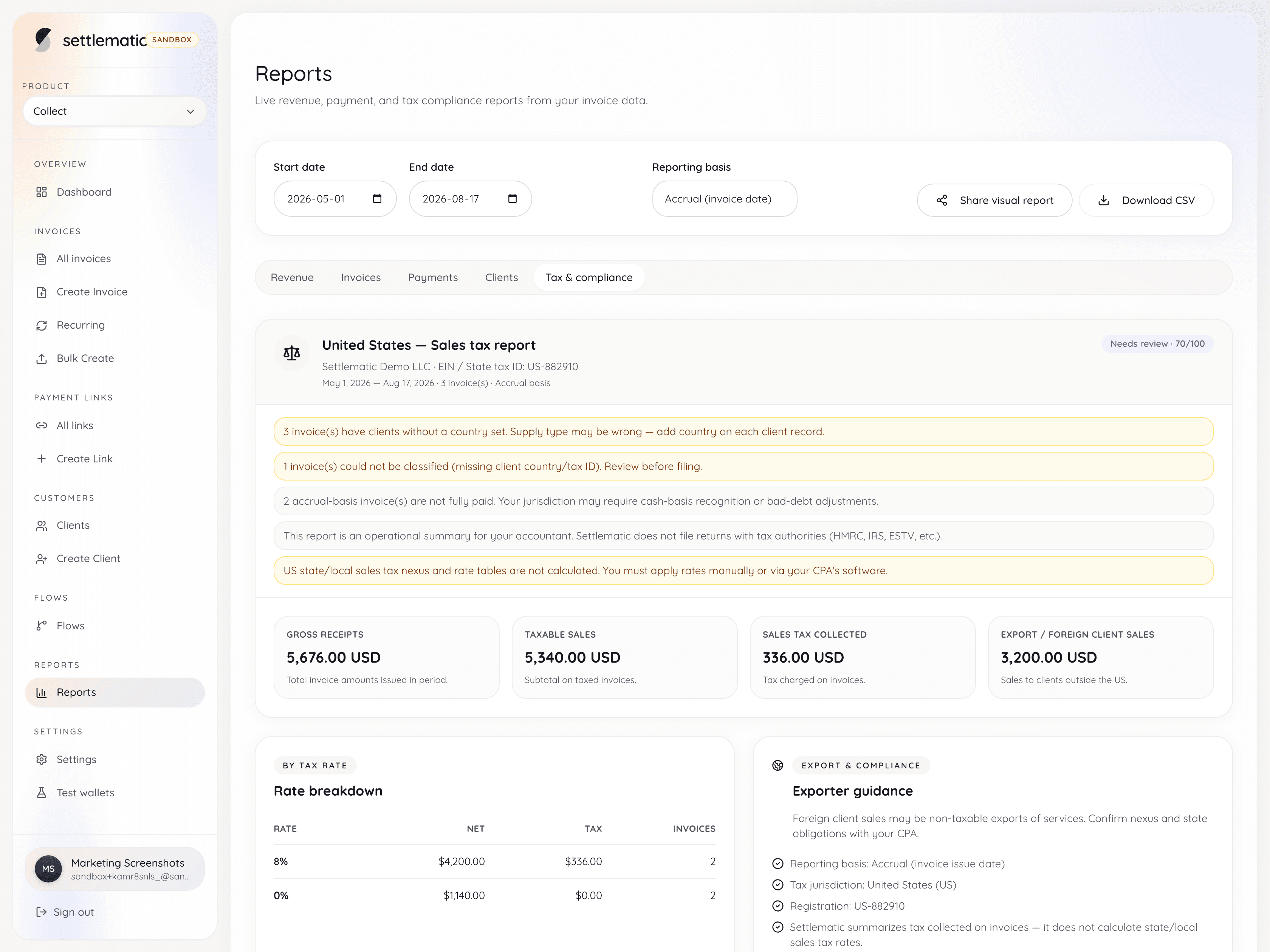
UK businesses can legally accept crypto for goods and services. Three rules matter: HMRC includes the sterling value of exchange tokens received in trading profits; VAT is due on the supply of those goods or services, valued in sterling at the tax point; and FCA cryptoasset regulation is aimed at firms that custody, exchange, or promote crypto — not at a merchant taking payment for its own account.
We build Settlematic, a non-custodial crypto invoicing platform, so treat this as informed but interested. Every tax point below is sourced to HMRC's cryptoassets manual or GOV.UK. This is general information, not legal or tax advice.
Is it legal to accept crypto in the UK?
Yes. No UK statute prohibits a company or sole trader from accepting Bitcoin, Ether, USDC, USDT, or EURC for its own sales. Crypto is not legal tender, but it is a valid form of consideration. What the law does is tax the receipt and, separately, regulate people who provide cryptoasset services to others.
How does HMRC tax crypto you accept?
HMRC CRYPTO40350 is the working rule: if you accept exchange tokens as payment from customers in the course of a trade, those tokens go into taxable trading profits. Value them in pound sterling at the point the transaction takes place. That sterling figure is ordinary income (Corporation Tax for companies, Income Tax for unincorporated traders) and becomes your base cost if you later sell or swap the tokens.
You still pay HMRC in sterling. GOV.UK does not accept crypto for tax, penalties, or settlements. Keep a GBP fair-market value on every paid invoice — tx hash, asset, network, and confirmation time — so Self Assessment or the Company Tax Return can be reconstructed without a block explorer. See crypto tax for business.
VAT: the supply, not the token
HMRC CRYPTO45000 is explicit: VAT is due in the normal way on goods or services sold in exchange for cryptoasset exchange tokens. The VATable amount is the sterling value of the tokens at the tax point. The exchange of the tokens themselves is not the supply you are charging VAT on.
Place-of-supply and reverse-charge rules are unchanged by the payment rail. UK B2B services to a UK VAT-registered customer follow the usual UK VAT analysis; supplies that are outside the scope because the customer is overseas stay outside the scope. Put a GBP VAT line on the invoice even when the client pays USDC. Detail in VAT and GST on crypto invoices.
| Question | HMRC treatment | What to record |
|---|---|---|
| Income | Trading profit at GBP value when paid | Invoice total, GBP FX at confirmation, tx hash |
| VAT on your supply | Due in the normal way, sterling at tax point | VAT rate, VAT number, GBP tax line |
| The token itself | Not the VATable supply | Asset and network for the audit file |
| Paying HMRC | Sterling only — no crypto | Bank or card, not a wallet |
When does the FCA get involved?
The FCA regulates cryptoasset activities — including custody, exchange, and financial promotions to UK consumers. Accepting crypto as consideration for your own goods or services is not, by itself, a cryptoasset activity. The line is control: if a processor holds private keys or the means of access on behalf of you or your clients, that firm is in the safeguarding/custody analysis. A merchant whose deposit addresses are bound at issuance to a wallet it controls is receiving payment, not running a cryptoasset business for others.
The UK is expanding the perimeter: cryptoasset activities are scheduled to come further into the FCA regime from October 2027, with application windows before that. Watch whether you (or your processor) safeguard crypto on behalf of another person. We cover the custody test in do crypto payment gateways need a license and custodial vs non-custodial processors.
How non-custodial settlement fits a UK merchant
Settlematic is non-custodial. Each Collect invoice or Gateway checkout address is bound at issuance to a destination you control. The client pays on-chain; funds never sit in a processor wallet we can freeze or redirect. You still have AML, sanctions, and record-keeping duties for your own business. Settlematic supports KYB/KYC and Travel Rule workflows where those apply. Confirm your facts with UK counsel.
GBP invoices, stablecoin settlement
Quote the invoice in GBP (or USD/EUR if the contract says so). Let the client pay USDC, USDT, or EURC on the chain they already hold. Your books stay in sterling; settlement is on-chain. That is the setup UK accountants can defend: commercial obligation in GBP, payment proof as a transaction hash, VAT on the supply.
Start accepting crypto in the UK
Settlematic Collect issues fiat-quoted invoices with hosted checkout, USDC/USDT/EURC across six chains, and automatic tx-hash reconciliation. Try the sandbox demo or see pricing.
This article is general information, not legal or tax advice. Confirm with a UK accountant or solicitor. Sources: HMRC CRYPTO40350, CRYPTO45000, GOV.UK cryptoasset tax, FCA cryptoassets. Verified 8 Sep 2026; rules change.
Sources
Frequently asked questions
- Is it legal to accept crypto payments in the UK?
- Yes. There is no ban on a UK business accepting Bitcoin, Ether, or stablecoins such as USDC and USDT for its own goods or services. HMRC taxes the sterling value as trading income, and VAT applies to the underlying supply. FCA authorisation is a separate question that turns on whether you provide cryptoasset services to others.
- How does HMRC tax crypto I accept as payment?
- If you accept exchange tokens as payment in the course of a trade, HMRC includes them in taxable trading profits at the pound sterling value when the transaction takes place. That sterling amount is also your cost for any later gain or loss if you dispose of the tokens. You still pay Corporation Tax or Income Tax in sterling — HMRC does not accept crypto as a tax payment.
- Do I charge VAT when a client pays in crypto?
- Yes, in the normal way. HMRC's cryptoassets manual states that VAT is due on goods or services sold in exchange for cryptoasset exchange tokens, valued in sterling at the tax point. The supply of the token itself is not the VATable supply. Crypto settlement does not change place-of-supply or reverse-charge rules.
- Do I need FCA authorisation to invoice UK clients in crypto?
- Generally not to accept payment for your own sales. The FCA perimeter covers cryptoasset activities such as custody, exchange, and certain promotions to UK consumers. A merchant whose invoice addresses settle directly to a wallet it controls is receiving payment, not safeguarding crypto on behalf of another person.
- Should I invoice in GBP or USD?
- Invoice in the currency of the contract. UK clients often want GBP on the PDF even if they pay USDC. Record the GBP fair-market value at confirmation for HMRC. Settlematic Collect supports fiat-quoted invoices with on-chain settlement.