Crypto Tax for Business: A Cross-Market 2026 Guide
How businesses recognize crypto revenue in the US, Australia, Canada, and India — fair-value-at-receipt, GST, record-keeping, and how fiat-quoted invoices keep you compliant.
Do this next
Accept crypto for your own sales
- Tax the supply in local currency at the tax point.
- Licensing usually follows custody, not invoicing.
- Keep a per-invoice fiat figure at settlement.
TL;DR
For a business, crypto received as payment is revenue, recognized in your local currency at fair market value on the date of receipt — the US, Australia, Canada, and India all agree on that core principle. A later disposal is a second taxable event. The hard part is record-keeping, and fiat-quoted invoices that capture value at settlement solve most of it.
For a business, crypto received as payment is revenue — not a windfall and not tax-free. Across the US, Australia, Canada, and India, the shared rule is that you recognize income in your local currency at the fair market value of the crypto on the date you receive it. A later sale or swap is a second, separate taxable event. The rates and forms differ by country; the recognition-at-receipt principle does not.
We build Settlematic, a non-custodial crypto invoicing platform, so we care about this precisely because clean records are what make crypto revenue survivable at tax time. Every rule below is sourced to the relevant tax authority and last verified on 7 September 2026. This is not tax advice — see your accountant.
Do you owe tax when a business gets paid in crypto?
Yes. The moment your business accepts crypto for goods or services, you have earned income. Treat it exactly as if a customer handed you cash equal to the crypto's local-currency value at that moment. Whether you then hold, spend, or convert the crypto is a separate decision with its own tax consequences. The two events to track are always:
- Receipt: revenue equal to fair market value in your local currency on the receipt date.
- Disposal: a gain or loss (or further business income) when you later sell, swap, or spend that crypto, measured against the value you already booked.
How does crypto revenue recognition differ by country?
| Country | Crypto treated as | Revenue at receipt | Notable rule |
|---|---|---|---|
| United States | Property | Fair market value in USD at receipt | Later disposal = capital gain/loss; new Form 1099-DA broker reporting |
| Australia | Property / digital currency | Money value in AUD when income is derived | GST reported in AUD; tax invoice must show GST payable in AUD |
| United Kingdom | Exchange tokens in a trade | Sterling value when the transaction takes place | VAT on the supply, not the token; HMRC paid in GBP only |
| Canada | Commodity | Fair market value in CAD at transaction time | Receiving crypto for goods/services is a barter transaction = business income |
| India | Virtual Digital Asset | INR value at receipt (business income) | Later VDA transfer taxed flat 30% (§115BBH); 1% TDS (§194S); Schedule VDA |
United States: fair market value at receipt
The IRS treats digital assets as property. Payment received for goods or services is ordinary income at the fair market value of the crypto in USD on the date of receipt. When you later dispose of it, you compute a capital gain or loss against that basis. From the 2025 tax year, brokers report dispositions on the new Form 1099-DA, and state money-transmitter rules can also apply to businesses that move crypto for others. See our US guide for detail.
Australia: watch the GST in AUD
The ATO treats receiving digital currency as payment much like receiving money: the money value of the crypto in AUD is ordinary income when derived. The catch that trips up merchants is GST — if you make a taxable supply and are paid in crypto, the GST amount in your business activity statement must be reported in AUD, and your tax invoice must show the GST payable in AUD (or enough information to calculate it), using the exchange rate on your conversion day. More in our Australia guide.
United Kingdom: sterling at the tax point
HMRC includes exchange tokens received in a trade in taxable profits at the sterling value when the transaction takes place. VAT is due on the underlying supply, not on exchanging the token, and HMRC is paid in GBP only. Keep a GBP figure per invoice at settlement. Full merchant setup: accept crypto payments in the UK.
Canada: it's a barter transaction
The CRA characterizes accepting crypto for goods or services as a barter transaction, reported as business income at the crypto's fair market value in CAD at the time of the transaction. If you hold crypto as inventory, you value it consistently year to year using a reasonable method. Canada also began CARF data collection from 1 January 2026, with the first CRA report due in 2027. See our Canada guide.
India: the strictest regime
India books crypto received for goods or services as business revenue in INR at receipt, then taxes any later VDA transfer at a flat 30% under Section 115BBH, with 1% TDS under Section 194S, mandatory transaction-level Schedule VDA reporting, no loss set-off, and only cost of acquisition deductible. It is the most punitive of the four and demands the most granular records. Full detail in our India guide.
The real problem is record-keeping
Notice what every regime above requires: the local-currency value at the precise moment of receipt, per transaction. Miss that and you cannot compute revenue, GST, or a later gain — and in India you get a defective return. Crypto prices move by the minute, so reconstructing values months later from block explorers is error-prone and audit-fragile. The compliant path is to capture value at settlement, automatically, at the invoice level.
- Timestamped local-currency value for every payment received.
- A per-transaction trail linking on-chain settlement to a specific invoice.
- Reconciliation between what you invoiced and what actually landed on-chain.
- Export-ready data your accountant can drop into a tax return.
How fiat-quoted invoicing keeps you compliant
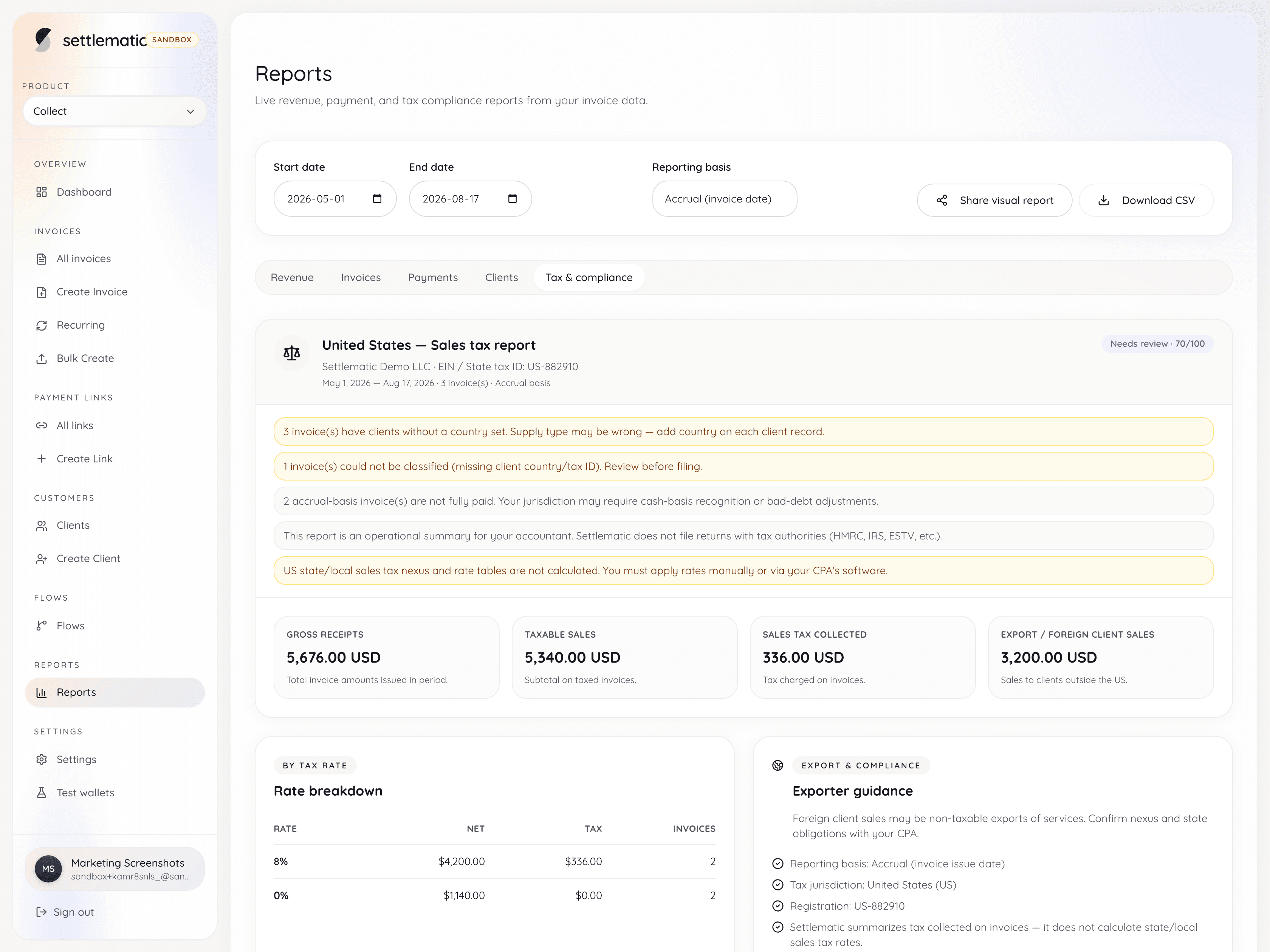
This is exactly what Settlematic Collect is built for. You invoice in USD, EUR, GBP, AUD, CAD, or INR; the client pays in crypto quoted at send-time; and the fiat value is captured against the invoice at the moment of settlement. Because Settlematic is non-custodial, funds land in a wallet you control, and each payment fires a webhook with the confirmed on-chain settlement — giving you the timestamped, per-transaction records every tax authority above expects. Settlematic is not a tax agent and does not file for you; it produces the data your accountant needs.
Get started
See the records for yourself in the free sandbox: issue a fiat-quoted invoice end to end and export the settlement trail. Book a demo or review Collect pricing.
This article is general information, not legal or tax advice. Tax treatment depends on your jurisdiction and facts — consult a qualified accountant. Verified 7 September 2026 — rules change.
Sources
Frequently asked questions
- Is crypto received by a business taxable?
- Yes. Crypto received for goods or services is revenue, recognized in your local currency at fair market value on the date of receipt. The US, Australia, Canada, and India all apply this core principle.
- Are there two taxable events?
- Usually yes. Receipt is revenue at fair value; a later sale, swap, or spend of that crypto is a second event — a capital gain/loss or further income measured against the value you already booked.
- Do I owe GST when paid in crypto in Australia?
- If you make a taxable supply and are paid in crypto, the ATO requires the GST in your business activity statement to be reported in AUD, and your tax invoice must show GST payable in AUD using your conversion-day rate.
- How is crypto revenue treated in Canada?
- The CRA treats accepting crypto for goods or services as a barter transaction, reported as business income at the crypto's fair market value in CAD at the time of the transaction.
- What records do I need for crypto revenue?
- The timestamped local-currency value at receipt for every transaction, a per-transaction trail linking on-chain settlement to invoices, and reconciliation between invoiced and received amounts. Fiat-quoted invoicing captures this automatically.