Recover Wrong-Chain Crypto Invoice Payments: A Practical Playbook
Step-by-step playbook to recover wrong-chain crypto invoice payments: EVM key access, bridging USDC, Solana mismatches, refunds, and prevention with Settlematic.
Do this next
Create a crypto invoice
- Quote the invoice in fiat.
- Client pays USDC, USDT, or EURC.
- Funds settle to a wallet you already control.
TL;DR
Wrong-chain payments happen when a client sends on a network you did not allow. Settlematic flags mismatches early; recovery depends on whether funds are recoverable on-chain.
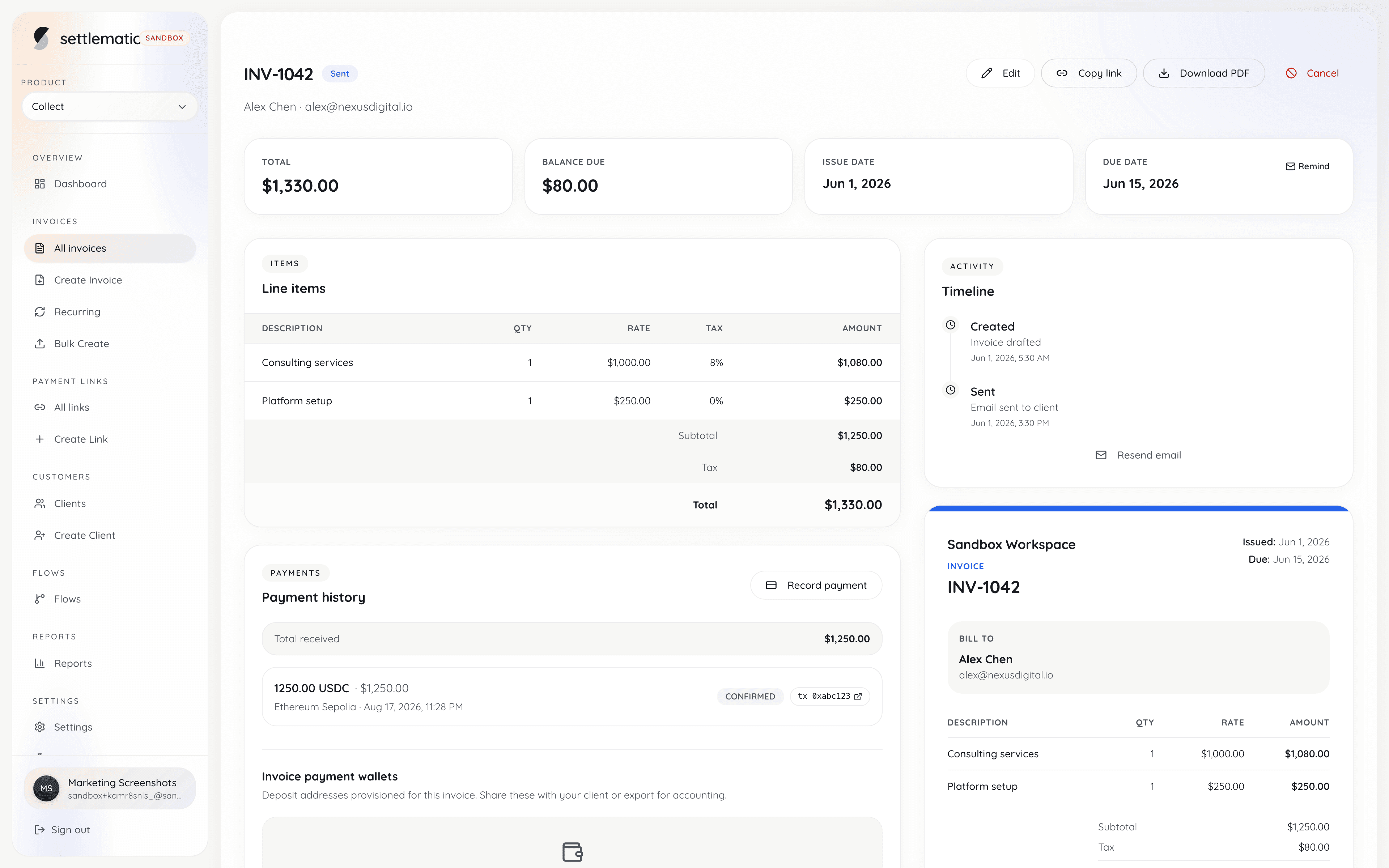
This playbook walks through recovering wrong-chain crypto invoice payments—the operational procedure finance and engineering teams execute after detecting that a client sent cryptocurrency to an invoice address on a blockchain network other than the one specified. Wrong-chain recovery is among the most time-sensitive crypto billing incidents because funds are usually not lost immediately; they sit in addresses you may or may not control, on networks your accounting may not monitor by default. Speed, key control assessment, and methodical bridging or refund decisions determine whether the invoice closes cleanly or enters weeks of support limbo.
Phase 0: Incident Intake
Before touching wallets, capture structured incident data:
- Invoice ID and expected network/token/amount
- Actual tx hash, network, token, amount, timestamp
- Client contact and sending address (from tx)
- Payment address on invoice
- Do you control private keys for payment address? (non-custodial Settlematic: yes, via your wallet derivation)
- Current invoice status in platform
Create support ticket; assign owner (finance + technical). Set SLA: initial client response within 4 business hours for payments >$1,000.
Cross-reference overview in crypto-invoice-paid-wrong-chain for client communication tone.
Phase 1: On-Chain Verification
EVM chains
Open block explorer for actual network (etherscan.io, basescan.org, etc.). Verify:
Same 0x address on Ethereum and Base are different ledger positions—both controlled by same key if derived from your seed.
Solana
Use solscan.io. Verify SPL token mint matches USDC (EPjFWdd5...). Address format is base58—no collision with EVM.
Red flags (escalate legal/compliance)
- Funds sent to address you do not control
- Sanctioned address interaction (OFAC)
- Mixer or high-risk cluster (enterprise policy)
Phase 2: Recovery Path Decision Tree
Phase 3A: EVM Cross-Chain Recovery (Most Common)
Scenario: Invoice specified USDC on Base; client sent USDC on Ethereum mainnet to 0xYourInvoiceAddress.
Step 1: Confirm balance
Connect wallet (MetaMask, Rabby, hardware wallet) to Ethereum mainnet. Import invoice derivation account if not in default wallet. USDC balance should show.
Step 2: Decide disposition
| Option | When to use | Actions |
|---|---|---|
| Accept on Ethereum | You hold ETH-chain USDC; accounting allows | Mark invoice paid; note network in export per export-crypto-invoice-data-quickbooks-xero |
| Bridge to Base | Treasury policy requires Base USDC | Use official Circle CCTP or canonical bridge |
| Refund client | Client will resend on correct chain | Send USDC minus agreed gas to client address |
Step 3: Bridge safely (if bridging)
Use official bridges only:
- Circle CCTP for USDC between supported domains (Ethereum, Base, Arbitrum, etc.)
- Avoid unverified third-party bridges for B2B recovery
Process:
- Connect wallet with USDC on source chain
- Approve USDC spend if required
- Initiate bridge; record bridge tx hash
- Wait for destination confirmation (minutes to hours)
- Verify USDC on target chain
- Mark invoice paid; attach source tx + bridge tx to invoice record
Step 4: Gas management
You need ETH on source chain for bridge gas. If invoice wallet has only USDC, fund ETH from operations wallet first.
Step 5: Accounting entries
- Record USDC receipt on source chain at FMV
- Bridge fees → expense account
- Final position on target chain matches invoice expectation
Reconcile in month-end close.
Phase 3B: Wrong Token, Right Chain
Scenario: Invoice required USDC on Base; client sent USDC on Base but wrong amount, or sent DAI, or native ETH.
Underpayment: Invoice remains partially paid; request balance.
Wrong ERC-20: If you control address, you hold client's DAI. Options: accept at DAI FMV, swap to USDC via DEX (slippage + gas risk), refund DAI.
Native ETH overpayment: ETH received; invoice was USDC—negotiate credit or refund excess ETH.
Never swap large amounts without client acknowledgment if contract terms specify exact token.
Phase 3C: Solana ↔ EVM Mismatch
Scenario: Solana invoice (base58 address); client sent to EVM address from prior invoice.
If funds hit EVM address you control: Phase 3A applies on EVM side. Solana invoice remains unpaid on Solana monitoring—update Settlematic manually with cross-chain payment note after recovery.
If client sent SPL USDC to Solana address but wrong mint (e.g., wormhole USDC vs native): token-specific recovery; consult Solana token docs.
Scenario: Client sent to Solana address when invoice was EVM—rare if addresses differ. Verify actual destination in tx.
Phase 4: Irrecoverable or High-Difficulty Cases
Document honestly:
- Typo address (one character off valid address)
- Sent to burned address or contract with no withdrawal
- Unsupported chain with no wallet support
Client resend policy: Request new payment on correct chain; offer credit for recoverable portion if partial.
Bad debt: If client refuses and funds lost, consult accountant on write-off.
Phase 5: Platform and Webhook Updates
After recovery:
- Update invoice status to paid with corrected network metadata
- Fire or manually reconcile webhook consumers per webhook-patterns-crypto-billing
- Attach tx hashes (source + bridge if applicable) for audit
- Close support ticket with resolution code
Settlematic dashboard allows admin notes on invoice for cross-chain resolution documentation.
Phase 6: Client Refund Procedure
When refunding instead of accepting:
- Confirm client refund address on same network as stuck funds
- Verify address via test micro-send if large amount
- Send full amount minus contractually allowed gas deduction
- Provide refund tx hash
- Request client pay invoice again on correct network—or void and reissue
Use multi-sig or hardware wallet for refunds >$10,000.
Phase 7: Prevention Hardening
Post-incident:
- Review custom-branding-crypto-invoices payment page warnings
- Add client-specific network lock for repeat offenders
- Include recovery cost clause in MSA
- Train client AP contact per get-paid-in-crypto-us-eu-clients
- Enable wrong-chain detection alerts in Settlematic
Recovery Time Estimates
| Case type | Typical duration |
|---|---|
| EVM wrong chain, accept as-is | 1-2 hours |
| EVM wrong chain, bridge | 2-24 hours |
| Wrong token swap | 4-48 hours |
| Client refund + resend | 3-7 business days |
| Irrecoverable | N/A |
Security During Recovery
- Never share seed phrases with clients
- Verify client identity before refunds (same AP contact, signed email)
- Beware "helpful" third parties offering recovery for fee—often scams
- Use hardware wallet for signing recovery txs
Enterprise Runbook Integration
Larger teams embed this playbook in:
- PagerDuty alert on invoice.payment_wrong_chain webhook
- Confluence runbook linking this article
- Quarterly tabletop exercise simulating $50k wrong-chain payment
Book demo for enterprise wrong-chain alert configuration.
Non-Custodial Recovery Advantage
Custodial processors may recover internally—but you wait on their ops queue. Non-custodial Settlematic invoices give you direct key access for EVM recovery without ticket to third-party custodian. You own the timeline.
Contrast with what-is-non-custodial-crypto-invoicing: recovery capability follows key control.
Case Studies (Composite)
Case A: $15,000 USDC Ethereum vs Base
Agency controls EVM keys. Accepted USDC on Ethereum; marked paid; bridged to Base during treasury sweep. Client informed; no relationship damage. Time: 3 hours.
Case B: $3,200 USDC Solana invoice, client sent on Polygon
Different address families—client actually reused old Polygon invoice address from prior month. Funds at Polygon address; matched to old paid invoice; client resent on Solana. Time: 5 days.
Case C: $500 typo address
Irrecoverable. Client resent $500 on correct chain; original loss written off. Prevention: hosted payment links only, no manual address entry.
Legal and Contractual Considerations
Recovery playbooks intersect contract law. Master service agreements should define: (a) client responsibility for correct network selection; (b) merchant effort standard for recovery assistance ("commercially reasonable efforts"); (c) fee allocation for bridge gas and ops time; (d) payment deemed received when funds are accessible on any agreed alternative network if merchant elects to accept. US UCC Article 9 secured transaction rules rarely apply to simple service invoices but trade finance tokenization introduces UCC filing questions—out of scope for standard B2B services. EU clients may invoke consumer protection if B2C—recovery fees must be proportionate. Document every client communication during recovery; disputes months later rely on email trails.
Bridge Selection Criteria
Not all bridges are equal for B2B USDC recovery:
| Bridge | USDC support | Trust model | Typical time |
|---|---|---|---|
| Circle CCTP | Native USDC | Circle attestation | 15–60 min |
| Official L2 bridges | Often USDC | Rollup security | 7 days (ETH) to minutes (L2) |
| Third-party liquidity | Varies | Smart contract risk | Minutes |
| CEX internal transfer | If same CEX | CEX custody | Hours |
Prefer Circle CCTP for Ethereum ↔ Base ↔ Arbitrum USDC moves. Avoid obscure bridges for five-figure recoveries—smart contract exploit risk exceeds bridge fee savings. Record bridge tx hash in invoice notes for accounting export.
Hardware Wallet Recovery Workflow
For invoice addresses derived to hardware wallet (Ledger, Trezor):
- Connect hardware device to machine with bridge software (Rabby, MetaMask hardware connect)
- Select correct derivation account matching invoice index
- Verify address on device screen matches explorer to address before signing
- Sign bridge or refund transaction on device—never enter seed phrase in browser
- Archive signed tx hash in Settlematic invoice admin notes
Corporate policy may require dual hardware wallets for refunds above threshold—implement multisig on treasury refund wallet separate from per-invoice derivation if policy demands.
Post-Recovery Reconciliation Checklist
- [ ] Invoice marked paid with final network noted
- [ ] Source tx hash + bridge tx hash (if any) in export
- [ ] QuickBooks/Xero updated per export guide
- [ ] Month-end worksheet updated per reconciliation guide
- [ ] Client confirmation email sent with resolution summary
- [ ] Prevention action items assigned (template update, client training)
- [ ] Incident logged in analytics for wrong-chain rate tracking
Training Simulations for Finance Teams
Quarterly tabletop exercise: fabricate wrong-chain scenario with testnet funds. Finance lead walks through Phase 0–7 without time pressure. Measure time-to-resolution; target under 4 hours for EVM-EVM case. Debrief: what runbook step was unclear? Update internal wiki linking crypto-invoice-paid-wrong-chain overview and this playbook. New finance hires complete simulation before handling live recovery tickets solo.
After recovery, update client-facing get-paid-in-crypto-us-eu-clients onboarding packet with lessons learned—one wrong-chain incident should make the next payment from that client error-free.
Recovery complete does not mean process complete: schedule 30-day follow-up to confirm client successfully paid next invoice on correct chain without assistance. Zero-touch second payment validates your prevention improvements better than any internal post-mortem document alone.
Communication templates for each recovery phase
Standardize client communications to reduce emotional escalation during wrong-chain incidents. Phase 0 acknowledgment: "We received your payment notification and are verifying on-chain. Expected response within 4 business hours with status." Phase 3 resolution: "Funds confirmed on [network]. Invoice #[ID] marked paid. Attached: explorer link and accounting receipt." Phase 4 irrecoverable: "Funds sent to [address] are not recoverable by either party. Per our MSA section [X], please resend [amount] on [network] via current invoice link. We have voided the failed attempt from AR."
Templates should never blame clients aggressively — AP teams make network selection errors routinely when exchanges default to Ethereum mainnet. Blame-focused language delays resends and damages renewal conversations. Internally, log root cause (client error, unclear payment page, reused old address) for prevention metrics without putting accusatory language in client emails.
Insurance and cost recovery for recovery labor
Commercial general liability and E&O policies rarely cover wrong-chain recovery costs or bridge gas expenses. Some MSAs permit passing bridge gas and reasonable ops time to clients when wrong-chain payment results from client network selection error — specify hourly rate or flat fee in payment terms before incidents occur. Charging $150 recovery fee on $15,000 payment is reasonable; charging $2,000 without prior disclosure creates disputes.
Track recovery labor hours internally even if not billed — wrong-chain rate × average recovery hours quantifies ROI of prevention investments (network lock UI, client training). Present data to leadership when requesting AP walkthrough budget or dedicated payment-page UX improvements.
Integrating wrong-chain alerts into incident management
Production teams should wire invoice.payment_wrong_chain webhooks to PagerDuty or Opsgenie with severity based on amount. Runbook attachment in alert payload should link to this playbook and crypto-invoice-paid-wrong-chain overview. On-call engineer's job is Phase 0–1 verification, not unilateral client communication — hand off to finance after on-chain confirmation with structured incident data.
Post-incident review within five business days: root cause category, recovery path taken, time-to-resolution, client satisfaction, prevention action item with owner and due date. Aggregate reviews quarterly for wrong-chain rate trending — spike after adding new network option signals UX gap, not client incompetence.
Client retention after wrong-chain payment incidents
Wrong-chain incidents test client relationships more than payment amount — AP teams feel embarrassed sending funds to wrong network, and slow opaque recovery amplifies frustration. Retention playbook: acknowledge within four hours, provide explorer link proving funds located, give daily status updates until resolution, never blame client in writing, offer prevention walkthrough on next invoice call. Clients who receive professional recovery often become strongest advocates; clients left in silence for five days churn regardless of eventual fund recovery.
Track retention metric: percentage of wrong-chain clients who pay next invoice on correct network without support contact within thirty days. Target above ninety percent after implementing recovery communication templates. Account managers should personally call clients with payments above ten thousand dollars — email-only recovery feels transactional for material amounts. Document lessons learned in client CRM note; next renewal conversation references improved payment page UX if prevention changes shipped.
Regulatory and tax reporting for recovered funds
Recovered wrong-chain payments may traverse multiple on-chain transactions — original client send, optional bridge, optional treasury sweep. Each hop generates tx hash requiring export documentation. Accounting treatment: revenue recognized when merchant gains control of correct asset on agreed network, not when client first broadcast wrong-chain transaction. Bridge gas and recovery labor may be operating expense or pass-through to client per MSA — record separately from revenue.
Tax reporting uses functional currency amount at recognition date. If client sent USDC on Ethereum but merchant accepted on Ethereum without bridging, recognition date is Ethereum confirmation timestamp. If merchant bridged to Base before recognition, document bridge completion as internal transfer between merchant-controlled wallets — not second revenue event. Cross-border clients may have VAT implications if recovery fee charged as separate invoice line — consult tax advisor before billing recovery fees. Maintain incident file seven years aligned with income tax record retention; tx hashes substantiate payment chain if revenue questioned.
Frequently asked questions
- Should I charge clients for recovery labor?
- If MSA permits, yes—quote gas + hourly ops fee before bridging.
- Can Settlematic bridge automatically?
- No—non-custodial means you sign bridge txs from your wallet.
- Is Circle CCTP safe for USDC?
- Official Circle infrastructure; preferred over anonymous bridges for B2B amounts.
- What about tokenized invoice solutions?
- Smart contract invoices may encode network ID on-chain—reduces but does not eliminate user error at exchange withdrawal.
- How do I test recovery without real loss?
- Testnet invoices with intentional wrong-network sends in controlled environment.
- Where is pricing for alert features?
- See pricing; wrong-chain webhooks on paid tiers.