Client Paid Your Crypto Invoice on the Wrong Chain? What to Do
Wrong-chain crypto invoice payments happen often. Learn immediate steps, recovery options, prevention tactics, and how Settlematic flags mismatched network deposits.
Do this next
Create a crypto invoice
- Quote the invoice in fiat.
- Client pays USDC, USDT, or EURC.
- Funds settle to a wallet you already control.
TL;DR
If a client paid your crypto invoice on the wrong chain, do not panic—funds are usually recoverable if you control the address on both chains or can access the private key for the invoice address. Document the transaction immediately, contact the client, assess whether the token is bridged or stuck, and follow recovery steps before attempting any bridge or manual sweep. Prevention—single-network invoices, bold UI warnings, and Settlematic's chain-specific payment pages—reduces recurrence.
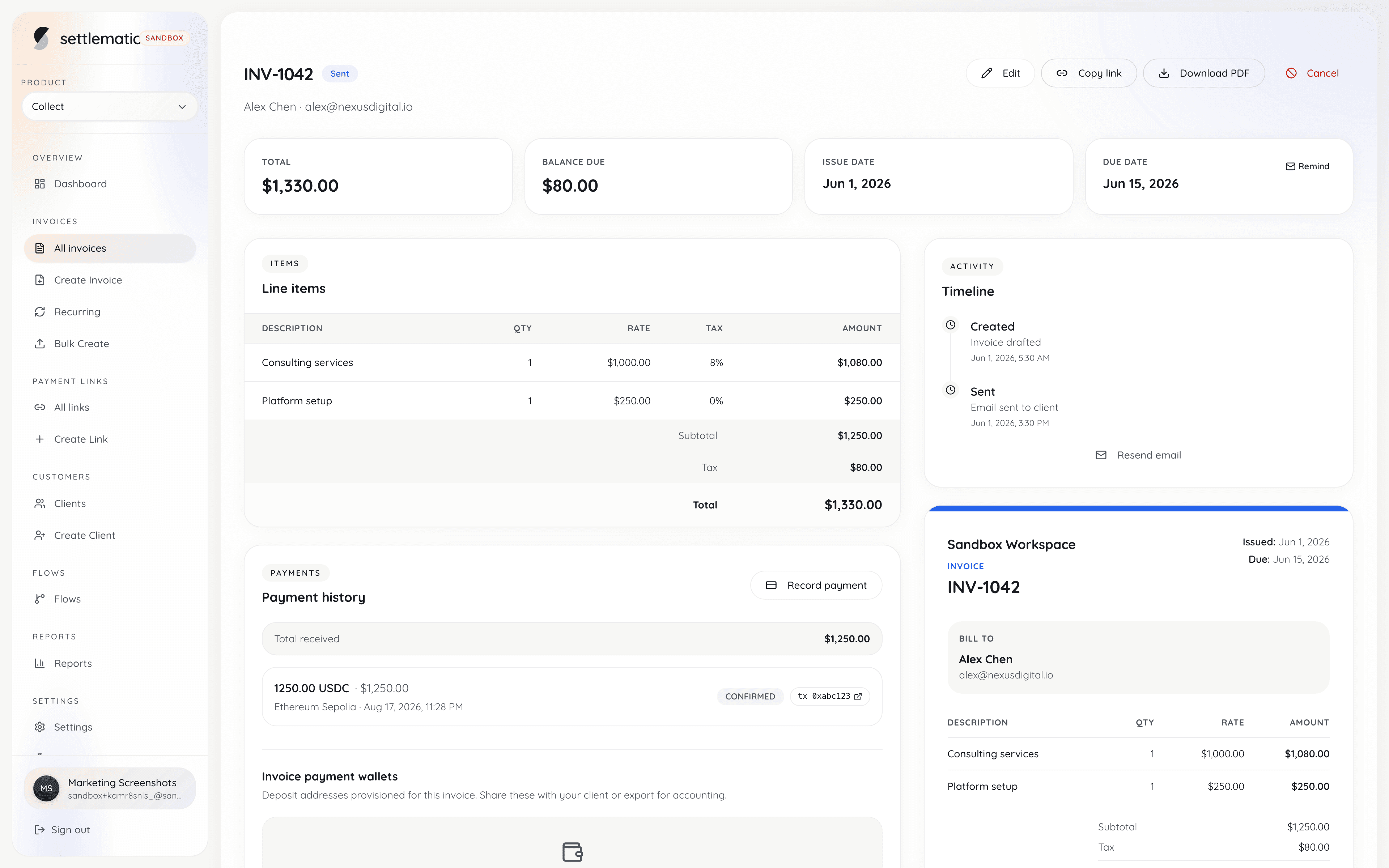
A client paid your crypto invoice on the wrong chain when they sent the correct token (or wrong token) to your invoice address on a blockchain network different from the one specified on the invoice—for example, sending USDC on Ethereum mainnet when the invoice required USDC on Base. This is one of the most common operational errors in B2B crypto billing in 2026, driven by multi-chain stablecoin availability, exchange default withdrawal networks, and finance teams unfamiliar with chain selection dropdowns.
How Wrong-Chain Payments Happen
Understanding causes prevents blame and speeds resolution.
Exchange default networks. Coinbase, Kraken, and Binance pre-select a withdrawal network. AP clerks confirm without reading. USDC leaves on Ethereum while invoice says Base.
Address format confusion. EVM chains share 0x address formats—clients assume addresses are interchangeable across Ethereum, Polygon, Arbitrum, and Base. They are not for token transfers without bridges.
Copy-paste from old invoices. Repeat clients reuse a previous payment address from a different-network invoice.
Multi-chain QR ambiguity. QR codes encoding only an address without chain metadata cause errors when scanned by generic wallets.
Token contract confusion. Sending USDT when invoice specified USDC, or sending native ETH to a USDC contract expectation.
Settlematic assigns one network per invoice and displays prominent warnings on branded payment pages, but human error persists industry-wide.
Immediate Steps (First 24 Hours)
1. Verify the transaction on-chain
Locate the transaction on a block explorer:
- Ethereum family: etherscan.io, basescan.org, arbiscan.io
- Solana: solscan.io, explorer.solana.com
Record: tx hash, from address, to address, token contract, amount, timestamp, network.
2. Compare to invoice specification
Pull invoice record from Settlematic dashboard. Confirm:
- Expected network vs actual network
- Expected token vs actual token
- Expected amount vs received amount
- Payment address match (same 0x on wrong EVM chain lands at same address if you control that key on both chains)
3. Do not attempt random bridges
Blind bridging can lock or lose funds. Recovery path depends on key control and token type—see recover-wrong-chain-crypto-invoice-payment.
4. Notify the client
Professional, non-accusatory email:
- Confirm you detected their payment
- Explain network mismatch factually
- Outline recovery timeline and any fees they may bear per contract terms
- Request their sending address for refunds if needed
5. Mark invoice status internally
Flag as wrong_chain_payment or equivalent. Do not mark paid until funds are accessible in intended form. Webhook systems may emit dedicated events—see webhook-patterns-crypto-billing.
Recovery Scenarios by Type
| Scenario | Funds recoverable? | Typical path |
|---|---|---|
| USDC on Ethereum, invoice was Base; you control EVM key | Yes | Access ETH-chain USDC at same address; bridge or keep on Ethereum |
| USDC on Ethereum, invoice was Solana | Partial/complex | Different address families—funds at EVM address, not Solana address |
| ETH sent instead of USDC on correct chain | Yes | You received ETH; negotiate credit or refund |
| USDC on correct chain, underpaid | Yes | Partial payment workflow; invoice remains open |
| Token sent to deprecated contract | Difficult | Contract-specific; may require support from token issuer |
| Sent to wrong address entirely | Often no | Phishing or typo—not wrong chain but wrong destination |
EVM-to-EVM wrong chain (most common)
If invoice address was 0xABC... on Base and client sent USDC on Ethereum mainnet to 0xABC..., the same private key controls that address on every EVM chain. USDC sits in your Ethereum wallet. Options:
- Accept as payment; update books noting network discrepancy
- Bridge USDC to Base via official Circle bridge or canonical bridges
- Return USDC on Ethereum to client minus gas
Non-custodial invoicing with deterministic EVM addresses makes this recovery straightforward—you hold the keys.
EVM invoice, Solana payment attempt
Solana addresses are base58, unrelated to 0x. Client may have sent to an address from a different invoice. Trace their tx; funds may be lost if sent to invalid address or wrong recipient.
Solana invoice, EVM payment
Inverse problem. Emphasize network in client onboarding per get-paid-in-crypto-us-eu-clients.
Prevention Strategies
Invoice design
- One network per invoice—never "pay on any of these"
- Large typography: "Pay USDC on Base Mainnet only"
- Hosted payment page pre-selects network; no manual address copy if possible
- QR encodes chain ID where wallet supports EIP-681 or Solana pay standards
Client education
- One-page payment guide PDF with screenshots of exchange network selector
- Require AP contact to confirm network in reply email before first payment
- Video walkthrough for enterprise clients
Platform configuration
Settlematic Collect enforces chain-specific payment instructions and can detect deposits on non-invoice chains when address overlap exists (EVM). Configure webhooks to alert on anomalies.
Contract terms
Include clause: client bears recovery costs for wrong-chain sends where merchant must pay bridge gas or manual intervention.
Accounting Treatment
Wrong-chain payment received but invoice specified different network:
- Record asset at fair market value on network where received (IRS property treatment)
- Note network discrepancy in memo field
- Upon bridge to preferred chain, record bridge fees as expense
- Mark invoice paid when economically settled per your policy
Export to QuickBooks per export-crypto-invoice-data-quickbooks-xero with network field populated.
Communication Templates
To client (detection)
"We've identified your payment of [amount] [token] on [actual network]. Invoice #[n] specified [expected network]. Your funds are safe. We're processing recovery and will confirm when invoice is marked paid. Expected resolution: [timeframe]."
To client (need action)
"To complete recovery, please confirm your refund address on [network] if we cannot apply payment as-is. Do not send additional payments until we confirm."
When Funds Are Not Recoverable
Honest assessment builds trust:
- Sent to typo address with no key control
- Sent unsupported token to address with no withdrawal path
- Sent to invoice after key rotation without forwarder contract
Document loss for tax purposes; consult accountant on bad debt treatment if invoice remains unpaid and client refuses to resend.
Technical Deep Dive: Why EVM Addresses Collide Across Chains
Externally owned accounts (EOAs) on Ethereum, Base, Arbitrum, Polygon share the same address from the same private key. Token balances are chain-specific state. USDC on Base is not USDC on Ethereum—they are different contract storage locations. Wallets show separate balances per network.
This is why wrong-chain EVM payments are recoverable (funds exist somewhere you control) but not automatically credited (invoice reconciliation expects specific chain).
Solana uses ed25519 keypairs with unrelated address space—no cross-chain address collision with EVM.
Integration with Support Workflows
Support ticket fields:
- Invoice ID
- Expected vs actual network
- Tx hash
- Recovery status: investigating / recoverable / completed / lost
- Link to recover-wrong-chain-crypto-invoice-payment internal runbook
Settlematic dashboard transaction detail accelerates triage.
Exchange-Specific Withdrawal Pitfalls
Each major exchange surfaces network selection differently—training materials should screenshot the exact UI your clients use. Coinbase Commerce and Coinbase Prime differ from retail Coinbase withdrawal flows. Kraken requires explicit network confirmation for USDC with a second modal many users dismiss. Binance default USDC withdrawal may route through BSC or Ethereum depending on account region—EU users face different defaults than US users. Fireblocks and BitGo corporate wallets require treasury admin approval; payment may sit "pending approval" for 24 hours while your invoice due date passes—set expectations in invoice terms that on-chain receipt date governs, not client initiation date. Provide exchange-specific PDF appendices for top three exchanges your client base uses.
Internal Escalation Matrix
| Payment value | Wrong-chain type | Escalate to | SLA |
|---|---|---|---|
| <$1,000 | EVM-EVM | Finance ops | 24 hr |
| $1k–$25k | Any recoverable | Finance + engineering | 8 hr |
| >$25k | Any | CFO + legal review | 4 hr |
| Any | Irrecoverable | Account manager + client exec | Same day |
Document escalation in Confluence or Notion; link this article and recover-wrong-chain-crypto-invoice-payment from ticket templates.
Post-Incident Analytics
Track wrong-chain rate monthly: wrong_chain_count / total_paid_invoices. Target <2% after first successful client payment. Spike analysis by client, exchange, and network informs targeted education. Clients with repeat offenses get mandatory hosted-payment-link-only policy—disable raw address display in PDF for those accounts if Settlematic supports per-client templates. Share aggregate stats in QBRs with enterprise clients to justify joint training investment.
Relationship Management After Errors
Clients who wrong-chain pay often feel embarrassed or defensive. Lead with "funds are safe" before explaining error. Avoid blaming AP clerk in writing—internal client politics are not your battle. Fast resolution builds loyalty; slow opaque resolution damages trust more than the error itself. Offer to join client's internal AP training call—thirty minutes prevents recurrence and deepens account relationship. For recoverable cases, waive recovery fees on first offense if contract permits discretionary goodwill.
Insurance and Client Communication Templates
Some merchants purchase crypto payment error insurance from specialty underwriters—read policies carefully; operational wrong-chain errors are often excluded as "user error." Client communication template library accelerates response:
Initial detection (email): "We confirm receipt of [amount] [token] on [network]. Invoice #[n] specified [expected network]. Your funds are secure at address [address]. We are processing application to your invoice and will update you within [SLA]."
Resolution complete: "Invoice #[n] is now marked paid. Transaction reference: [tx_hash]. Thank you for your patience."
Store templates in support CRM; personalize network names per incident. Never promise recovery before Phase 1 verification completes—overpromising damages trust if funds prove irrecoverable.
Maintain a wrong-chain incident log spreadsheet: date, invoice ID, networks involved, recovery hours, fees, outcome. Quarterly review with product team informs custom branding and payment page UX improvements. Patterns in your data beat industry averages for prioritizing prevention investments.
Wrong-Chain Prevention in RFP Responses
When responding to enterprise RFPs that ask about crypto payment risk, cite your wrong-chain rate trend, hosted payment page standard, client training program, and recovery SLA. Procurement teams weight operational maturity over raw crypto enthusiasm. Include link to recover-wrong-chain-crypto-invoice-payment in security appendix as evidence of documented incident response—not as admission of frequent failures, but as operational readiness comparable to disaster recovery runbooks.
Solana and Base both support USDC but are not interchangeable at the address level—your RFP should explicitly state which networks you invoice on and your measured wrong-chain rate per network, demonstrating network-specific operational competence rather than generic "we accept crypto" marketing.
Enterprise clients increasingly request proof that your invoicing vendor is non-custodial—pair wrong-chain runbooks with what-is-non-custodial-crypto-invoicing documentation in security questionnaires to show end-to-end operational maturity across prevention and recovery.
Train client AP teams to verify network in exchange UI matches invoice before clicking confirm—five seconds of verification prevents five hours of recovery. Include animated GIF in onboarding email showing network dropdown on top three exchanges your clients use.
Prevention costs minutes; recovery costs hours—budget onboarding time accordingly for every new crypto-paying client regardless of how crypto-sophisticated they claim to be.
Wrong-chain recovery timeline by scenario
Set client expectations with realistic SLAs:
| Scenario | Typical recovery time | Client action required |
|---|---|---|
| EVM wrong chain, same address | 1–24 hours | None if merchant accepts as payment |
| EVM wrong chain, bridge needed | 24–72 hours | Approve bridge gas |
| Solana/EVM cross-family | 48 hours–never | Case-by-case; often unrecoverable |
| Wrong token, correct chain | 24 hours | Send correct token |
| Typo address | Usually never | Resend payment |
Communicate timeline in first response email — underpromise, overdeliver. Finance teams escalate to executives when recovery exceeds 48 hours without updates.
Prevention technology stack
Layer defenses beyond payment page warnings:
- Hosted payment link only — Disable raw address in PDF for enterprise clients; force click-through where wallet pre-fills network.
- EIP-681 / Solana Pay URIs — QR encodes chain + token + amount; wallet parses correctly.
- Pre-payment client attestation — AP checkbox: "I confirm Solana network selected" before address displays.
- Treasury policy alignment — Client allowlist matches your invoice networks before first bill.
- Webhook anomaly alerts — Transfer detected on non-invoice chain to known EVM address triggers ops review before client emails.
| Prevention layer | Wrong-chain reduction | Implementation effort |
|---|---|---|
| Bold network UI | 30–50% | Platform default |
| Hosted link only | 40–60% | Config change |
| Client attestation | 10–20% additional | Process |
| Exchange-specific guides | 20–30% first payment | Content |
| Treasury pre-alignment | Prevents mismatch | Sales/ops |
Combined stack targets <1% wrong-chain rate after client onboarding — achievable at scale with discipline.
Legal and contractual considerations
Master service agreements should address wrong-chain liability:
- Client bears recovery costs when merchant must pay bridge gas or manual intervention fees.
- Payment not deemed received until correct asset on correct network per invoice specification — or define alternative policy when merchant accepts EVM cross-chain payment at same address.
- Merchant not liable for irrecoverable sends to typo addresses.
- Client must not send additional payments during recovery without written confirmation.
Legal review varies by jurisdiction — template clauses are starting points, not substitutes for counsel. Document actual recovery outcomes in incident log for future contract refinement.
Training internal support teams
Support agents handling wrong-chain tickets need:
- Explorer fluency (Etherscan, Basescan, Solscan)
- Access to invoice dashboard with expected vs actual network fields
- Escalation matrix (already documented above)
- Prohibition on advising clients to use unverified bridge contracts
- Template emails (detection, need action, resolution complete)
Quarterly 30-minute refresher with new exchange UI screenshots. Wrong-chain volume correlates with exchange UI changes more than merchant error rates — stay current on Coinbase/Kraken withdrawal flows.
Frequently asked questions
- Is wrong-chain payment the client's fault?
- Often yes operationally, but merchants share responsibility for clear instructions. Collaborative resolution preserves relationships.
- Should I mark invoice paid before recovery completes?
- Policy choice: mark paid when funds are accessible in any form you accept, or only when on specified network. Document consistently.
- Can Settlematic automatically bridge wrong-chain funds?
- Non-custodial platforms do not bridge without your wallet signature. You control recovery actions.
- Does insurance cover wrong-chain losses?
- Unlikely for operational errors. Custodial processor insurance does not apply to direct wallet payments.
- How common is this error?
- Industry estimates suggest 5-15% of first-time B2B crypto payments hit network or token mismatches. Drops sharply after successful first payment.
- Where do I learn full recovery procedures?
- See our dedicated playbook: recover-wrong-chain-crypto-invoice-payment. Book demo for enterprise support SLAs.