Invoice-Scoped Wallet Addresses Explained: Why One Address Per Invoice Matters
Learn how invoice-scoped wallet addresses enable automated crypto invoice reconciliation — BIP-84 Bitcoin derivation, CREATE2 on EVM, and non-custodial address binding.
Do this next
Create a crypto invoice
- Quote the invoice in fiat.
- Client pays USDC, USDT, or EURC.
- Funds settle to a wallet you already control.
TL;DR
Invoice-scoped wallet addresses are unique deposit destinations allocated to a single invoice at issuance. They let you match on-chain transfers to receivables without payment memos or shared treasuries. Settlematic binds each address to your settlement configuration using BIP-84 derivation on Bitcoin and CREATE2 counterfactual addresses on EVM chains — so reconciliation is automated without the platform ever holding signing keys.
The reconciliation problem on public blockchains
Bank wires carry reference numbers. Card charges carry merchant descriptors. Raw crypto transfers carry only amount, sender, receiver, and token — no reliable invoice ID field that works when your customer withdraws from Coinbase.
If ten open invoices all list the same treasury address, a 5,000 USDC deposit is ambiguous. Finance teams resort to amount guessing, payer emails, and spreadsheet torture. Invoice-scoped addresses fix this by making the destination itself the invoice identifier.
What "invoice-scoped" means
An invoice-scoped address is:
- Allocated when the invoice is issued (not reused across invoices)
- Bound to a specific invoice record in your AR system
- Monitored until the invoice is paid, expired, or manually closed
- Linked in webhooks and exports to that invoice's ID
It is not merely a new address in a personal wallet app — it is part of an automated receivables workflow.
Custodial vs non-custodial scoped addresses
| Approach | Who generates keys | Where funds land first |
|---|---|---|
| Custodial scoped | Platform | Platform-controlled deposit wallet |
| Non-custodial scoped | Platform derives from merchant config | Merchant-bound destination |
Settlematic uses the non-custodial pattern. Compare custodial vs non-custodial crypto invoicing.
Bitcoin: BIP-84 hierarchical derivation
For native SegWit Bitcoin, Settlematic consumes a merchant-provided account-level xpub (watch-only). Each invoice receives the next child index in a BIP-84 path. Properties:
- Platform never sees private keys
- Addresses are deterministic from your xpub
- Indices are allocated transactionally — no reuse
- Incoming BTC is attributable to exactly one invoice
Treasury ops can sweep from derived addresses using their own signing infrastructure outside Settlematic, or hold UTXOs per policy.
EVM chains: CREATE2 counterfactual addresses
On Ethereum, Polygon, and BSC, Settlematic uses CREATE2 to compute deposit addresses from a factory contract and invoice-specific salt. Init code embeds the merchant treasury so value routes according to the binding established at issuance — without the platform custodying a hot wallet per invoice.
Payers send standard ERC-20 transfers (USDC, USDT, EURC) or native ETH; no custom contract interaction required from exchange withdrawals.
Solana and Tron considerations
High-throughput chains used for stablecoin settlement (Solana, Tron) get per-invoice destinations compatible with exchange withdrawal UX — plain address + amount. Indexers watch for matching transfers to scoped addresses and apply chain-appropriate confirmation rules.
Supported assets include USDC and USDT on both networks alongside EVM and Bitcoin.
Why reuse is forbidden
Reusing a scoped address across invoices reintroduces ambiguity. Settlematic allocates addresses monotonically per derivation path or salt sequence. If an invoice expires unpaid, the address remains historically tied to that invoice — finance can audit what happened years later.
Hosted pay page UX
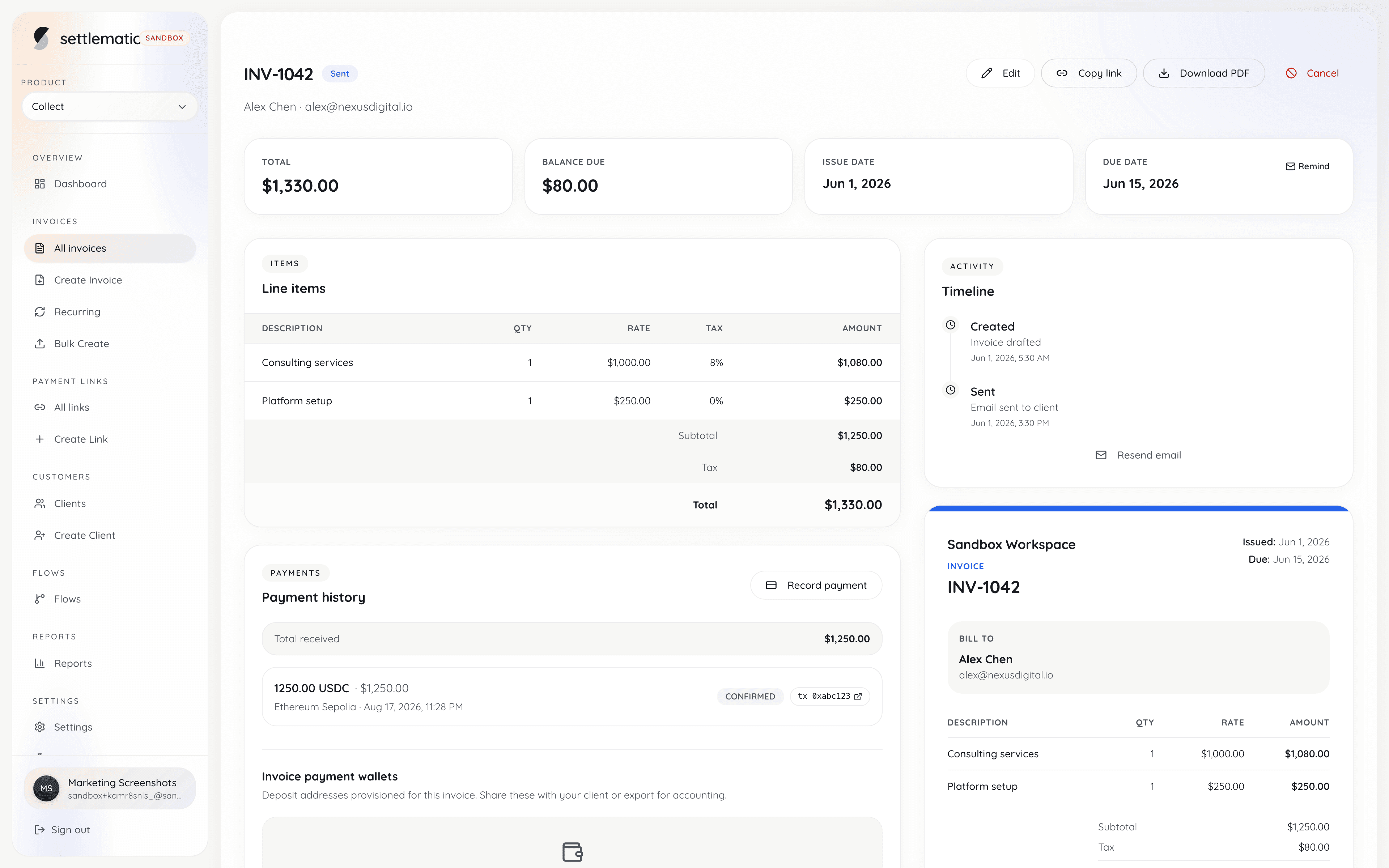
Payers should not copy addresses from PDFs manually if you can avoid it. Hosted pages show QR codes, exact amounts, countdown timers for rate locks, and wrong-network warnings. Settlematic Collect generates these pages automatically per invoice.
Webhooks and ERP closure
When indexers confirm payment to a scoped address, Settlematic emits webhooks containing invoice ID, tx hash, payer address, token, chain, crypto amount, and quoted fiat amount. That payload is sufficient for many ERPs to mark receivables paid without human review.
Partial payments and overpayments
Scoped addresses also disambiguate which invoice received an underpayment. Policies can allow partial acceptance or hold invoice open until top-up. Overpayments trigger distinct webhook events so finance can issue credits or refunds according to policy.
Smart terms like early discounts are covered in smart invoices guide.
Security review talking points
When security asks "what if Settlematic is compromised?":
- Attacker cannot sweep funds without merchant keys
- Worst case may be bogus invoice state — reconcile against chain directly
- Hash-chained audit logs support forensic review
This is qualitatively different from custodial deposit wallet breaches.
Implementation checklist for merchants
- Generate xpub or configure factory/treasury per chain
- Test one small invoice on each network you will accept
- Document internal runbook for wrong-network payer tickets
- Connect webhooks to accounting
- Train AP contacts at enterprise clients to use hosted links
Book demo for a guided setup walkthrough.
Relationship to static templates
PDF templates that print one treasury address undermine scoped addressing. If you use templates, generate them from software so each PDF embeds the correct scoped destination. Crypto invoice template guide.
Who benefits most
- Agencies with parallel client invoices (agency guide)
- SaaS with many subscribers paying asynchronously (SaaS guide)
- International B2B with USDC settlement (international billing)
Bottom line
Invoice-scoped addresses are the atomic unit of crypto AR automation. Non-custodial binding lets you adopt them without making your invoicing vendor a custodian. Settlematic Collect | pricing | demo
Extended analysis: operational depth (1)
| Review checkpoint | Pass criteria |
|---|---|
| Custody | Vendor cannot sign merchant settlement txs |
| Addresses | Unique per invoice, never reused |
| Pricing | No uncapped % of volume on large tickets |
| Chains | Matches payer withdrawal options |
| Terms | Discounts/late fees on pay page if needed |
Extended analysis: operational depth (2)
| Review checkpoint | Pass criteria |
|---|---|
| Custody | Vendor cannot sign merchant settlement txs |
| Addresses | Unique per invoice, never reused |
| Pricing | No uncapped % of volume on large tickets |
| Chains | Matches payer withdrawal options |
| Terms | Discounts/late fees on pay page if needed |
Extended analysis: operational depth (3)
| Review checkpoint | Pass criteria |
|---|---|
| Custody | Vendor cannot sign merchant settlement txs |
| Addresses | Unique per invoice, never reused |
| Pricing | No uncapped % of volume on large tickets |
| Chains | Matches payer withdrawal options |
| Terms | Discounts/late fees on pay page if needed |
Frequently Asked Questions
Is one address per invoice overkill?
Not if you have more than one open receivable. Shared addresses do not scale.
Can customers pay from exchanges?
Yes — plain transfers to scoped addresses work from Coinbase, Binance, etc.
What if I lose my xpub backup?
You cannot regenerate future addresses reliably. Treat xpub like important treasury config.
Does Settlematic support BTC?
Yes — native SegWit via BIP-84 invoice-scoped derivation.
How is this different from payment links?
Payment links are UX; scoped addresses are the reconciliation primitive underneath.
Where do I configure this?
In Settlematic Collect during organization setup — see demo.