Crypto Invoice Template: Required Fields, Download Guide, and When to Use Software
A practical crypto invoice template checklist: required fields, PDF vs hosted pay links, compliance notes, and when spreadsheet templates break down for B2B billing.
Do this next
Create a crypto invoice
- Quote the invoice in fiat.
- Client pays USDC, USDT, or EURC.
- Funds settle to a wallet you already control.
TL;DR
A usable crypto invoice template includes fiat totals, per-line tax, allowed assets/networks, payment terms, and a hosted pay URL - not just a wallet address cell.
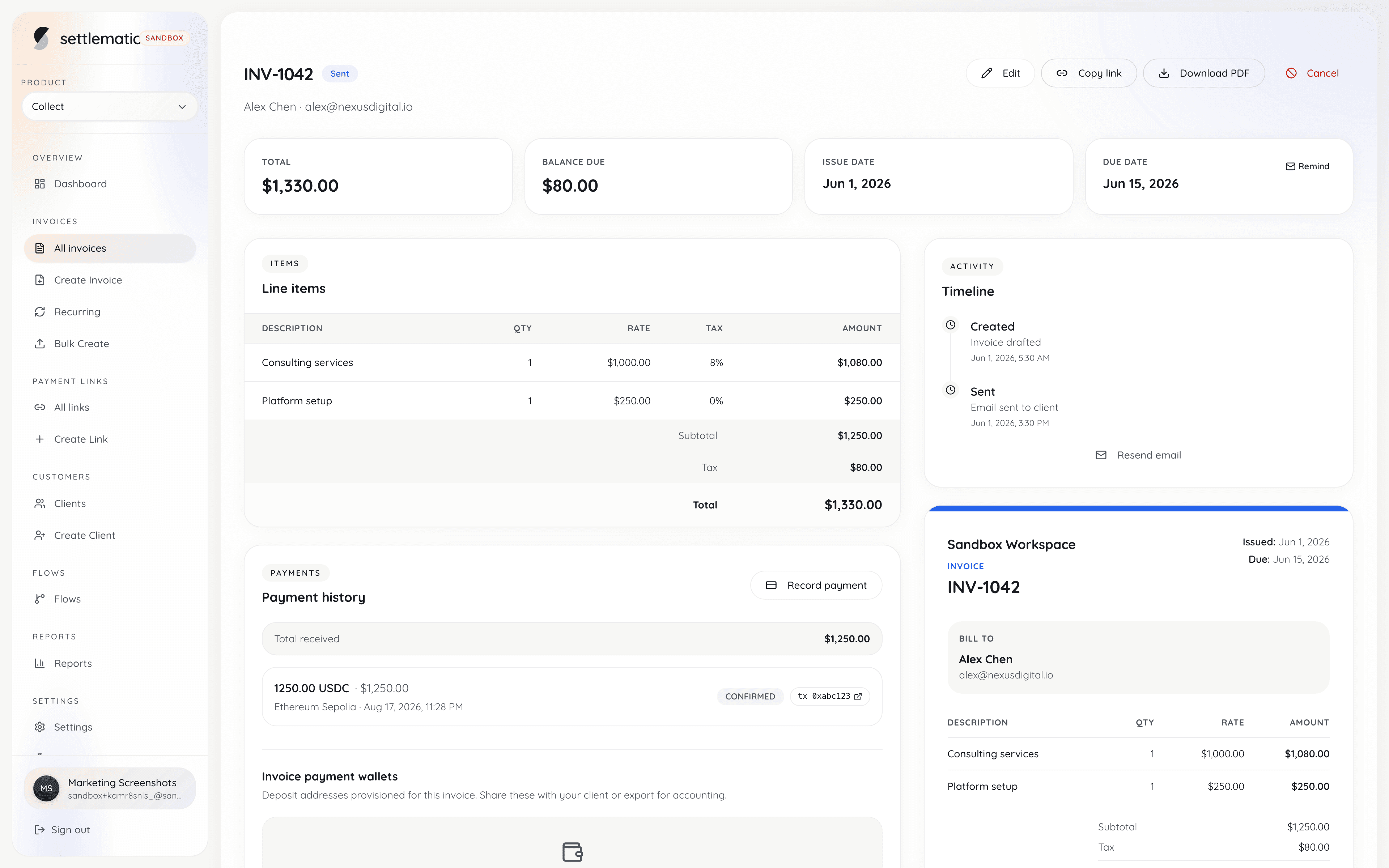
Why a generic invoice template fails for crypto
Traditional invoice templates assume bank wires or card charges. Crypto settlement adds dimensions spreadsheets were never designed to handle: which chain, which token contract, exact amount in smallest units, and a payment destination that maps to exactly one receivable. Paste your static treasury address into a PDF and you will spend hours each month matching deposits to open invoices.
A usable crypto invoice template is therefore a data contract between you and your payer, not a logo header. Whether you deliver it as PDF, email body, or hosted pay page, the fields below are non-negotiable for B2B teams that care about audit trails.
Required fields checklist
| Field | Why it matters |
|---|---|
| Invoice number | Unique AR reference for accounting and tax |
| Issue date & due date | DSO metrics and late-fee enforcement |
| Seller legal name, address, tax ID | VAT/GST and 1099-style reporting |
| Buyer legal name and billing address | Contract counterparty identification |
| Fiat amount or crypto amount | Ambiguity causes underpayment disputes |
| Quoted fiat + settlement asset | e.g. USD 10,000 payable in USDC |
| Exchange rate source & lock expiry | Prevents FX surprise on delayed payers |
| Network (chain) | Wrong chain = lost or stuck funds |
| Token contract (for ERC-20/TRC-20) | USDC on Ethereum ≠ USDC on BSC without bridge |
| Unique deposit address | One address per invoice for reconciliation |
| Payment instructions | "Send exact amount; no memo required" |
| Refund / contact policy | Enterprise buyers expect escalation path |
Missing any row in this table creates support tickets. The most common failure mode is quoting USD while only listing a wallet address with no rate lock — the payer sends "about" the right USDC two days later and finance cannot auto-match.
Copy-paste crypto invoice structure
Use this skeleton in Google Docs, Notion, or your ERP export:
Templates that omit unique_invoice_address force shared-wallet reconciliation — workable once a quarter, painful at scale. For address binding mechanics, see invoice-scoped wallet addresses explained.
PDF templates vs hosted pay pages
| Delivery method | Pros | Cons |
|---|---|---|
| Static PDF | Familiar to finance; easy archive | Addresses and rates go stale; no live status |
| Email HTML | Fast to send | Spam filters; mobile formatting |
| Hosted pay page | Live rate lock, QR, status | Requires software vendor |
Hosted pages shine when you quote fiat and settle crypto: the page recalculates the token amount until expiry, shows a QR code, and marks paid when chain indexers confirm. Settlematic Collect provides hosted pay links with invoice-scoped addresses bound at issuance — no manual address paste per invoice.
Compliance and record-keeping fields
Tax authorities care about when income was earned and what you received, not which wallet software you prefer. Your template should preserve:
- Timestamp of invoice issuance
- Agreed consideration in functional currency
- Actual crypto received (amount, token, tx hash)
- FX rate used if quoted in fiat
Non-custodial invoicing software attaches tx hashes automatically via webhooks; PDF-only workflows depend on someone copying hashes from a block explorer into a spreadsheet. If you are building a manual process, add a mandatory "Transaction hash" column to your payment log.
Regulatory posture of the tool you use also matters. Custodial sweep models may implicate money-transmitter rules; non-custodial tooling like Settlematic keeps settlement in wallets you control. Compare models in custodial vs non-custodial crypto invoicing.
When spreadsheet templates stop scaling
Templates work when:
- You issue fewer than five crypto invoices per month
- Every payer is crypto-literate and follows instructions
- One person owns treasury and AR
Templates break when:
- Multiple open invoices share one deposit address
- Payers routinely send wrong networks or partial amounts
- You need webhooks into QuickBooks or Xero
- Enterprise buyers require KYB and branded portals
At that inflection point, software pays for itself in finance hours alone — before counting percentage fees avoided on large tickets. See pricing for flat subscription tiers that do not tax volume.
Integrating templates with Settlematic Collect
You do not have to abandon PDF culture overnight. Many teams generate PDFs from Collect for internal approval, then send the hosted pay link for actual settlement. The PDF carries human-readable terms; the link carries live address binding and confirmation state.
Workflow:
- Create client record in Settlematic Collect
- Issue fiat-quoted invoice with allowed assets (USDC, USDT, EURC, ETH, BTC)
- Export PDF if procurement requires it; email hosted link for payment
- Webhook closes the receivable when confirmations hit your threshold
Request demo to see PDF + hosted link side by side.
Industry-specific template tweaks
Agencies often bill retainers plus pass-through expenses. Split line items in the template and tie each project code to a client ID so crypto deposits map to the right engagement. Agency invoicing guide covers retainer patterns.
SaaS vendors need subscription period language on the template ("Service period: 2026-08-01 to 2026-08-31"). Crypto settlement does not remove revenue recognition rules. SaaS crypto invoicing guide discusses MRR tracking.
International contractors should show both VAT status and settlement asset on the same document. International billing guide walks through FX locks.
Smart terms beyond the static template
Early payment discounts and late fees belong in the template body and in the payment object if you use software. Otherwise payers claim they never saw the discount window. Settlematic smart invoices encode terms on the pay page — details in smart invoices guide.
Choosing software: evaluation shortcuts
If you have outgrown templates, compare vendors on:
| Criterion | Question to ask |
|---|---|
| Custody | Who can move funds? |
| Address model | One static address or per-invoice binding? |
| Pricing | % of volume or flat subscription? |
| Chains | Do you need Solana, Tron, Bitcoin SegWit? |
| Webhooks | Can ERP auto-close invoices? |
Best crypto invoicing platforms 2026 is an independent-style buyer's guide. What makes Settlematic different explains our non-custodial architecture.
Download vs generate: practical recommendation
There is no universal "best" PDF on the internet — jurisdiction and chart of accounts differ. Build one template from the skeleton above, store it in your ERP, and generate addresses from software rather than embedding static wallets.
Free download sites rarely update for new chains (e.g. EURC on Ethereum) or enterprise KYB flows. A living product updates asset lists and compliance surfaces as networks evolve.
Bottom line
A crypto invoice template is only as good as the payment destination and rate lock it encodes. Use PDFs for legal prose; use Settlematic Collect for addresses, confirmation, and webhooks. Settlematic Collect | pricing | demo
Extended analysis: operational depth (1)
| Review checkpoint | Pass criteria |
|---|---|
| Custody | Vendor cannot sign merchant settlement txs |
| Addresses | Unique per invoice, never reused |
| Pricing | No uncapped % of volume on large tickets |
| Chains | Matches payer withdrawal options |
| Terms | Discounts/late fees on pay page if needed |
Extended analysis: operational depth (2)
| Review checkpoint | Pass criteria |
|---|---|
| Custody | Vendor cannot sign merchant settlement txs |
| Addresses | Unique per invoice, never reused |
| Pricing | No uncapped % of volume on large tickets |
| Chains | Matches payer withdrawal options |
| Terms | Discounts/late fees on pay page if needed |
Frequently Asked Questions
Can I use a free Word crypto invoice template?
Yes for occasional invoices. Add network, token, unique address, and rate lock fields. For recurring B2B billing, migrate to software before shared-wallet reconciliation becomes a full-time job.
What is the minimum information on a USDC invoice?
Invoice ID, parties, fiat or token amount, network choice, unique deposit address, due date, and contact for payment errors.
Should I show my main wallet address on every invoice?
No. Use one address per invoice. See invoice-scoped addresses.
Does Settlematic provide PDF exports?
Yes. Settlematic Collect generates invoices with hosted pay links and exportable records for finance archives.
How do I handle VAT on a crypto invoice?
Show VAT on the fiat-quoted total; settlement asset is a payment method. Keep tx hash and received amount for audit.
When should I stop using templates?
When you have more than a handful of open crypto receivables monthly, need ERP webhooks, or bill six-figure tickets where manual matching risk is unacceptable.