What Is a Crypto Invoice? Definition, Fields, and How to Create One
Learn what a crypto invoice is, which fields it must include, how it differs from a wallet address, and how to create professional stablecoin invoices with automatic payment detection.
Do this next
Create a crypto invoice
- Quote the invoice in fiat.
- Client pays USDC, USDT, or EURC.
- Funds settle to a wallet you already control.
TL;DR
A crypto invoice is a structured payment request that specifies who owes what (usually in fiat terms), for which goods or services, by when — and provides a unique, non-custodial deposit address or payment link for on-chain settlement. It is not a static wallet QR code. Required fields mirror traditional invoices plus crypto-specific metadata: network, asset, bound address, and expected on-chain amount. Create one in minutes with Settlematic Collect.
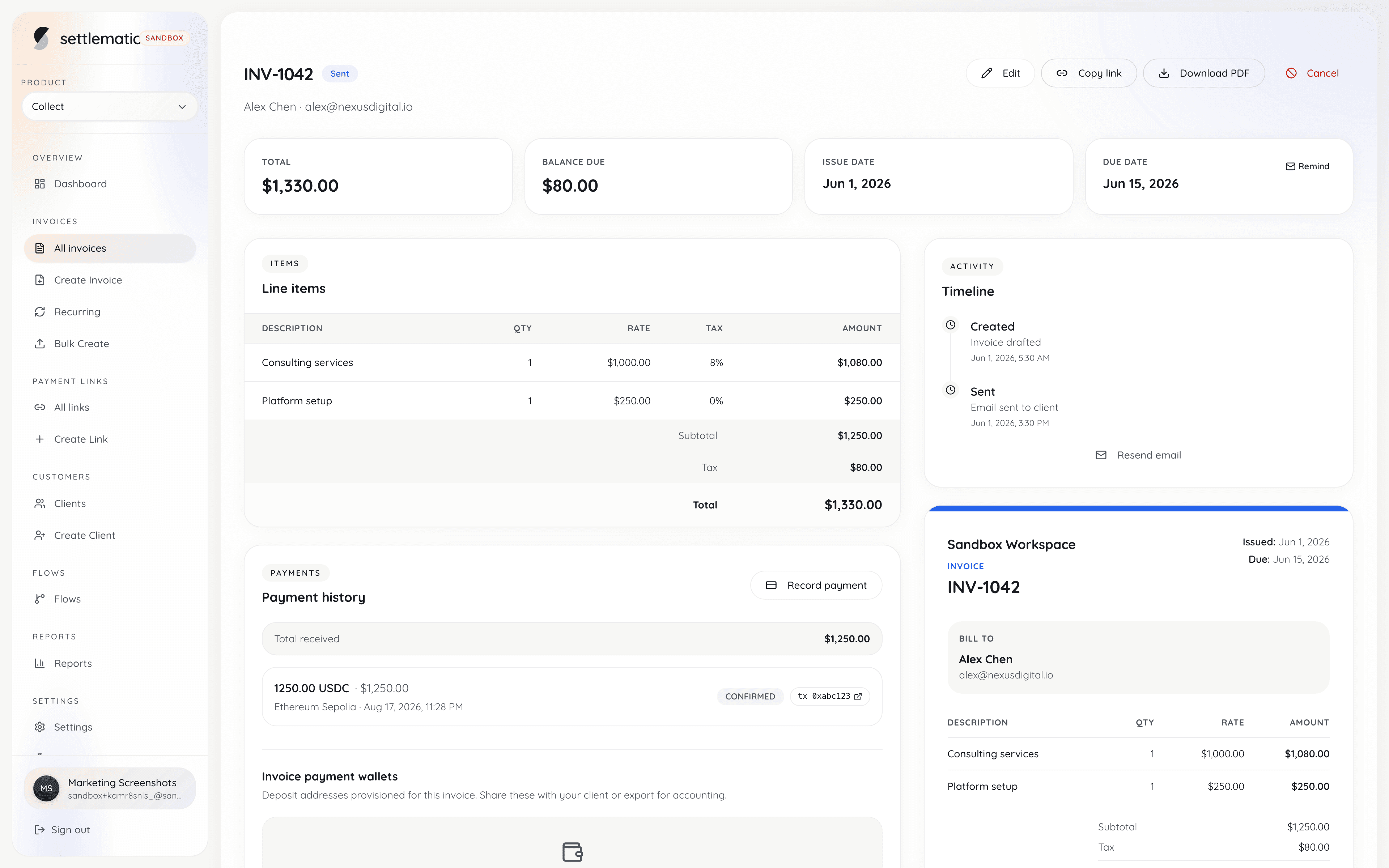
If you have ever pasted a wallet address into an email and called it an invoice, this article is for you. That approach lacks the structure accountants, clients, and auditors expect — and it breaks the moment you have more than one open request for payment.
Definition: crypto invoice vs crypto payment
| Term | Meaning |
|---|---|
| Crypto invoice | Document + payment instructions tying a specific obligation to a specific on-chain payment |
| Crypto payment | The on-chain transfer that settles an obligation (may or may not be tied to an invoice) |
| Payment link | Hosted checkout page derived from an invoice |
| Wallet address | Public key hash that can receive funds — not by itself an invoice |
A crypto invoice answers four questions a bare address cannot:
- Who is being billed (client legal name, contact)?
- What are they paying for (line items, description)?
- How much is owed (fiat-denominated amount with crypto settlement terms)?
- When is it due (issue date, due date, terms)?
The on-chain layer adds:
- Where to pay (unique deposit address bound to merchant wallet)?
- In what asset (USDC, EURC, ETH)?
- On which network (Solana, Base, Polygon)?
Anatomy of a crypto invoice
Professional crypto invoices include standard commercial fields plus settlement metadata.
Header and parties
| Field | Example | Purpose |
|---|---|---|
| Invoice number | INV-2026-0187 | Unique identifier for reconciliation |
| Issue date | 2026-07-15 | Start of payment terms |
| Due date | 2026-07-29 | Net-14 terms |
| Seller | Your LLC name, address, tax ID | Legal payee |
| Buyer | Client Corp, billing contact | Legal payer |
Line items
| Description | Qty | Rate | Amount |
|---|---|---|---|
| Backend API development — July | 80 hrs | $125 | $10,000 |
| Infrastructure review | 1 | $1,500 | $1,500 |
| Subtotal | $11,500 | ||
| VAT (if applicable) | $0 | ||
| Total due | $11,500 USD |
Line items stay fiat-denominated even when settlement is USDC. Clients and auditors think in dollars or euros; the payment layer handles conversion at checkout.
Payment instructions (crypto-specific)
| Field | Example |
|---|---|
| Accepted assets | USDC |
| Accepted networks | Base, Solana |
| Deposit address | Unique per invoice (not merchant's static wallet) |
| Expected crypto amount | 11,500 USDC (quoted at payment time) |
| Payment link | https://pay.example/inv/abc123 |
| Memo / reference | Invoice INV-2026-0187 (display only — not on-chain memo) |
Critical detail: the deposit address must be unique per invoice in any system handling more than one open invoice. Otherwise you cannot match payments to obligations.
Footer
- Payment terms ("Net 14, 1.5% late fee after 30 days")
- Legal entity and registration numbers
- Support contact
- Note: "Payment settles on-chain; transaction hash serves as receipt"
How a crypto invoice flows from creation to paid
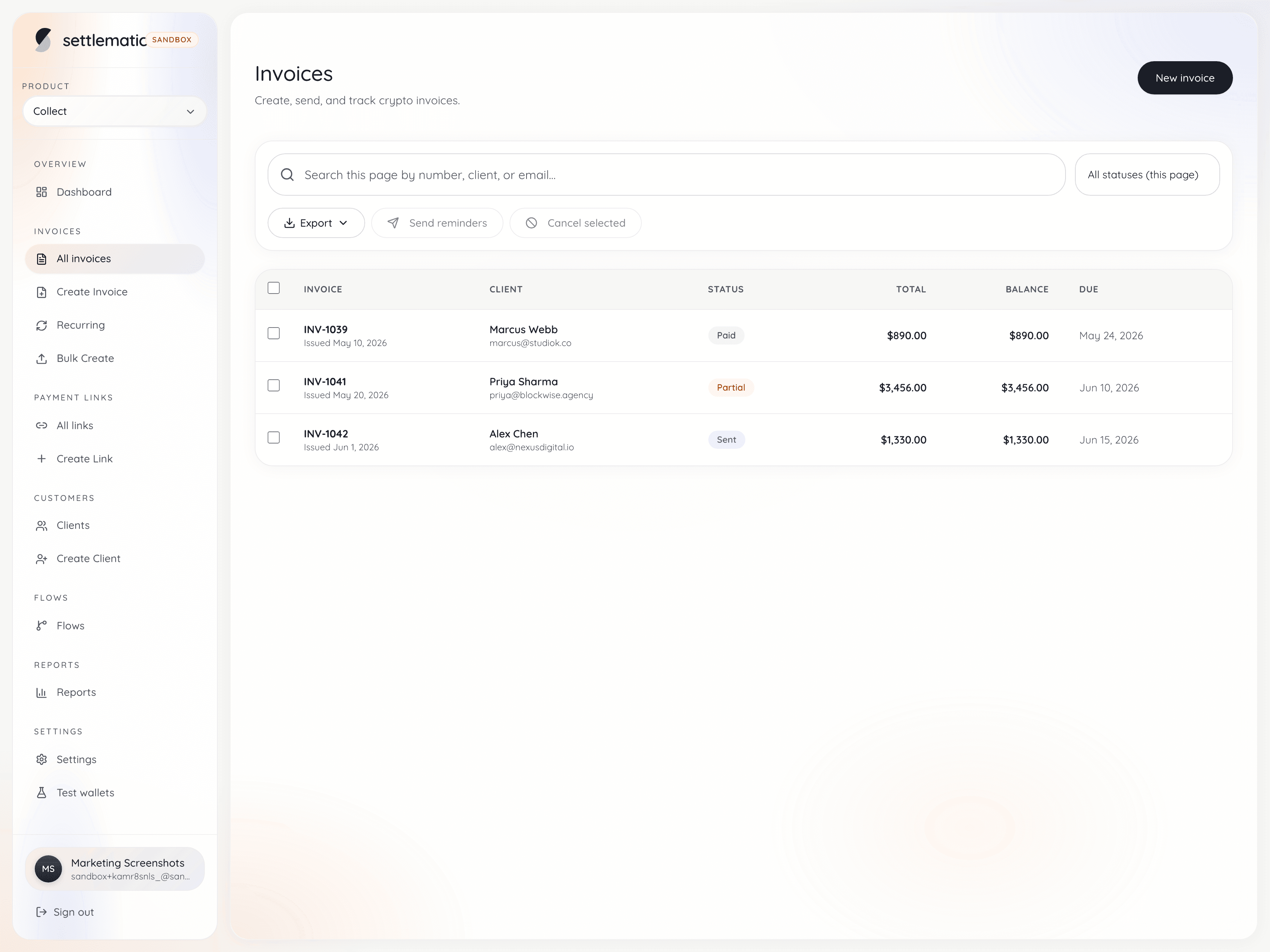
- Create invoice in Settlematic Collect with line items and client details.
- Bind a deposit address to your settlement wallet at issuance — non-custodial platforms do this cryptographically so neither you nor the platform can redirect funds later.
- Deliver PDF via email and hosted payment link for one-click payer UX.
- Client pays from exchange or self-custody wallet within the accepted network.
- Detect confirmation via indexer + RPC (on-chain payment detection).
- Mark paid; fire webhook if integrated.
- Export record for accounting (tax reporting guide).
Crypto invoice vs traditional invoice
| Dimension | Traditional (PDF + wire) | Crypto invoice |
|---|---|---|
| Settlement rail | Bank SWIFT/ACH | Blockchain |
| Reference matching | Wire memo field | Unique address + tx hash |
| Confirmation time | 1–5 days | Minutes |
| Proof of payment | Bank statement | On-chain transaction |
| Reversibility | Wire recall (difficult) | Immutable after confirmation |
| Custody | Bank holds funds | Non-custodial: your wallet |
Everything upstream of settlement — contract, scope, line items, tax treatment — stays the same. Crypto changes how payment arrives and how you prove it.
What a crypto invoice is not
Avoid these common mistakes:
Not a static wallet address on letterhead. Receiving address reuse makes reconciliation ambiguous and violates basic bookkeeping separation.
Not a smart contract invoice unless you need one. Most B2B services use address-bound invoices, not on-chain escrow contracts. Escrow adds gas, audit surface, and client friction without benefit for standard consulting work.
Not a tax document by itself in all jurisdictions. It supports tax reporting but may need supplementary forms (1099, VAT return, etc.).
Not anonymous. Professional invoices include seller and buyer identity — required for B2B and accountant reconciliation.
Fiat quote, crypto settle: the standard pattern
The dominant 2026 pattern for invoicing USD and getting paid crypto:
- Invoice displays $5,000.00 USD
- Payment page shows 5,000 USDC (or live equivalent if paying in another accepted asset)
- Client mental model stays fiat; settlement stays efficient on-chain
Why not invoice directly in BTC or ETH? Volatility between issue date and due date creates disputes. Stablecoins align invoice amount with received value.
Required fields checklist
Before sending any crypto invoice, verify:
- [ ] Unique invoice number
- [ ] Seller legal identity and contact
- [ ] Buyer legal identity and contact
- [ ] Itemized or summarized services with amounts
- [ ] Total due in fiat
- [ ] Due date and payment terms
- [ ] Accepted asset(s) and network(s)
- [ ] Unique deposit address or payment link (not reused from prior invoices)
- [ ] Statement that on-chain confirmation constitutes payment receipt
Optional but recommended:
- [ ] Tax IDs / VAT numbers
- [ ] Purchase order reference from client
- [ ] Late payment policy
- [ ] Link to security practices
How to create a crypto invoice (step by step)
Step 1: Sign up and configure settlement
Create an account, complete business verification if required, and register your settlement wallet — the address where confirmed payments land. Use a dedicated business wallet. Test configuration in the demo sandbox first.
Step 2: Add client details
Store client name, email, billing address, and preferred network if known. Repeat clients save time on invoice #2 onward.
Step 3: Enter line items
Mirror what you would put on a traditional invoice. If you bill hourly, include hours and rate. Fixed milestones get one line each.
Step 4: Set currency and networks
Choose USD (or EUR) as display currency. Enable USDC on Base, Solana, or other networks your client accepts. More networks increase payment success rate; too many confuse non-technical payers — default to one primary plus one backup.
Step 5: Review bound address
Before sending, confirm the invoice shows a unique deposit address. In non-custodial systems, that address is bound to your settlement wallet at creation — verify your settlement wallet is correct in settings, not per invoice.
Step 6: Send PDF and payment link
Email both. Corporate AP teams often want PDF for their records and the link for treasury to execute payment.
Step 7: Monitor status
Dashboard shows open, partially paid, paid, overdue, expired. Enable notifications. Integrate webhooks for automated fulfillment.
Partial payments and overpayments
Real clients make mistakes:
| Situation | Handling |
|---|---|
| Underpayment | Invoice stays partially paid; client tops up or you issue delta |
| Overpayment | Credit next invoice or refund off-platform per contract |
| Wrong network | May require manual recovery — prevent with clear payment page UX |
| Late payment after expiry | New invoice with new address typically required |
On-chain confirmation thresholds determine when status flips to paid — not mempool sighting alone.
Record keeping and audit trail
Each paid crypto invoice should archive:
- PDF snapshot at time of send
- Invoice metadata (amounts, dates, parties)
- Transaction hash and block number
- Network and asset
- USD/EUR fair market value at receipt (for tax)
This bundle satisfies most accountant requests. See crypto invoicing for accountants.
Who uses crypto invoices
| Persona | Typical use |
|---|---|
| Freelancers | Project and retainer billing — best crypto invoicing for freelancers |
| Remote dev teams | Cross-border contractor payments |
| Agencies | Client billing with branded invoices |
| SaaS / API businesses | Usage invoices with webhook fulfillment |
| Creators | Sponsorship and licensing fees |
Choosing a platform
Evaluate:
- Non-custodial settlement (why it matters)
- Fiat-quoted invoices with stablecoin settlement
- Automatic detection (no manual block explorer checks)
- Exports and API access
- Pricing fit — Settlematic pricing
Settlematic Collect implements the full field set above without holding merchant funds.
Industry adoption trends in 2026
Crypto invoicing moved from experiment to standard option for cross-border B2B:
| Segment | Adoption driver |
|---|---|
| Freelancers | Wire cost elimination |
| Dev agencies | Contractor bench payments |
| SaaS | Web3-native customer base |
| Creators | Sponsor payments without PayPal freezes |
Platforms that combine fiat quotes with stablecoin settlement win because both sides of the transaction retain familiar mental models while gaining settlement speed.
Migrating from traditional invoicing tools
Switching from FreshBooks, Wave, or PDF templates:
- Export historical invoice list (numbers, amounts, clients)
- Run parallel month — old tool plus crypto invoices for new clients only
- Train AP contacts with demo payment walkthrough
- Cut over fully after two clean reconciliation cycles
No need to abandon traditional tools for fiat-only clients — hybrid billing is normal.
Credit notes, refunds, and void workflows
Crypto invoices require explicit void and credit workflows because on-chain payments are irreversible. Voiding an unpaid open invoice revokes payment page access and stops reminders — standard practice. Voiding after partial payment requires credit note documenting amount received and remaining obligation cancelled. Full refund after overpayment needs merchant-initiated outbound transfer documented with refund tx hash linked to original invoice.
Credit notes should reference original invoice number, explain reason (overpayment, service cancellation, pricing adjustment), and specify whether credit applies to future invoice or requires on-chain refund. Accountants need credit note PDFs matching debit/credit journal entries — crypto settlement does not simplify credit documentation, only payment receipt proof.
Pro forma invoices and quotes vs payable invoices
B2B sales cycles often start with quotes or pro forma invoices before payable invoices issue. Pro forma documents should be clearly labeled "not a tax invoice" or "quote only" to prevent clients from attempting payment or claiming VAT deduction prematurely. When quote converts to payable invoice, issue new invoice number with new bound deposit address — never accept payment against quote document without converting to formal invoice.
Quotes may display estimated crypto settlement amounts with disclaimer "rate at payment time on formal invoice." Formal invoice locks payment window rate per platform policy. Distinguishing quote from invoice prevents reconciliation ambiguity when clients send funds early against non-binding documents.
Multi-language and localization considerations
International B2B clients may require invoices in local language alongside English. PDF templates should support localized field labels (Rechnung, Facture, Factura) while keeping invoice numbers and amounts numerically consistent across language versions. Payment link can remain single URL with browser language detection on hosted page.
VAT and tax registration numbers must appear in jurisdiction-required format — German USt-IdNr., French TVA intracommunautaire, UK VAT number post-Brexit. Crypto settlement does not exempt localized invoice formatting requirements. Store client preferred language on client record for automated PDF generation.
API-created invoices and programmatic billing
Developers creating invoices via API must include the same fields manual dashboard creation requires — omitting buyer legal name or invoice number breaks accountant exports downstream. API payloads should mirror PDF-visible data: line items array, tax lines, due date, settlement asset/network configuration, client metadata. Programmatic creation without validation causes "ghost invoices" with payment addresses but no PDF for client AP records.
Pair API invoice creation with automated email delivery or CRM task for account manager to send PDF — API creation alone does not notify client. Webhook on invoice.created can trigger internal Slack notification with payment link for manual client outreach in high-touch B2B sales.
---
A crypto invoice is a professional payment request — not a wallet address in an email. Include standard commercial fields, bind a unique deposit destination, deliver a payment link, and let automatic detection close the loop. Create your first invoice in Settlematic Collect, explore the demo, and compare plans on pricing.
Frequently asked questions
- Is a crypto invoice legally binding?
- It is a payment request supporting a contract for services or goods — same legal role as a traditional invoice. Enforceability depends on underlying contract law, not payment rail.
- Do I put my personal wallet on the invoice?
- No. Use a platform-generated unique deposit address bound to your business settlement wallet, or at minimum a unique address per invoice. Never publish your cold storage address on recurring documents.
- Can clients pay from Coinbase or Binance?
- Yes, if the exchange supports withdrawals to your invoice's network. The payment link specifies network — client selects matching withdrawal network in exchange UI.
- What if my client only pays by bank wire?
- Offer both. Crypto invoices do not require exclusivity. Many merchants use crypto for international clients and wires for domestic.
- How is a crypto invoice different from a payment gateway checkout?
- Invoices are merchant-initiated (you bill the client); checkout is often customer-initiated (client buys from your site). Same settlement mechanics; different UX entry point. Collect supports both payment links and invoice workflows.
- Should the invoice show the crypto amount or only fiat?
- Show fiat as primary; display crypto amount on payment page with live quote. Showing both on PDF is acceptable if dated with "rate at payment time" disclaimer.
- Are crypto invoices suitable for VAT-registered EU businesses?
- Yes, with proper VAT line items and registration numbers on the PDF. Settlement asset does not replace VAT invoicing requirements.