Crypto Invoice Template: Essential Fields & Best Practices (2026)
Free crypto invoice template guide: essential tax fields, fiat-quoted billing, required structural data, and hosted link payment workflows.
Do this next
Create a crypto invoice
- Quote the invoice in fiat.
- Client pays USDC, USDT, or EURC.
- Funds settle to a wallet you already control.
TL;DR
A professional crypto invoice template must include standard business identity fields (names, tax IDs, addresses), itemized fiat billing amounts (USD/EUR), clear payment terms, and a dynamic payment link or rate-locked QR code tied to a non-custodial wallet address to ensure tax compliance and prevent underpayment.
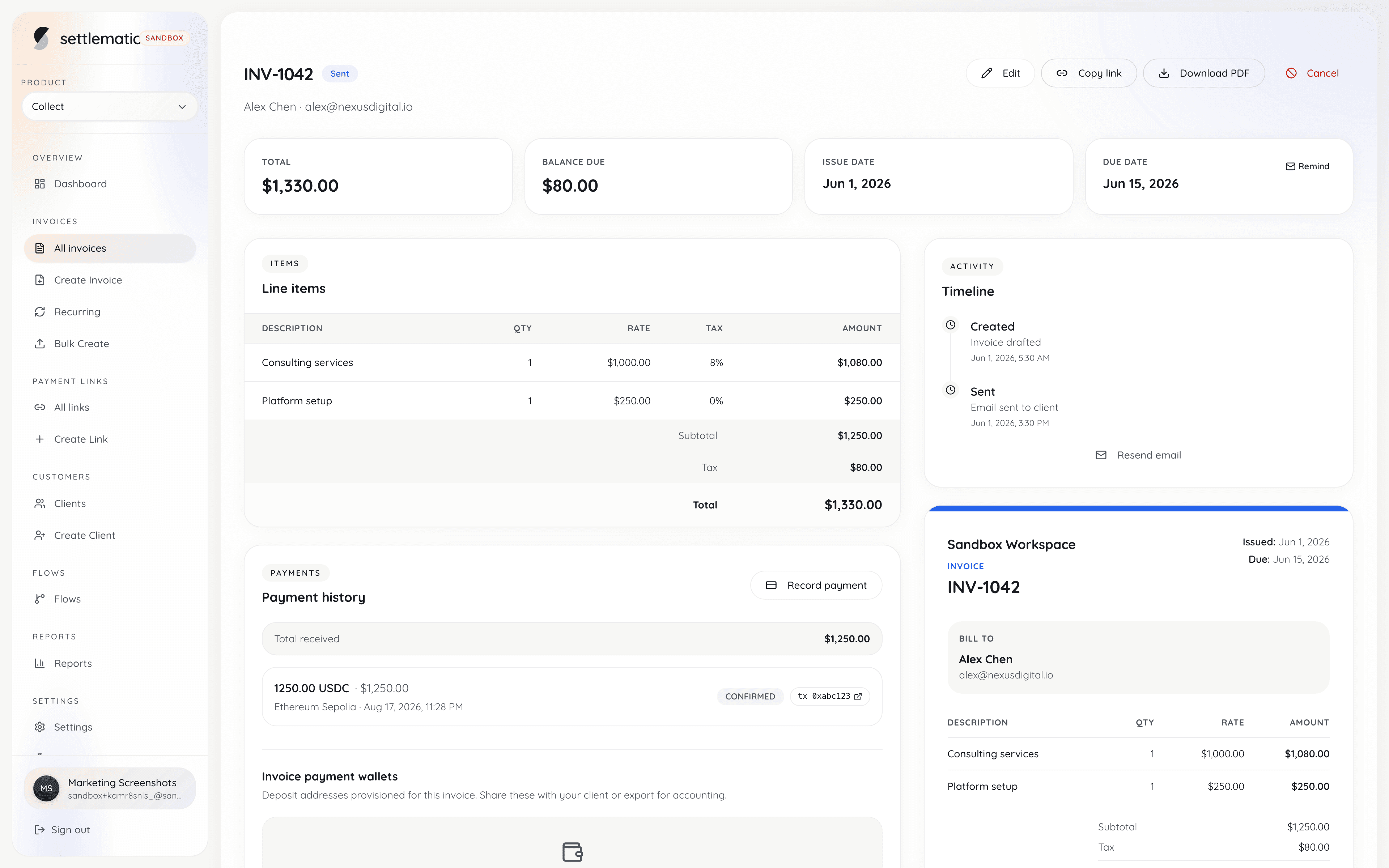
A professional crypto invoice template must include standard business identity fields (names, tax IDs, addresses), itemized fiat billing amounts (USD/EUR), clear payment terms, and a dynamic payment link or rate-locked QR code tied to a non-custodial wallet address to ensure tax compliance and prevent underpayment.
As digital agencies, software engineering teams, and global freelancers increasingly transition to cryptocurrency settlement, maintaining clean and legally compliant invoicing standards is vital. While creating an invoice for crypto payments shares many structural elements with traditional invoicing, it introduces unique requirements around exchange rate locks, multi-chain selection, on-chain transaction hashes, and local tax reporting.
Many businesses start by downloading a static Excel or Word crypto invoice template. However, static templates frequently fail in practice because crypto exchange rates fluctuate constantly. In this guide, we break down the essential fields every crypto invoice must contain, explain why dynamic hosted invoicing outperforms static documents, and provide jurisdictional tax guidelines.
The anatomy of a compliant crypto invoice template
Whether you generate invoices as PDF files, interactive web pages, or automated system exports, tax authorities require specific structural fields to validate revenue deductions and sales tax compliance. For a complete step-by-step walkthrough on billing workflows, see our comprehensive guide on how to invoice clients in crypto.
| Invoice Section | Field Name | Crypto Invoicing Requirement | Best Practice |
|---|---|---|---|
| Header | Invoice Number & Date | Unique sequential identifier and formal date of issuance. | Must match accounting ledger sequential numbering (e.g. INV-2026-001). |
| Merchant Identity | Legal Business Name, Address, Tax ID / VAT ID | Identifies the payee entity for corporate tax reporting. | Include legal entity registration number and official business address. |
| Client Identity | Client Name, Company Name, Address, Client Tax ID | Identifies the payer for Travel Rule and corporate expense claims. | Required for B2B invoices exceeding local compliance thresholds. |
| Line Items | Description, Quantity, Unit Fiat Price, Line Total | Itemizes goods or services in base fiat currency (USD/EUR/GBP). | Keep descriptions clear to justify business expense legitimacy. |
| Tax & Discounts | Applicable VAT / GST Rate, Subtotal, Grand Total | Calculates sales tax based on base fiat contract value. | Display local fiat currency total clearly before crypto conversion. |
| Payment Instructions | Hosted Payment Link / Rate-Locked QR Code | Presents live exchange rates and network deposit addresses. | Use dynamic hosted links to prevent price slippage and underpayment. |
| Settlement Metadata | Blockchain Network, Asset, Tx Hash (Post-payment) | Audit trail connecting fiat bill to on-chain confirmation. | Attach block explorer URL and tx hash to receipt once settled. |
Why dynamic hosted invoicing beats static template files
Downloading a static Word, PDF, or spreadsheet invoice template is a common first step, but static templates create major operational friction when applied to cryptocurrency:
- Exchange Rate Slippage: A static PDF listing 'Pay 1.5 ETH' will be incorrect if the client pays 3 days later after market price movements.
- Underpayments & Overpayments: Clients paying from exchange accounts often forget that withdrawal fees are deducted from the sent total, leaving your invoice partially unpaid.
- Network Selection Errors: Static address templates cannot prevent a client from sending Solana USDC to an Ethereum address, risking permanent loss of funds.
- Manual Reconciliation: Matching incoming wallet transactions back to static PDF invoice numbers requires constant manual block explorer checking.
Modern billing tools like Settlematic Collect solve these issues by embedding dynamic checkout logic directly into the invoice link. The invoice lists your exact fiat terms (e.g. $2,500 USD), but when the client opens the link to pay, it fetches live spot exchange rates, presents multi-chain options (USDC, USDT, EURC, ETH, BTC), and locks the rate for 15 minutes.
Jurisdictional tax notes for crypto invoice templates
Tax rules regarding crypto invoicing vary across international jurisdictions. Below is a summary of major regulatory requirements to keep in mind when designing your invoicing workflow:
- United States (IRS): Income must be reported in USD based on the fair market value of the cryptocurrency at the exact time and date received. The transaction hash and conversion rate source must be retained in your tax records.
- European Union (MiCA & VAT): Invoicing between EU entities must adhere to standard VAT rules. Under EU law, cryptocurrency exchange transactions are exempt from VAT, but the underlying supply of goods or services remains subject to standard VAT in EUR.
- United Kingdom (HMRC): HMRC treats crypto receipts as business revenue recognized in GBP on the date of receipt. Tax invoices issued to UK clients must clearly state the GBP equivalent of any VAT charged.
- India (Income Tax & GST): Under Section 194S, 1% TDS applies on specified VDA transfers. Business revenue received in crypto must be recorded in INR at receipt. No loss set-off is permitted against other income heads under Section 115BBH.
- Australia (ATO): GST applies to the AUD value of taxable sales paid in crypto. The tax invoice must display the GST payable amount denominated in AUD.
- Canada (CRA & FINTRAC): Crypto payments are treated as barter transactions or property transfers. Revenue must be converted to CAD at the time of payment for tax filing.
Step-by-step: Creating your first dynamic crypto invoice
Moving from a static template to an automated non-custodial crypto invoicing workflow takes only a few minutes with Settlematic Collect:
- 1. Create an Account: Sign up for Settlematic and set up your workspace profile with your company name, logo, and tax registration ID.
- 2. Add Settlement Destinations: Add your non-custodial wallet addresses for Ethereum, Polygon, Solana, BSC, Tron, or Bitcoin in Settings → Settlement.
- 3. Build the Invoice: Navigate to Invoices → New Invoice. Select a client, set your base currency (USD/EUR/GBP), add itemized line items, and set payment terms.
- 4. Enable Allowed Assets: Choose which crypto assets your client can pay with (e.g. restrict to stablecoins like USDC and USDT or allow ETH and BTC).
- 5. Send the Hosted Link: Email the invoice directly to your client or copy the unique hosted payment link into your project communications.
- 6. Automatic Settlement: When the client pays on-chain, funds land directly in your non-custodial wallet, the invoice status changes to PAID, and a PDF receipt is dispatched automatically.
Streamline your crypto billing with Settlematic
Stop wrestling with manual spreadsheet templates and static PDF wallet addresses. With Settlematic Collect, you get a complete invoicing platform featuring fiat-quoted billing, non-custodial settlement, automated payment reminders, and tax-ready reporting.
Start creating professional crypto invoices today. Explore our interactive demo or view our flexible pricing plans to automate your billing workflow.
Sources
Frequently asked questions
- Should a crypto invoice be denominated in fiat or cryptocurrency?
- For tax compliance and contract clarity, always denominate the invoice line items and total in a fiat currency (such as USD or EUR). The crypto equivalent should be quoted dynamically at the time of payment.
- Why should I avoid using static wallet addresses on invoice templates?
- Static wallet addresses expose your entire transaction history publicly on block explorers, create accounting confusion when multiple clients pay the same wallet, and risk loss of funds if clients pay on an incorrect chain.
- What sales tax or VAT rules apply to crypto invoices?
- In most jurisdictions (US, EU, UK, Australia), sales tax or VAT is calculated on the fiat value of the taxable sale at the time the invoice is issued, regardless of which crypto asset is used for settlement.
- Can I convert a PDF crypto invoice template into an automated workflow?
- Yes. Platforms like Settlematic Collect convert traditional invoice data into dynamic hosted links, automatically handling rate quotes, deposit detection, and webhook reconciliation.
- How long should I keep copies of paid crypto invoices for tax purposes?
- Tax authorities typically require businesses to retain detailed transaction records, invoices, exchange rate quotes, and on-chain tx hashes for 5 to 7 years depending on your jurisdiction.