How to Accept Stablecoin Payments Across Multiple Chains
Learn how to accept USDC, USDT, and EURC payments across Ethereum, Base, Polygon, Arbitrum, Optimism, and Solana. Chain selection, treasury consolidation, and fiat-quoted invoicing explained.
Do this next
Create a crypto invoice
- Quote the invoice in fiat.
- Client pays USDC, USDT, or EURC.
- Funds settle to a wallet you already control.
To accept stablecoin payments across multiple chains, quote invoices in fiat, let the payer choose USDC, USDT, or EURC on the chain they hold it, issue a unique deposit address per invoice, detect the payment on-chain, and sweep to one treasury wallet. Settlematic handles detection and non-custodial settlement across Ethereum, Polygon, BSC, Solana, and Tron.
TL;DR
Accepting stablecoin payments across multiple chains requires three decisions: which assets to support (USDC, USDT, EURC), which networks to enable (Base, Polygon, Solana, etc.), and how to consolidate treasury without becoming custodial. Quote invoices in fiat, let payers choose their chain at checkout, bind each payment to a unique deposit address, and reconcile automatically. Settlematic Collect handles multi-chain detection and non-custodial settlement; you focus on chain policy and treasury routing.
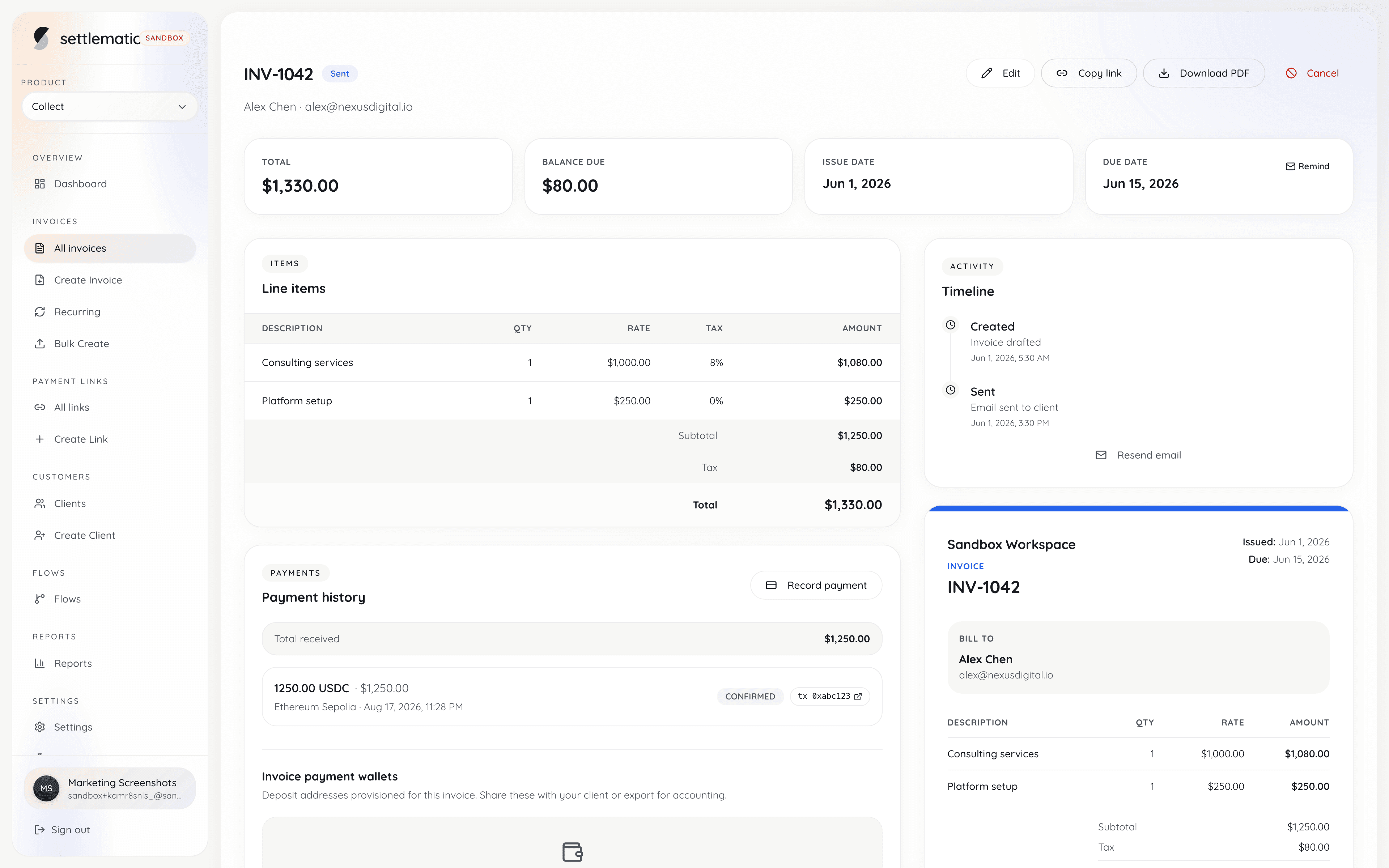
Stablecoins solved crypto's volatility problem for B2B billing. They did not solve the fragmentation problem. USDC exists on Ethereum, Base, Polygon, Arbitrum, Optimism, Solana, and more — and your clients hold balances on different networks depending on their exchange, wallet, and gas preferences. A merchant who accepts stablecoins on only one chain loses deals to friction.
This guide walks through the operational and technical decisions for multi-chain stablecoin acceptance without custodial intermediaries.
Why multi-chain stablecoin acceptance matters
Cross-border B2B payments increasingly settle in stablecoins because they clear faster than wire transfers and cost less than card networks for large invoices. But "pay in USDC" is ambiguous without a network specifier. Sending USDC on Ethereum to an address expecting Base deposits loses funds — or strands them in an incompatible format.
Professional invoicing removes ambiguity. The payer sees a fiat total, selects a supported network, and pays to a chain-specific deposit address derived for that invoice. Your reconciliation layer matches the on-chain transfer regardless of which chain they chose.
If you are new to the invoice model, start with what is a crypto invoice. Multi-chain acceptance is an extension of that foundation, not a separate product category.
Stablecoin selection: USDC, USDT, and EURC
Not all stablecoins serve the same merchant needs. Your acceptance policy should reflect client demand, regulatory comfort, and chain availability.
| Stablecoin | Primary use case | Chain breadth | Regulatory notes |
|---|---|---|---|
| USDC | USD-denominated B2B | Wide (EVM + Solana) | Circle-issued; strong US compliance posture |
| USDT | USD-denominated; high liquidity | Very wide | Popular in APAC; verify client preference |
| EURC | Euro-denominated B2B | Growing (EVM + Solana) | Circle euro stablecoin; useful for EU clients |
USDC is the default for US-dollar invoicing in 2026. Deep liquidity, broad chain deployment, and institutional familiarity make it the path of least resistance for American and global tech clients.
USDT remains dominant in certain markets. If your client base includes APAC traders or exchanges defaulting to Tether, supporting USDT reduces payment friction even if USDC is your treasury preference.
EURC matters when you invoice European clients who think in euros. Quoting €8,500 and accepting EURC eliminates mental conversion for the payer. Pair with custom branding for EU-facing professional presentation.
You do not need to accept every stablecoin on every chain. Start with USDC on two or three high-volume networks, expand based on payment data.
Chain selection: where to enable acceptance
Each chain trades off gas cost, confirmation speed, liquidity, and your clients' wallet distribution.
| Network | Typical gas cost | Confirmation speed | Best for |
|---|---|---|---|
| Ethereum mainnet | High | 12–15 sec/block | Large settlements; institutional wallets |
| Base | Low | ~2 sec | Coinbase-ecosystem clients; low-fee USDC |
| Polygon | Very low | ~2 sec | High-volume smaller invoices |
| Arbitrum | Low | ~0.25 sec | DeFi-native clients; Ethereum security |
| Optimism | Low | ~2 sec | OP-stack ecosystem users |
| Solana | Very low | Sub-second | Fast settlement; mobile-first payers |
Practical recommendation for most B2B merchants: Enable USDC on Base, Polygon, and Solana. Add Ethereum mainnet for large-ticket clients who insist on L1. Add Arbitrum and Optimism if your client survey shows demand.
The goal is coverage without operational chaos. Three to five networks handle the vast majority of stablecoin B2B volume in 2026.
Fiat-quoted invoicing: the client-facing layer
Never quote invoices in raw stablecoin amounts unless your contract explicitly denominates in crypto. Quote in USD, EUR, or GBP — whatever your client expects on a traditional invoice.
The workflow:
- Create invoice with fiat line items ($12,000 for Q3 development)
- System calculates stablecoin equivalent at payment time (or locks rate at issuance, depending on policy)
- Payer selects network and asset at checkout
- Unique deposit address binds to your settlement wallet on that chain
- On-chain detection marks invoice paid and records tx hash
This mirrors how best crypto invoicing for freelancers describes the ideal workflow: fiat familiarity for the client, stablecoin settlement for speed.
Volatility risk between quote and payment is minimal with stablecoins — unlike Bitcoin invoicing — but you should still define whether the crypto amount locks at invoice creation or at payment initiation. Lock-at-payment is more common for multi-day terms.
Non-custodial address binding across chains
Multi-chain acceptance must remain non-custodial. Each invoice derives a unique deposit address per chain, bound to your registered settlement destination. Funds confirm on-chain and land in wallets you control — never in a processor balance.
The custody test from custodial vs non-custodial processors applies per chain: if the platform disappeared after confirmation, would your USDC on Base still be yours? If yes, the architecture is sound.
Verify binding logic via security documentation and developer verification tools. Per-invoice addresses alone are insufficient proof — custodial processors also issue unique addresses while holding keys.
Treasury consolidation: the hard part
Accepting on six chains means receiving USDC in six wallets unless you consolidate. Consolidation strategies:
Option 1: Native multi-chain treasury. Maintain a business wallet on each chain you accept. Reconcile per-chain balances in accounting. Simplest operationally; fragmented treasury view.
Option 2: Primary chain with periodic bridging. Accept on all enabled chains; bridge to your primary treasury chain (often Base or Ethereum) on a schedule. Adds bridge risk and gas cost; unified treasury.
Option 3: Off-ramp per chain. Convert to fiat per chain via exchange or off-ramp provider. Useful when your operating expenses are fiat-denominated and you want minimal crypto treasury exposure.
None of these options require custodial invoicing. Your invoicing platform detects payments; consolidation is a treasury decision downstream.
Document your consolidation policy before enabling chains. Finance teams hate discovering six wallet addresses at tax time without a plan.
Setting up multi-chain acceptance step by step
Step 1: Register settlement wallets
Connect or configure the wallet addresses where confirmed payments should ultimately settle, per chain. Use dedicated business wallets — not personal MetaMask accounts. Settlematic Collect stores destination configuration; deposit addresses derive from it non-custodially.
Step 2: Enable assets and networks
Select USDC (and optionally USDT, EURC) on your chosen networks. Disable chains you are not prepared to reconcile. Fewer chains with clean records beats many chains with gaps.
Step 3: Configure invoice templates
Include standard commercial fields: line items, tax, due dates, payment terms. Apply custom branding so payment pages look professional across all chains.
Step 4: Test in sandbox
Run full payment cycles on testnet via the demo sandbox. Validate detection on each enabled chain. Confirm webhooks fire — see webhook patterns for crypto billing. Never launch mainnet multi-chain without sandbox proof.
Step 5: Educate clients
Send the first multi-chain invoice with a brief note: "You can pay in USDC on Base, Polygon, or Solana — select your network at checkout." Most B2B payers understand network selection if the UI guides them.
Step 6: Monitor and reconcile
Use automatic on-chain payment detection for real-time status. Export CSV rows with chain, asset, tx hash, and fiat equivalent for accounting.
API and automation for multi-chain billing
High-volume merchants integrate invoice creation and payment webhooks programmatically. The developer API supports creating fiat-quoted invoices, specifying accepted chains, and receiving invoice.paid events with chain metadata in the payload.
For recurring retainers across chains, combine multi-chain acceptance with recurring crypto invoice setup. Each billing cycle generates a new invoice with fresh deposit addresses per chain.
Settlematic Gateway extends the same multi-chain detection to embedded checkout flows if invoicing is not your primary interface.
Gas abstraction and payer experience
Your clients should not need to understand gas markets. Hosted payment pages display the network, expected amount, and a clear "Pay" flow. Some platforms surface estimated gas; others default to low-fee chains in the UI ordering.
If a client holds USDC only on Ethereum mainnet but your preferred treasury is Base, accept the L1 payment. Forcing bridge education on payers kills conversion. Treasury consolidation is your problem, not theirs.
Risk management across chains
Multi-chain acceptance introduces chain-specific risks:
- Wrong-chain deposits: Unique per-chain addresses prevent most cross-chain mistakes. Clear UI labeling prevents the rest.
- Bridge exploits: Consolidation via bridges carries smart contract risk. Use established bridges; consider native per-chain treasury for large balances.
- Stablecoin depeg: Historically rare for USDC/USDT but non-zero. Monitor Circle and Tether attestations; diversify if single-issuer exposure concerns you.
- Regulatory divergence: EU MiCA, US state money transmitter rules, and UK FCA guidance evolve independently. Stablecoin acceptance does not eliminate compliance obligations.
Review security architecture for how your invoicing provider handles detection integrity across chains.
Comparison: manual multi-chain vs integrated invoicing
| Approach | Setup time | Reconciliation | Client UX | Non-custodial |
|---|---|---|---|---|
| Static addresses per chain in email | Minutes | Manual tx matching | Poor; error-prone | Yes (if your wallets) |
| Spreadsheet + block explorer | Hours | Painful at volume | Poor | Yes |
| Multi-chain invoicing platform | Hours | Automatic | Professional payment page | Yes (verify binding) |
| Custodial processor | Minutes | Dashboard balance | Good | No (float risk) |
Manual approaches work for one invoice. They collapse at ten open invoices across three chains.
Enterprise considerations
Enterprises adding stablecoin payment options typically require:
- RBAC for finance vs engineering users
- Webhook delivery SLAs and retry guarantees
- Audit logs with tx hash immutability
- SOC 2 or equivalent security attestations
- Sandbox environments mirroring production chain config
Book a demo for enterprise multi-chain evaluation. Test webhook volume and export formats before contractual commitment.
Common mistakes to avoid
- Enabling every chain on day one. Start narrow; expand with data.
- Quoting in crypto instead of fiat. Confuses clients and accountants.
- Using one static wallet address. Cannot reconcile multiple open invoices.
- Skipping sandbox testing per chain. Each network has distinct confirmation behavior.
- Ignoring treasury consolidation. Six chains without a plan creates finance chaos.
- Assuming custodial is easier. Float and payout delays trade one problem for another.
Official USDC contract addresses by network
Detection and client education require canonical contract references. Whitelist only official deployments:
| Network | USDC contract / mint |
|---|---|
| Ethereum | 0xA0b86991c6218b36c1d19D4a2e9Eb0cE3606eB48 |
| Base | 0x833589fCD6eDb6E08f4c7C32D4f71b54bdA02913 |
| Polygon | 0x3c499c542cEF5E3811e1192ce70d8cC03d5c3359 (native) |
| Arbitrum | 0xaf88d065e77c8cC2239327C5EDb3A432268e5831 |
| Optimism | 0x0b2C639c533813f4Aa9D7837CAf62653d097Ff85 |
| Solana | EPjFWdd5AufqSSqeM2qN1xzybapC8G4wEGGkZwyTDt1v |
Publish this table in client onboarding materials — clients verifying token contract before send prevents fake token scams. Platform detection must match the same whitelist — automatic detection guide.
Phased rollout strategy for multi-chain acceptance
Do not enable six chains on day one. Recommended rollout:
| Phase | Networks enabled | Duration | Success criteria |
|---|---|---|---|
| Phase 1 | Base + Solana | 30 days | >95% auto-detection, <3% wrong-chain |
| Phase 2 | Add Polygon | 30 days | Reconciliation clean |
| Phase 3 | Add Arbitrum/Optimism | As needed | Client demand documented |
| Phase 4 | Ethereum L1 | Optional | Large invoices only |
Each phase includes sandbox testing, one production pilot client, and finance reconciliation review before expanding. Rollback plan: disable new chain in settings; existing open invoices on that chain complete normally.
Client-facing network selection UX
Payment page network ordering affects conversion:
- Default highlight — Pre-select network matching client's historical payments (if known).
- Fee hint — "Solana: lowest fees" subtle badge; do not shame Ethereum L1 users.
- Single-screen selection — Network choice before address display; never show all addresses simultaneously.
- Confirmation step — "You selected Base. Confirm before revealing address."
| UX pattern | Wrong-chain rate impact |
|---|---|
| All addresses shown at once | High — client picks wrong row |
| Sequential network selection | Low |
| Hosted link with deep link | Lowest for mobile |
A/B test network ordering quarterly — payment data beats intuition.
Treasury reporting across chains
Finance needs unified view despite fragmented on-chain balances:
Daily ops dashboard (build from exports + explorer APIs):
- USDC total across all chains (USD equivalent)
- Per-chain balance
- Open invoice AR by chain
- 7-day inflow by chain
Monthly close report:
- Revenue by chain (which networks clients actually use)
- Bridge costs (if consolidating)
- Gas expenses (merchant-paid sweeps)
Data informs chain policy — if 80% of payments arrive on Solana after 90 days, consider Solana-primary UX with EVM as secondary. Paying to maintain unused chain infrastructure wastes reconciliation attention.
Conclusion
Multi-chain stablecoin acceptance is the pragmatic response to fragmented liquidity. Quote in fiat, enable USDC (and EURC or USDT as needed) on Base, Polygon, Solana, and selected L2s, bind unique deposit addresses non-custodially, and let automatic detection handle reconciliation. Plan treasury consolidation before you enable chains, test every network in the demo sandbox, and export clean records for finance.
Settlematic Collect implements this workflow without custodial float. Explore pricing, read the security model, and start with one chain if you must — but build the architecture for multi-chain from the start.
Frequently asked questions
- Which stablecoin should I accept first?
- USDC on Base and Polygon covers most US-dollar B2B demand in 2026. Add EURC if you invoice EU clients in euros. Add USDT if your client base specifically requests it.
- Do I need a wallet on every chain?
- You need a settlement destination registered per chain you accept. Whether you maintain balances on each chain or consolidate via bridging is a treasury policy decision.
- How does fiat quoting work with multi-chain checkout?
- You invoice $5,000. At payment, the payer selects USDC on Solana. The system displays the stablecoin amount (approximately 5,000 USDC) and a Solana-specific deposit address. Detection reconciles the payment to invoice INV-2026-0042 regardless of chain.
- Is multi-chain acceptance custodial?
- Not inherently. Non-custodial multi-chain invoicing derives per-invoice addresses bound to your wallets. Custody depends on architecture, not chain count. Read what is non-custodial crypto invoicing.
- What happens if a client pays on the wrong chain?
- Proper invoicing systems use chain-specific deposit addresses, making wrong-chain sends unlikely. If a client manually sends to an incorrect network, recovery depends on whether the address exists on that chain — often a support nightmare. Clear payment UI prevents this.
- Can I automate multi-chain invoicing via API?
- Yes. Create invoices programmatically, specify accepted chains, and consume webhooks on payment. See developer documentation and invoice paid webhook guide.