How to Invoice Clients in Crypto: The Definitive Guide (2026)
Master crypto invoicing for global clients: fiat-quoted billing, line items, non-custodial settlement, tax compliance, and recurring schedules.
Do this next
Create a crypto invoice
- Quote the invoice in fiat.
- Client pays USDC, USDT, or EURC.
- Funds settle to a wallet you already control.
Invoice clients in crypto by quoting the bill in fiat (USD/EUR/GBP), sending a hosted payment link with a locked crypto amount, and settling to a non-custodial wallet you control. [Settlematic Collect](/products/collect) automates detection, partial payments, and reconciliation.
TL;DR
To invoice clients in crypto, generate a fiat-denominated invoice (USD/EUR/GBP), include itemized line items and tax rules, send a hosted payment link that quotes real-time crypto rates, accept multi-chain stablecoins or native crypto, settle funds directly to self-custody wallets, and export transaction-level audit records for tax compliance.
To invoice clients in crypto, generate a fiat-denominated invoice (USD/EUR/GBP), include itemized line items and tax rules, send a hosted payment link that quotes real-time crypto rates, accept multi-chain stablecoins or native crypto, settle funds directly to self-custody wallets, and export transaction-level audit records for tax compliance.
Invoicing international clients in cryptocurrency has shifted from an edge-case request by Web3 startups to a mainstream payment preference for digital agencies, software consultancies, freelance contractors, and cross-border service providers. Traditional international bank wires take 3 to 5 business days, incur $30–$75 bank transfer fees, and expose both parties to unpredictable intermediate correspondent banking fees and foreign exchange markups.
Crypto invoicing solves these cross-border friction points by delivering near-instant settlement, fraction-of-a-cent network fees on Layer 2 blockchains, and 24/7/365 payment processing. However, issuing manual PDF invoices with static wallet addresses creates massive accounting headaches, tax compliance risks, and underpayment disputes. In this comprehensive guide, we cover the exact end-to-end framework for invoicing clients professionally in crypto.
The challenge with static wallet addresses on invoices
When merchants first begin accepting crypto, a common mistake is pasting a static Ethereum or Bitcoin wallet address onto a standard PDF invoice. While simple, this manual approach breaks down quickly at operational scale:
- Price Volatility Risk: If you invoice $5,000 USD and quote 1.8 ETH, a 10% market dip before the client pays leaves you underfunded relative to your contract value.
- Reconciliation Confusion: If five clients send 1,000 USDC to the exact same public wallet address, identifying which client paid which invoice requires tedious manual transaction timestamp matching.
- Privacy Leaks: Publishing a static wallet address on public invoices allows anyone to inspect your entire wallet history, total balance, and vendor payments on public block explorers.
- Network Mismatches: Clients frequently attempt to send Polygon USDC to an Ethereum mainnet address or native USDT to a smart contract address, resulting in lost funds or complex recovery efforts.
To eliminate these vulnerabilities, modern crypto billing relies on dedicated non-custodial billing platforms like Settlematic Collect, which combine fiat-denominated billing logic with dynamic, address-bound on-chain settlement.
Step 1: Quote invoices in fiat currency (USD, EUR, GBP)
Unless your business exclusively operates a tokenized treasury, legal contracts and tax obligations require denominating revenue in fiat currencies (e.g., USD, EUR, GBP).
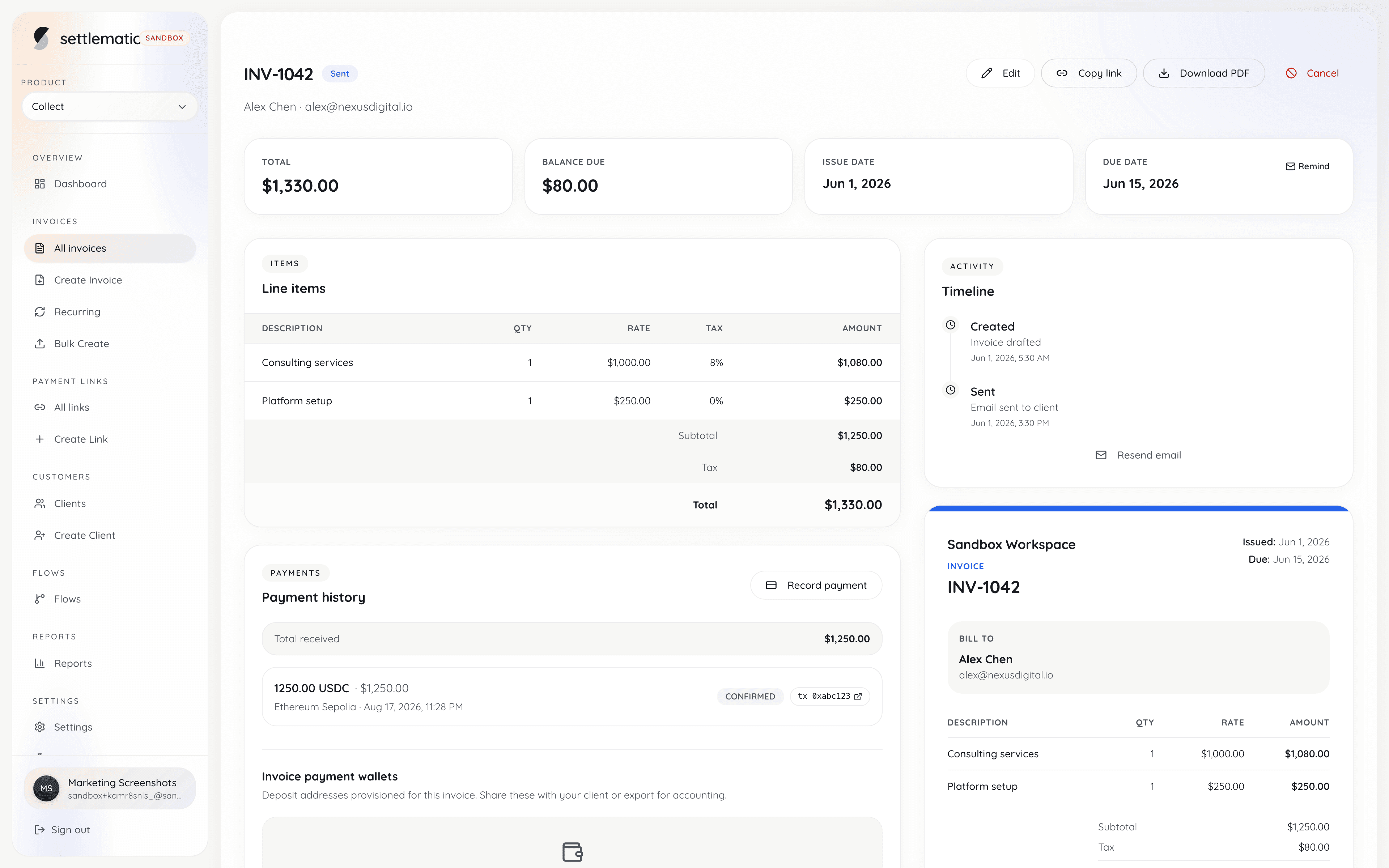
When creating an invoice in Settlematic, set your base currency in USD, EUR, or GBP. Add itemized line items, unit prices, quantity, and tax rates. Your accounting ledger tracks the exact fiat revenue owed. When the client opens the hosted payment link, Settlematic calculates the exact crypto equivalent using live market oracle feeds at the precise moment of payment. If you frequently accept USDT, see our guide on how to accept USDT payments.
Step 2: Build a compliance-ready crypto invoice structure
Tax authorities around the globe—including the IRS (US), HMRC (UK), ATO (Australia), and CRA (Canada)—treat cryptocurrency received as payment for services as taxable business income recognized at the fair market value in local fiat currency on the date of receipt.
To withstand tax audits and maintain clean bookkeeping, every crypto invoice issued must contain standardized accounting fields. You can reference our complete crypto invoice template guide for a deep dive on required invoice structure.
| Invoice Section | Required Data Fields | Crypto Invoicing Purpose |
|---|---|---|
| Merchant Information | Legal entity name, business address, Tax ID / VAT number | Establishes legal issuer identity for cross-border tax treatment. |
| Client Information | Client legal name, company name, billing email, address | Required for Travel Rule compliance and corporate tax expense deductions. |
| Billing Terms | Invoice date, due date, payment terms (Net 14, Net 30, Due on Receipt) | Triggers late-fee calculations or early payment discounts on smart invoices. |
| Line Items & Tax | Description of services, quantity, unit rate, applicable VAT / GST rate | Ensures clear contractual scope and accurate indirect tax calculations. |
| Hosted Payment Link | Dynamic URL with rate-locked multi-chain asset selection | Eliminates static wallet address risks and automates deposit detection. |
Step 3: Send hosted payment links to clients
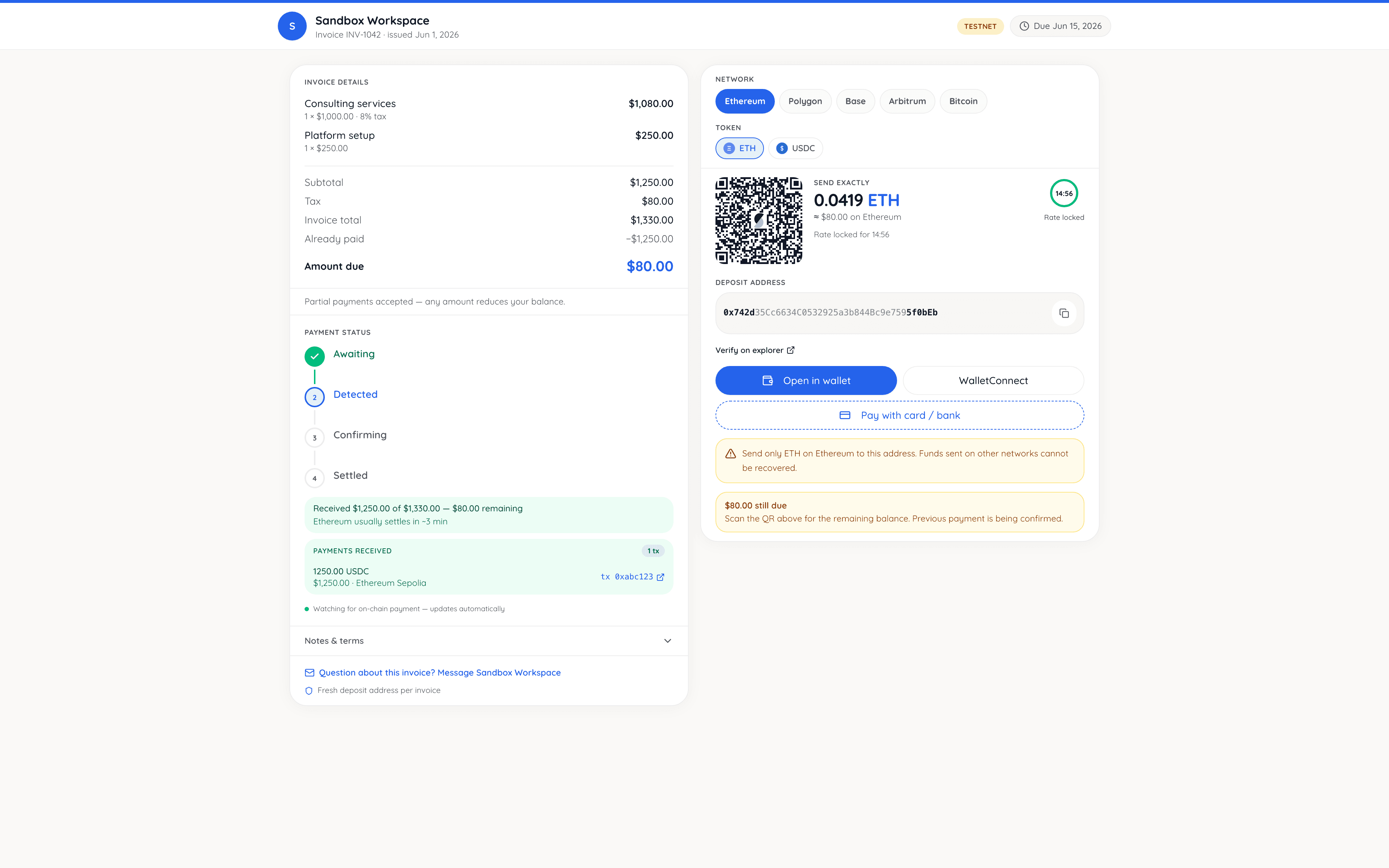
Instead of emailing static PDF attachments, deliver a dynamic hosted payment link to your client. When the client clicks the link, they access a responsive, mobile-optimized checkout interface customized with your business logo, brand colors, and invoice details.
The client chooses their preferred payment asset (USDC, USDT, EURC, ETH, BTC) and network (Ethereum, Polygon, BSC, Solana, Tron, Bitcoin). Settlematic locks the exchange rate for a 15-minute window and presents a clear QR code and copyable deposit address. The client can pay directly from any self-custody wallet (e.g. MetaMask, Phantom, Trust Wallet) or exchange account (e.g. Coinbase, Kraken, Binance).
Step 4: Ensure non-custodial address-bound settlement
A major strategic distinction in crypto billing is how funds reach your treasury. Custodial billing tools receive payment into an intermediary custodial balance, holding your revenue until daily or weekly bank settlement cycles. If the processor experiences operational holds or account freezes, your funds can be locked indefinitely.
Settlematic operates on a true non-custodial model. Every invoice generated binds deposit addresses directly to your configured settlement wallet using BIP-84 HD wallet derivation or CREATE2 counterfactual smart contract address binding. When your client broadcasts their payment to the blockchain, the funds land directly in your wallet.
- Direct Wallet Delivery: Funds go directly from client to your cold or hot wallet.
- Zero Intermediary Risk: Settlematic never holds private keys and cannot freeze or hold funds.
- Instant On-Chain Confirmation: Watch-only indexing nodes track payment status in real time.
- No Payout Step: Eliminates multi-day payout waits and minimum payout thresholds.
Step 5: Handle partial payments, smart invoices, and late fees
In real-world business billing, clients don't always pay invoices in a single exact transaction. They may underpay due to forgotten network gas fees, make partial installment payments, or pay late.
Settlematic Collect provides configurable smart invoice settings to manage these payment nuances automatically:
- Partial Payment Support: Allow clients to pay invoices in tranches. The hosted payment link updates the remaining balance due automatically upon each on-chain confirmation.
- Early Payment Discounts: Configure smart tiers (e.g. 3% discount if paid 7 days before due date) to incentivize early cash flow.
- Automated Overdue Late Fees: Set escalating late-fee percentages (e.g. 2% fee after 1 day overdue, 5% after 14 days) based on calendar days relative to the due date.
- Underpayment Reconciliation: If a client pays $995 on a $1,000 invoice, the invoice marks as PARTIALLY_PAID with a clear $5 balance remaining, preventing accidental invoice closure.
Step 6: Automate reconciliation and month-end accounting
For corporate finance teams and freelance professionals alike, manual crypto reconciliation is a major bottleneck. Independent contractors and agency owners should review our targeted guide on [crypto invoicing for freelancers](/blog/best-crypto-invoicing-for-freelancers) for specific workflow tips.
Settlematic automates the entire reconciliation lifecycle. When an on-chain payment is confirmed, Settlematic fires webhooks and records an audit log linking the original fiat invoice amount, the exact crypto asset received, the blockchain network, the transaction hash, and the exact timestamp. You can export date-filtered CSV or PDF reports pre-formatted for accounting software like QuickBooks, Xero, or custom ERPs.
Step 7: Automate recurring retainer billing
If you manage monthly agency retainers, software maintenance agreements, or subscription consulting contracts, manually re-creating invoices every month wastes valuable administrative time.
With Settlematic Collect, you can set up recurring invoice schedules on WEEKLY, MONTHLY, QUARTERLY, or YEARLY intervals. The system automatically creates the new fiat-denominated invoice on schedule, pre-fills line items and tax rules, and emails the hosted payment link directly to your client. You maintain predictable subscription cash flow while benefiting from crypto settlement.
Crypto invoicing comparison: Settlematic vs. Traditional vs. Custodial
To summarize the operational advantages, let's compare Settlematic against traditional bank invoicing and custodial crypto processors:
| Comparison Axis | Traditional Bank Wires | Custodial Crypto Processors | Settlematic Collect |
|---|---|---|---|
| Settlement Speed | 3 to 5 business days | 1 to 3 business days (batch) | Instant on-chain confirmation |
| Transaction Fee | $30–$75 per wire + FX fee | 1% – 2% + per-invoice fee | Flat subscription from $20/mo (0% fee) |
| Custody Risk | Central bank intermediary | High (processor holds funds) | Zero (Direct non-custodial wallet delivery) |
| Recurring Schedules | Manual wire setup per month | Limited or manual | Automated weekly/monthly recurring engine |
| Supported Chains | N/A (Fiat only) | Selected coins on custodial rails | Ethereum, Polygon, BSC, Solana, Tron, Bitcoin |
| Accounting Audit Trail | Bank statements only | Processor internal ledger | Complete on-chain tx hash + PDF receipts |
Start invoicing your clients in crypto today
Invoicing clients in crypto does not have to be a risky, manual process. By leveraging fiat-quoted billing, automated hosted payment links, non-custodial wallet settlement, and real-time reconciliation, you can offer a seamless payment experience while maintaining complete control over your business treasury.
Explore Settlematic Collect to start creating professional crypto invoices in under 15 minutes. Try our free sandbox environment in the demo or check our simple flat-rate pricing to get started today.
Sources
Frequently asked questions
- How do I protect my business from crypto price volatility when invoicing?
- Bill your client in a stable fiat currency (USD, EUR, or GBP) and let your invoicing software convert the amount into crypto at the exact moment of payment, or require payment in stablecoins like USDC or USDT.
- Can I send recurring crypto invoices for retainer clients?
- Yes. Platform tools like Settlematic Collect support automated weekly, monthly, or annual recurring invoice generation that emails hosted payment links to retainer clients on schedule.
- Do my clients need a special crypto app or account to pay my invoice?
- No. Clients simply click your hosted payment link, choose their preferred network and coin, and scan a QR code or transfer funds from any self-custody or exchange wallet.
- What tax information must be included on a crypto invoice?
- A compliant crypto invoice must list merchant and client legal names, addresses, tax IDs, invoice date, fiat billing currency, itemized goods or services, applicable VAT/sales tax, and payment terms.
- How are non-custodial crypto invoices settled?
- Non-custodial invoices bind deposit addresses directly to your private cold or hot wallet at issuance. Funds settle instantly on-chain without going through an intermediary ledger or payout delay.