How to Invoice a Client in USD and Get Paid in Crypto
Quote invoices in USD while receiving USDC or other crypto — FX handling, client UX, stablecoin settlement, partial payments, and accounting records. Step-by-step for B2B billing.
Do this next
Create a crypto invoice
- Quote the invoice in fiat.
- Client pays USDC, USDT, or EURC.
- Funds settle to a wallet you already control.
To invoice a client in USD and get paid in crypto, issue a fiat-denominated invoice with a locked exchange rate, let the client pay the equivalent in USDC, USDT, ETH, or BTC on a chain they hold, and record the USD value at receipt for your books. Settlematic Collect does this with a unique address per invoice bound to your own wallet.
TL;DR
Invoice in USD (or EUR) for client familiarity; receive settlement in USDC on your chosen network. The invoicing platform converts display amount to a live crypto quote at payment time, binds a unique deposit address, and detects on-chain payment. You record USD fair market value at receipt for taxes. Settlematic Collect implements this pattern natively — no manual spreadsheet FX.
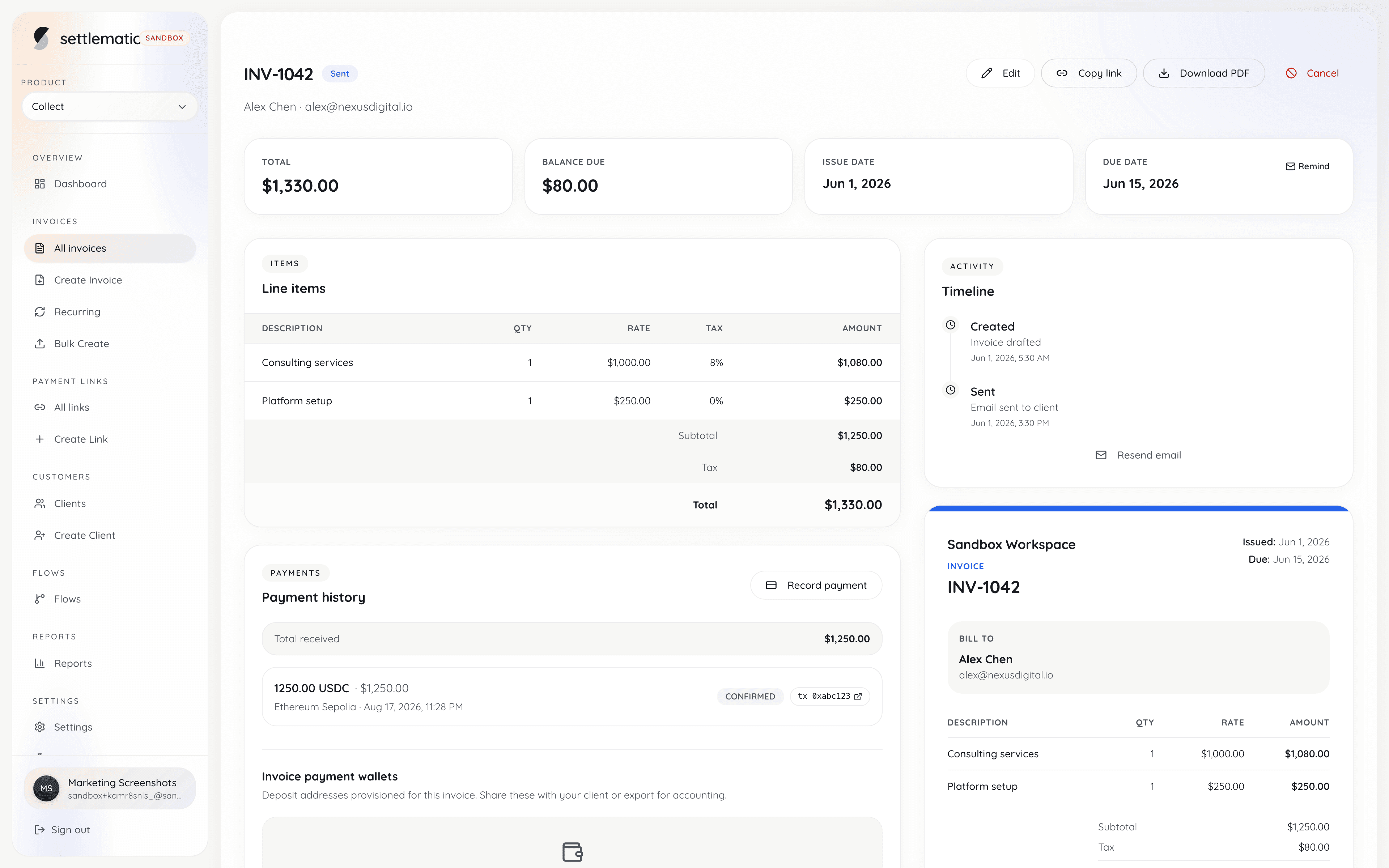
The most successful B2B crypto billing pattern in 2026 is not "invoice 0.5 ETH." It is "Invoice #1042 — $12,500.00 USD — Pay in USDC." The client sees dollars; treasury sends stablecoins; you receive assets pegged to the quoted amount; your books stay in fiat terms you already understand.
This guide walks through why USD-quoted / crypto-settled invoicing works, how to set it up, what clients experience, and how to handle edge cases without damaging relationships or audit trails.
Why quote fiat and settle crypto
| Stakeholder | Need | USD quote satisfies |
|---|---|---|
| Client AP | Budget in fiat | ✓ |
| Client treasury | Pay from USDC balance | ✓ (payment layer) |
| You (merchant) | Predictable contract value | ✓ |
| Your accountant | FMV in functional currency | ✓ (with export) |
| Auditors | Traceable obligation vs payment | ✓ (invoice + tx hash) |
Quoting directly in BTC or ETH reintroduces volatility disputes: "Bitcoin dropped 8% between invoice date and due date — we agreed on $12,500, not this token price."
Stablecoins collapse that gap. 1 USDC ≈ 1 USD for practical B2B purposes.
The mechanics: three timestamps
Understanding three moments prevents confusion:
| Timestamp | What happens |
|---|---|
| Invoice creation | USD amount fixed ($12,500). Contract obligation set. |
| Payment initiation | Client opens link; platform shows USDC amount from live quote |
| On-chain confirmation | USDC arrives; invoice marks paid; you record receipt |
For USDC, quote at payment time typically equals invoice USD amount minus zero — display shows 12,500 USDC. If accepting volatile assets (optional), quote locks briefly at checkout.
Step-by-step setup
Step 1: Configure display currency
In Settlematic Collect, set default invoice currency to USD (or EUR for EU clients). Line items, subtotals, and PDF totals display in fiat.
Step 2: Enable settlement assets and networks
Recommended default:
- Asset: USDC
- Networks: Base + Solana (low fees, broad exchange support)
Add Polygon for EURC if billing EU clients in euros — EURC patterns if available in your stack.
Step 3: Register settlement wallet
Non-custodial settlement to wallet you control. Each invoice gets unique deposit address bound to this wallet (address-bound settlement).
Step 4: Create USD invoice
Standard fields per what is a crypto invoice:
- Client legal name
- Line items in USD
- Due date, terms
- Total: $12,500 USD
Platform generates payment link showing crypto settlement instructions.
Step 5: Deliver to client
Email template:
> Attached is Invoice #1042 for $12,500.00 USD for [services]. Payment accepted in USDC via the secure link below. The link displays the exact USDC amount and network options. On-chain confirmation serves as payment receipt.
Attach PDF; include link. Corporate clients forward to treasury.
Step 6: Client pays from treasury or exchange
Client workflow:
- Open payment link
- Select network (Base recommended for US clients)
- Send USDC from Coinbase, Fireblocks, MetaMask, or Phantom
- Save transaction hash for their AP records
You receive notification when detection confirms.
Step 7: Bookkeeping entry
Record:
- Debit: USDC asset account $12,500
- Credit: Revenue $12,500
Or single USD revenue line if accountant treats USDC as USD equivalent. Jurisdiction-specific — share accountant guide.
Client UX: what non-crypto AP teams see
Good payment pages minimize crypto jargon:
- Large fiat amount: $12,500.00 USD
- Subtext: Pay with USDC
- Network selector with logos
- Copy address / QR / wallet connect
- Status: Awaiting payment → Confirming → Paid
Bad payment pages:
- Only show 0x address without context
- Only quote ETH with no USD anchor
- No network guidance (wrong-network payments follow)
Send AP teams the demo link preview during sales process if they are skeptical.
Contract language to add
Include in MSA or SOW:
> Payment due in US Dollar equivalent via USD Coin (USDC) on [approved networks]. Invoice amounts denominated in USD. Merchant will provide payment instructions including deposit address via Settlematic or equivalent invoicing platform. Payment complete upon on-chain confirmation of full invoice amount.
Adjust with counsel for your jurisdiction.
Handling FX when functional currency is not USD
If you are UK-based billing USD but functional currency is GBP:
- Invoice still quotes USD per contract
- USDC received — record GBP FMV at receipt using HMRC/CCH rates or oracle timestamp
- Export tx hash + timestamp for conversion audit
EUR businesses billing USD clients: same discipline. Stablecoin reduces but does not eliminate FX reporting when functional currency differs from invoice currency.
EUR invoice, USDC payment variant
EU clients sometimes want EUR-denominated PDFs:
| Display | Settlement |
|---|---|
| €9,200 EUR | EURC on Polygon OR USDC with live EUR/USD quote |
EURC where available avoids conversion ambiguity. See stablecoin cross-border guides in related content.
Partial payments and tolerance
| Scenario | Policy |
|---|---|
| 12,499 USDC on 12,500 invoice | Configure tolerance (e.g., ±$1) or require exact |
| Client sends 12,000 — negotiates | Partial paid; follow up for 500 |
| Client sends 13,000 | Overpayment — credit memo next cycle |
Document tolerance in payment terms. Exact-match requirements frustrate clients paying from exchanges with withdrawal fees.
Volatile asset settlement (optional)
Some merchants accept ETH/BTC with live quote at checkout:
- Invoice: $12,500 USD
- At payment: "Send 3.842 ETH" (15-minute quote window)
Adds volatility window risk. Stablecoins remain default for B2B — best freelancer invoicing discusses choice.
Comparison: USD invoice methods
| Method | Client UX | Your reconciliation | Custody |
|---|---|---|---|
| Wire in USD | Familiar | Bank statement | Bank |
| USD invoice + USDC (Collect) | Payment link | Automatic | Non-custodial |
| Manual USD invoice + static USDC address | Confusing | Manual | Non-custodial |
| Custodial processor USD invoice | Dashboard balance | Platform export | Custodial float |
Pricing and fees
Your client pays network gas (small on Base/Solana). You pay platform subscription or take-rate — compare pricing. No hidden FX spread if USDC 1:1 with USD invoice.
Tax reporting
USD face value at receipt for USDC. Aggregate monthly for tax time reporting. Invoice PDF + tx hash = audit trail.
Recurring USD invoices, crypto settlement
Retainers bill $4,500 USD monthly, settle USDC each cycle — recurring crypto invoices. Each cycle new address; same USD amount.
Security
- Verify payment link domain before clients pay (phishing)
- Non-custodial binding prevents redirect
- Security overview
Enterprise AP onboarding for USD invoices with crypto settlement
Corporate accounts payable teams need extra hand-holding on first payment:
| AP concern | Your response |
|---|---|
| "Is this legitimate?" | Share company registration + W-9/W-8 + official domain invoice link |
| "Our policy allows USD wire only" | Clarify invoice is USD-denominated; USDC is settlement rail equivalent to wire |
| "We need PO number on invoice" | Include client PO in invoice metadata field |
| "Treasury requires dual approval" | Payment link stays open 14+ days for multisig treasury workflow |
| "Audit wants bank reference" | On-chain tx hash is stronger proof than wire memo — provide explorer link |
Schedule 15-minute AP walkthrough on demo sandbox showing payer UX before first live invoice.
Multi-currency client bases
US clients: USD invoice + USDC default. EU clients: EUR invoice + EURC where supported, or USD invoice if contract specifies dollars. UK clients post-Brexit often prefer USD or EUR explicitly stated in SOW — never assume.
Document functional currency in contract to prevent disputes when client functional currency differs from invoice currency.
Integration with existing quote-to-cash stack
| Stage | USD quote + crypto settle |
|---|---|
| CRM quote approved | API creates draft invoice |
| SOW signed | Invoice sent automatically |
| Payment detected | Webhook closes CRM opportunity |
| Revenue recognized | Export to ERP |
Connects invoice paid webhooks to Salesforce, HubSpot, or custom Postgres — USD amount in CRM matches on-chain USDC 1:1 for stablecoin settlement.
Common USD invoice disputes and prevention
| Dispute | Prevention |
|---|---|
| "Amount differed from PDF" | PDF shows USD; link shows live USDC — footnote rate at payment |
| "We paid but you didn't ship" | Webhook-triggered fulfillment logs timestamp vs payment |
| "Wrong network" | Payment page network lock with confirmation modal |
| "Late fee on crypto payment" | Detection timestamp is objective receipt time — document in terms |
White-label payment pages for enterprise clients
Enterprise vendors billing Fortune 500 clients may need logo, color, and custom domain on payment pages — confirm branding options in Collect settings before RFP response. AP teams trust branded pages over generic checkout — reduces phishing suspicion and speeds first payment.
Sample client email for first USD crypto invoice
> Hi [AP contact] — Invoice #1042 for $12,500.00 USD is attached. Please pay via the secure link (USDC accepted on Base or Solana). The page shows the exact amount and step-by-step instructions. Reply if your treasury needs a walkthrough — we use Settlematic for verifiable on-chain receipt. Payment confirmation is automatic upon blockchain confirmation.
Volume pricing for high-USD invoice merchants
Merchants billing $500k+ annually in USD-quoted crypto invoices should compare flat pricing against 1% take-rate processors — savings compound at volume. Non-custodial settlement removes float risk that custodial take-rate models still carry.
Treasury operations for USD-quoted crypto receipts
Corporate treasuries receiving USDC against USD invoices need a documented sweep policy. Many teams leave invoice settlement wallets operational during the month and sweep to cold storage or institutional custody after month-end reconciliation. Others sweep daily above a threshold (for example, $25,000) to limit hot-wallet exposure. The policy should specify which chains trigger sweeps, who holds signing keys, and whether bridge consolidation happens before or after sweep. USD-quoted invoices simplify treasury reporting because each receipt maps to a known dollar obligation — the on-chain USDC balance at month-end should approximate open AR plus recent receipts, not a mystery pile of mixed obligations.
Treasury should also define which networks are approved for client payment versus which are accepted only for operational convenience. A USD invoice might display Base and Solana as payment options while treasury standardizes on Base for accounting exports. Document that internal policy so finance does not reconcile Solana receipts against a Base-only QuickBooks USDC account without a transfer journal entry.
Working with client procurement and vendor onboarding
Enterprise clients often require vendor onboarding before first USD invoice payment. Expect requests for W-9 or W-8BEN-E, proof of business registration, insurance certificates, and a completed vendor profile in their AP portal. Crypto settlement does not bypass procurement — it adds a payment-rail question. Provide a one-page payment instructions PDF alongside the standard vendor packet explaining that the invoice is USD-denominated, settlement is USDC on approved networks, and on-chain confirmation serves as payment receipt. Link to your hosted payment page screenshot so AP reviewers see a professional interface, not a raw wallet address.
If procurement asks whether you are a money transmitter or custodial processor, clarify that you invoice as a service provider and receive payment directly to wallets you control via non-custodial invoicing software. You are not asking their treasury to custody funds on your behalf. That distinction frequently unblocks security questionnaires that assume all crypto vendors operate like exchanges.
Measuring success after your first USD crypto invoice cycle
Track operational metrics after the first full billing cycle to justify expanding USD-quoted crypto invoicing:
| Metric | Target (mature ops) | Why it matters |
|---|---|---|
| Days sales outstanding (DSO) | Lower than wire baseline | Crypto settlement speed |
| Wrong-network rate | Under 2% of payments | Client education effectiveness |
| AP support tickets per invoice | Under 0.1 | Payment UX clarity |
| Reconciliation exceptions | Zero unresolved at month-end | Finance confidence |
| Client payment method adoption | 80%+ pay via link | Reduced manual chasing |
Review metrics monthly for the first quarter. If DSO improves but wrong-network rate spikes, invest in payment-page network lock and AP walkthroughs rather than abandoning crypto settlement. If reconciliation exceptions cluster around timezone cutoff, align export filters with your CPA's cash-basis policy before year-end.
Scaling USD invoicing across multiple entities
Agencies and holding companies with multiple legal entities must map each entity to its own settlement wallet and invoice branding in Settlematic Collect. A USD invoice from Entity A must never bind to Entity B's wallet — auditors treat that as commingling even if both entities share ownership. Configure separate organizations or sub-accounts per legal entity, each with distinct invoice numbering sequences, tax IDs on PDFs, and webhook routing to entity-specific ERP ledgers. Cross-entity client relationships (parent pays for subsidiary services) still require explicit intercompany documentation on the invoice; crypto settlement does not replace transfer pricing records.
Invoicing in USD while getting paid in crypto gives clients fiat clarity and gives you stablecoin speed without volatility arguments. Configure Settlematic Collect, send PDF plus payment link, and let detection reconcile on-chain USDC to your USD invoice automatically. Preview payer UX in the demo and compare pricing before your next enterprise SOW.
Frequently asked questions
- Does invoicing in USD mean I must accept wire instead of crypto?
- No. USD is the denomination of the obligation; crypto is the settlement rail. Offer both if needed.
- What if USDC depegs during payment?
- Rare for USDC. If depeg occurs, contract terms govern — most B2B invoices treat 1 USDC = 1 USD within reasonable tolerance. Enterprise treasuries monitor peg.
- Can clients deduct crypto payments as business expenses?
- Client-side tax question — generally yes for legitimate service expenses at FMV. They need your invoice PDF.
- Do I show exchange rate on PDF?
- For stablecoin USDC matching USD, optional footnote: "Payment accepted in USDC equivalent to USD amount at time of payment."
- How do I invoice USD but give client an ETH option?
- Platform live quote converts USD to ETH at checkout. Warn about quote expiry and volatility.
- What networks should I offer for USD corporate clients?
- Base and Solana cover most 2026 USDC treasury setups. Add Polygon for EU.
- Can API create USD invoices programmatically?
- Yes — amount in cents USD, settlement config in API body. Webhook on paid.