How to Accept USDT Payments for Business (2026 Guide)
Accept USDT payments across Tron, Solana, Polygon, BSC, and Ethereum with zero percentage fees, non-custodial wallet settlement, and fiat-quoted invoices.
Do this next
Create a crypto invoice
- Quote the invoice in fiat.
- Client pays USDC, USDT, or EURC.
- Funds settle to a wallet you already control.
TL;DR
To accept USDT payments, businesses can use a non-custodial crypto payment platform like Settlematic to generate fiat-quoted invoices or payment links. Customers pay USDT across Tron, Solana, Polygon, BSC, or Ethereum. Funds land directly in your wallet without intermediary holding periods, custody risks, or percentage transaction fees.
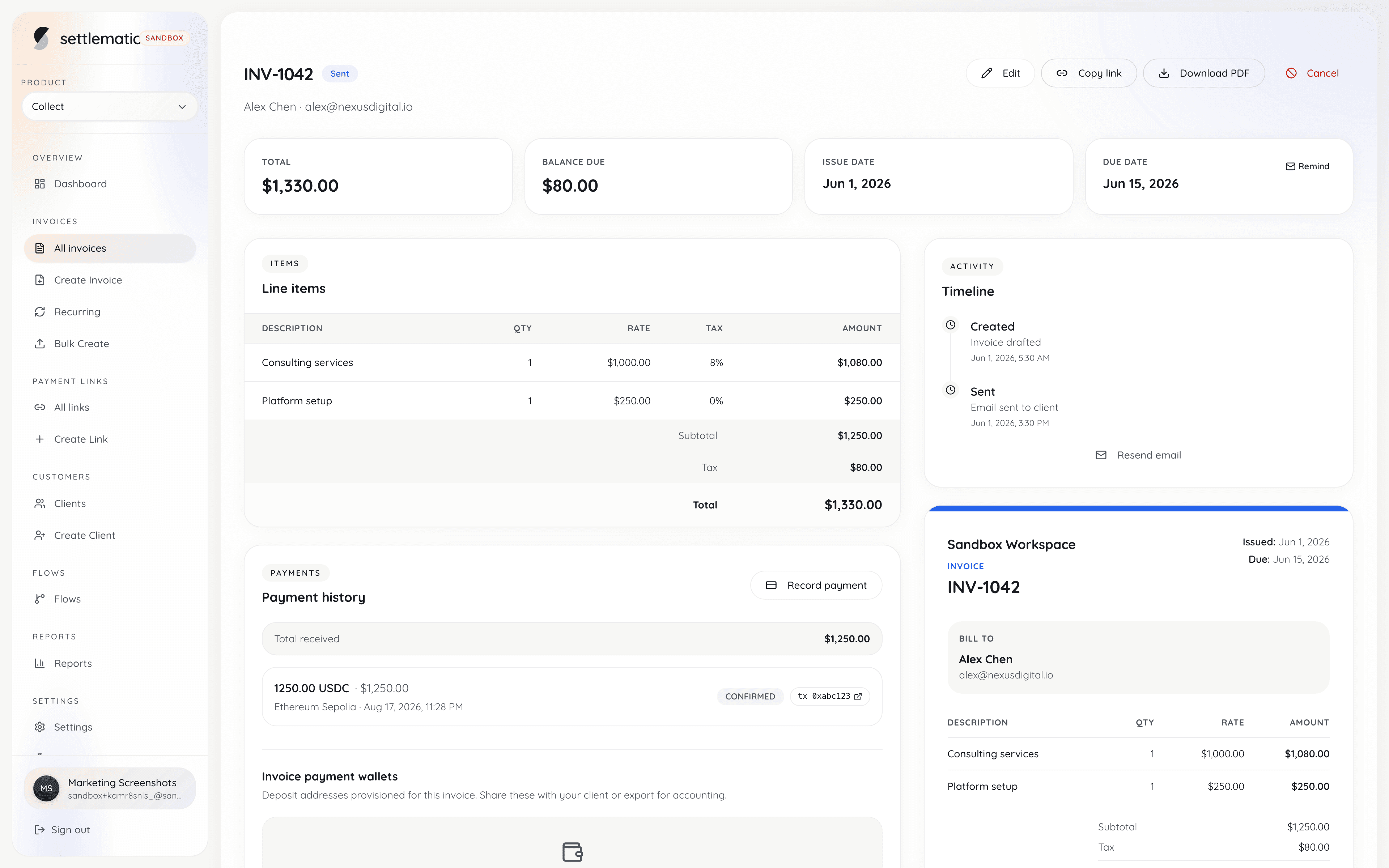
To accept USDT payments, businesses can use a non-custodial crypto payment platform like Settlematic to generate fiat-quoted invoices or payment links. Customers pay USDT across Tron, Solana, Polygon, BSC, or Ethereum. Funds land directly in your wallet without intermediary holding periods, custody risks, or percentage transaction fees.
Tether (USDT) remains the world's largest stablecoin by market capitalization and daily trading volume. For cross-border suppliers, digital service providers, freelancers, and Web3 companies, USDT represents the primary medium of exchange in international digital commerce. However, accepting USDT efficiently requires choosing the right blockchain networks and avoiding heavy custodial processor commissions.
Why businesses accept Tether (USDT) for payments
Accepting credit cards or international SWIFT wire transfers for global commercial billing incurs significant friction: 3% to 5% card processing commissions, $25 to $50 wire fees per transfer, multi-day settlement delays, and aggressive currency conversion margins. USDT offers a dollar-pegged alternative that clears on public blockchains in seconds or minutes.
Key commercial advantages of accepting USDT include:
- Global liquidity and client adoption: USDT is widely held by international contractors, Web3 firms, and cross-border buyers across Asia, Europe, Latin America, and Africa.
- Zero payment rolling reserves: Unlike traditional merchant payment processors, blockchain transactions cannot be retroactively reversed or placed in chargeback holds.
- Multi-chain flexibility: USDT operates natively across high-throughput blockchains like Tron and Solana, reducing transaction costs to pennies.
- Dollar purchasing power stability: Quoting invoices in USDT protects both buyer and seller from the price volatility of un-pegged crypto assets like Bitcoin or Ether.
Supported USDT blockchains and network fee breakdown
USDT exists as a smart contract token on several major blockchains. When accepting USDT payments, offering multi-chain options ensures your clients can pay using their preferred network without encountering prohibitive gas fees.
| Blockchain Network | Token Standard | Avg. Gas Fee | Confirmation Speed | Primary Business Use Case |
|---|---|---|---|---|
| Tron | TRC-20 | $1.00 - $2.50 | 3 - 6 seconds | High-volume cross-border payments & international transfers |
| Solana | SPL USDT | < $0.01 | 400 milliseconds | Micropayments, quick checkout, low-value invoices |
| Polygon | ERC-20 | $0.02 - $0.10 | 2 - 5 seconds | E-commerce checkout, SaaS subscriptions, low-cost L2 |
| BNB Chain (BSC) | BEP-20 | $0.10 - $0.30 | 3 seconds | Regional Asian & Middle Eastern commercial payments |
| Ethereum | ERC-20 | $2.50 - $15.00+ | 12 - 15 seconds | Institutional transfers, large enterprise contracts |
While Ethereum L1 is widely trusted by institutional treasury teams, networks like Tron and Solana handle the majority of operational USDT transfer volume due to minimal transaction overhead. Settlematic supports USDT deposits across all five networks.
How fiat-quoted USDT invoicing works
Billing directly in a set quantity of crypto creates accounting headaches when exchange rates shift between invoice issuance and payment. Settlematic resolves this through fiat-quoted invoicing.
When you issue an invoice for $5,000 USD, Settlematic queries live price feeds at the moment your client opens the payment link. The system displays the exact amount of USDT required on their chosen network. Once the client sends the transaction, Settlematic verifies the confirmation on-chain, reconciles the exact invoice amount, and fires a payment confirmation webhook.
For detailed tax compliance in specific regions, see our compliance guides on how to accept crypto payments in India and comparing USDC vs. USDT for business.
Non-custodial vs. custodial USDT processors
Traditional crypto payment gateways operate on a custodial model: they receive your client's USDT into their company wallet, hold the balance on an internal ledger, charge a 1% to 2% fee, and release payouts to your bank or wallet on a daily or weekly schedule.
Settlematic is non-custodial. Every invoice or payment link generates a unique deposit address cryptographically bound to your designated settlement wallet (such as cold storage, a hardware wallet, or a corporate multisig). Incoming USDT moves directly from your client to your wallet on the blockchain. Settlematic never holds private keys, cannot pause your payouts, and never charges a percentage take-rate.
| Feature | Custodial Gateways (e.g. BitPay) | Settlematic Non-Custodial |
|---|---|---|
| Processing fee | 1.0% to 2.0% per transaction | Flat subscription from $20/mo; 0% take-rate |
| Payout timing | Batch payout (1-3 business days) | Instant on-chain confirmation directly to wallet |
| Custody risk | Processor holds merchant funds | Zero processor custody; direct wallet receipt |
| Account freeze risk | Processor can hold or freeze payouts | Impossible for Settlematic to freeze funds |
| Supported USDT networks | Limited (often Ethereum/Polygon only) | Tron, Solana, Polygon, BSC, Ethereum |
Step-by-step: Setting up USDT payments with Settlematic
Accepting USDT for your business requires three simple steps using Settlematic Collect:
- 1. Connect your settlement destination: Input the self-custody wallet addresses where you want to receive USDT across Tron, Solana, Polygon, BSC, or Ethereum.
- 2. Create a fiat-quoted invoice or payment link: Enter your invoice line items in USD, EUR, or GBP. Add client details, due dates, and tax references.
- 3. Send to your client: Share the hosted payment link or automated PDF invoice. Your client selects their preferred chain and pays the exact USDT equivalent.
Learn more about invoice generation workflows in our guide to how to invoice clients in crypto.
Honest trade-offs and business considerations
While non-custodial USDT payments offer maximum security and lowest costs, businesses must consider two operational realities:
- Off-ramping to fiat: Settlematic settles USDT directly into your Web3 wallet. If you need local fiat currency in a traditional bank account, you must manage exchange off-ramping separately through a crypto exchange or corporate broker.
- Regulatory nuances (e.g. EU MiCA): Under the European Union's Markets in Crypto-Assets (MiCA) regulation, un-permissioned e-money tokens face specific operational limits. European businesses often pair USDT acceptance with USDC or EURC for strict institutional compliance.
Start accepting USDT today
Eliminate payment fees and protect your commercial revenue from custodial holds. Explore [Settlematic Collect pricing](/pricing) or test our non-custodial invoicing platform risk-free in the free sandbox demo.
Sources
Frequently asked questions
- Which blockchain networks support USDT for business payments?
- Tether (USDT) is issued on multiple blockchains. Settlematic supports USDT across Tron (TRC-20), Solana (SPL), Polygon, BNB Chain (BSC), and Ethereum (ERC-20). Tron and Solana offer the lowest network fees and fastest transaction confirmation times for high-volume B2B billing.
- Do I need a special merchant account to accept USDT?
- No. With a non-custodial payment platform like Settlematic, you do not need a custodial merchant account or a processor bank approval. You connect your existing corporate wallet address, and incoming USDT payments settle directly to that wallet on-chain.
- How do I quote USDT invoices without crypto price volatility?
- Settlematic uses fiat-quoted invoicing. You set the invoice total in USD, EUR, or GBP. At send time or when the customer opens the invoice, real-time exchange rates lock the exact amount of USDT required to settle the exact fiat value.
- What fees are involved when accepting USDT payments?
- The customer pays network transaction (gas) fees directly on the blockchain. Settlematic charges a flat monthly subscription starting at $20/month with zero percentage fees or volume take-rates. Custodial processors typically take 1% to 2% per payment.
- Is accepting USDT legal for international cross-border invoices?
- Yes, in most jurisdictions businesses can accept USDT for cross-border goods and services. Revenue is recognized in your domestic fiat currency at the fair market value on the date of receipt for accounting and tax compliance purposes.