How to Accept USDC Payments: Multi-Chain Setup Guide
Accept USDC payments across Ethereum, Solana, Polygon, Base, and BSC with non-custodial wallet settlement, zero percentage fees, and instant fiat-quoted invoicing.
Do this next
Create a crypto invoice
- Quote the invoice in fiat.
- Client pays USDC, USDT, or EURC.
- Funds settle to a wallet you already control.
TL;DR
To accept USDC payments, businesses can deploy non-custodial checkout or invoicing using Settlematic. USDC payments settle directly to your corporate self-custody wallet on Ethereum, Solana, Polygon, BSC, or Arbitrum. Fiat-quoted billing locks exchange rates at invoice creation, eliminating price volatility without taking percentage fees.
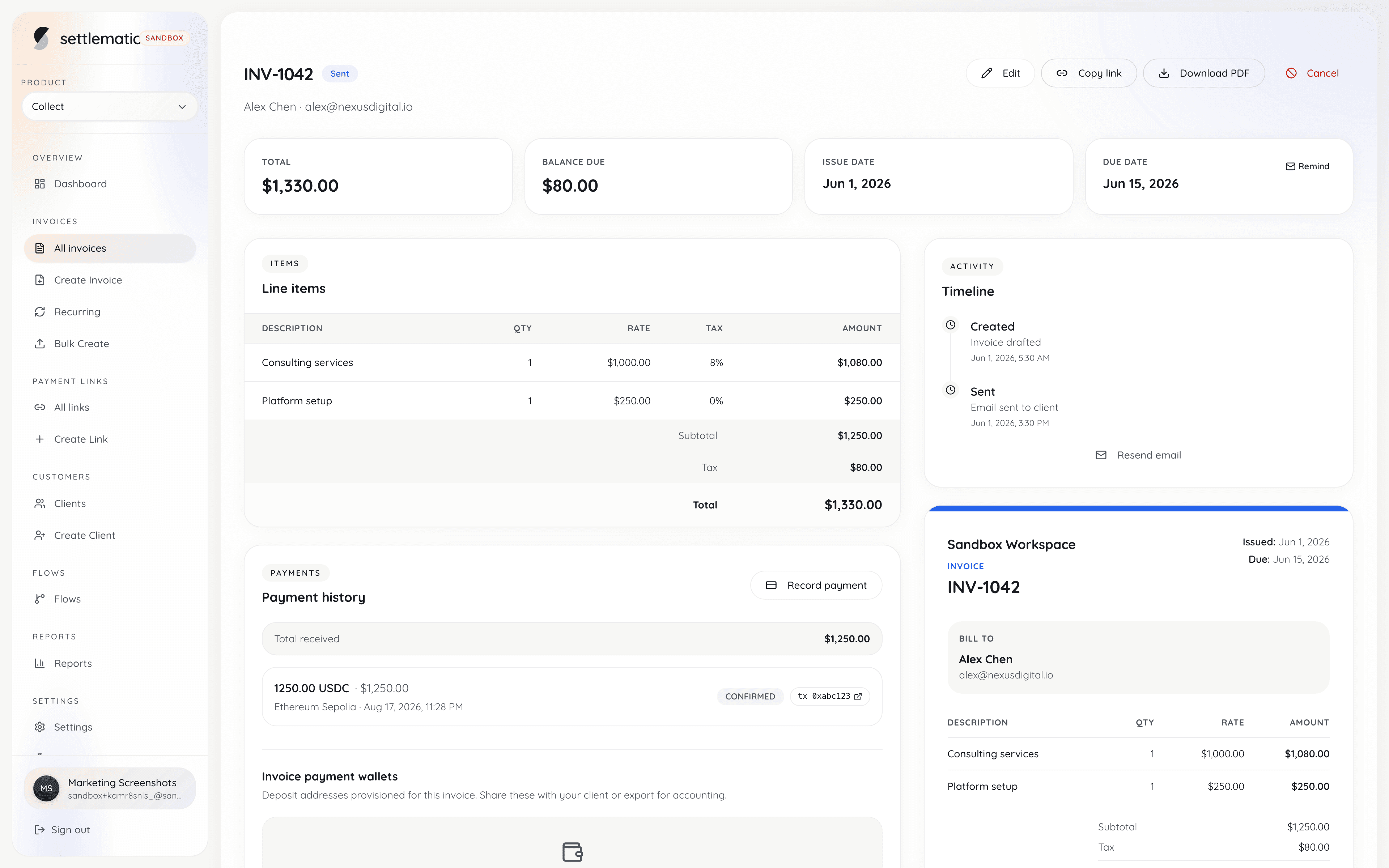
To accept USDC payments, businesses can deploy non-custodial checkout or invoicing using Settlematic. USDC payments settle directly to your corporate self-custody wallet on Ethereum, Solana, Polygon, BSC, or Arbitrum. Fiat-quoted billing locks exchange rates at invoice creation, eliminating price volatility without taking percentage fees.
USD Coin (USDC), issued by Circle, has emerged as the gold standard for corporate treasury, institutional B2B commerce, and regulatory-compliant crypto invoicing. Backed by fully reserved cash and short-term US Treasury assets, USDC offers corporate finance teams a fully auditable digital dollar.
Why accept USDC payments for your business
For technology platforms, SaaS companies, agencies, and cross-border exporters, traditional international payment rails like credit cards and SWIFT wires impose severe operational overhead. Accepting USDC eliminates intermediary banks, reduces settlement times from days to seconds, and cuts transaction processing fees to zero.
Key commercial benefits of accepting USDC include:
- Unmatched regulatory compliance: Circle holds licenses across major global markets, including Electronic Money Institution (EMI) status under MiCA in Europe and State Money Transmitter licenses across the US.
- Monthly audited transparency: USDC reserves are held in segregated accounts at regulated US financial institutions and verified monthly by top-tier accounting firms.
- Instant cross-border clearance: Payments clear 24/7/365 without bank holiday delays, wire cutoff times, or foreign exchange holdbacks.
- Zero chargeback risk: Blockchain transactions are final once confirmed on-chain, protecting merchants from fraudulent credit card disputes.
Supported USDC networks and performance metrics
USDC is supported natively across multiple high-performance blockchains. Settlematic enables businesses to accept USDC across major chains, letting customers choose the most cost-effective network.
| Blockchain Network | Avg. Network Fee | Settlement Finality | Target Business Use Case |
|---|---|---|---|
| Solana (SPL) | < $0.001 | 400 - 800 ms | High-frequency checkout, micro-transactions, instant billing |
| Polygon | $0.01 - $0.05 | 2 - 4 seconds | SaaS subscription billing, general B2B invoicing |
| Base (L2) | $0.01 - $0.08 | 1 - 2 seconds | Developer platforms, Web3 application checkouts |
| Arbitrum (L2) | $0.02 - $0.10 | 1 - 2 seconds | DeFi treasury, cross-border corporate payments |
| Ethereum (L1) | $2.00 - $12.00+ | 12 - 15 seconds | Large enterprise contracts, multi-million dollar wires |
By offering multi-chain USDC acceptance through Settlematic, your clients pay minimal network gas fees while your finance team receives settled funds instantly.
Fiat-quoted invoicing: Eliminating crypto volatility
Invoicing clients in fixed crypto token units creates billing friction when underlying exchange rates fluctuate. Settlematic solves this with fiat-quoted invoicing.
You create an invoice denominated in USD, EUR, or GBP. When your client accesses the payment link, Settlematic calculates the exact amount of USDC required at live market rates. The rate quote locks for a configurable payment window, ensuring your account receives the exact fiat value owed.
To compare stablecoin characteristics in detail, see our analysis of USDC vs. USDT for business and our guide on tax compliance when accepting crypto in the US in how to accept crypto payments in the USA.
Non-custodial settlement: Maximum security, zero take-rates
Most merchant payment processors rely on a custodial architecture. They receive your client's USDC into their pooled wallet, hold the balance on an internal ledger, deduct a 1% to 2% processor fee, and require a daily or weekly payout step to transfer funds to your bank or external wallet.
Settlematic operates on a non-custodial, address-bound model. Every invoice or checkout session dynamically generates a deposit address tied directly to your self-custody wallet (such as a hardware wallet or Safe multisig). Settlematic never takes custody of funds, never holds private keys, cannot freeze your payouts, and charges zero percentage transaction fees.
| Comparison Metric | Custodial Gateways | Settlematic Non-Custodial |
|---|---|---|
| Processing take-rate | 1% to 2% of total volume | 0% volume fee (flat subscription) |
| Custody of funds | Processor holds merchant balances | Merchant retains 100% non-custodial control |
| Payout delays | 1 to 3 business days | Instant on-chain clearance |
| Account freeze vulnerability | High (processor compliance holds) | Zero (funds settle directly to your wallet) |
| Multi-chain support | Usually 1 or 2 chains | Solana, Polygon, Base, Arbitrum, Ethereum, BSC |
Step-by-step: How to accept USDC with Settlematic Collect
Setting up non-custodial USDC invoicing takes only a few minutes using Settlematic Collect:
- 1. Enter your corporate wallet address: Provide the wallet addresses where you want incoming USDC to settle across your preferred chains.
- 2. Generate a fiat-quoted invoice: Set invoice line items in USD, EUR, or GBP, specify tax terms, and attach project notes.
- 3. Deliver payment link to client: Send the hosted payment link via email or PDF. The client connects their Web3 wallet or scans the QR code to pay exact USDC.
- 4. Automated confirmation: Settlematic monitors the blockchain, verifies the transaction confirmation, marks the invoice paid, and dispatches webhook notifications.
For broader invoicing strategies, review our guide to how to invoice clients in crypto.
Operational considerations and honest limitations
When implementing USDC payments, finance teams should account for two key operational workflow factors:
- Self-custody wallet management: Because Settlematic never holds your funds, your business is responsible for maintaining secure seed phrase and private key backup protocols.
- Separate bank off-ramping: Settlematic settles payments in USDC on-chain. Converting USDC to fiat currency in a traditional bank account requires connecting your wallet to an off-ramp provider or crypto exchange.
Start accepting USDC payments
Stop paying 2% payment processor fees and eliminate settlement holds. Review our transparent pricing plans or test USDC invoicing today in the free sandbox demo.
Sources
Frequently asked questions
- Why do institutional and US businesses prefer accepting USDC?
- USDC (issued by Circle) is backed 100% by cash and short-dated US Treasuries with monthly public attestation reports. It is fully registered under US money transmitter frameworks and holds Electronic Money Institution (EMI) authorization under EU MiCA regulations, making it the most compliant stablecoin for corporate B2B billing.
- Which networks are best for accepting USDC payments?
- For low-cost, instant settlement, Solana and Layer-2 networks like Polygon, Base, and Arbitrum offer sub-penny gas fees and 1-second finality. Ethereum mainnet remains popular for enterprise transactions over $50,000.
- How does Settlematic prevent exchange rate loss when accepting USDC?
- Settlematic provides fiat-quoted invoicing. You invoice in USD, EUR, or GBP, and Settlematic locks the live rate when your buyer opens the invoice. The buyer pays exact USDC, eliminating slippage and exchange rate variance.
- Does accepting USDC require paying percentage payment processing fees?
- Not with Settlematic. Traditional processors take 1% to 2% of every payment. Settlematic operates on a flat monthly subscription model starting at $20/month with zero percentage fees, saving thousands in transaction costs.
- Can I accept USDC payments directly into a hardware wallet or multisig?
- Yes. Settlematic is non-custodial and address-bound at issuance. All customer payments settle on-chain directly to the wallet address you configure, including Safe multisig wallets, Ledger hardware devices, or corporate hot wallets.