Best Non-Custodial Crypto Payment Platforms in 2026
Compare Settlematic, BTCPay, Request Finance, and Coinbase Commerce on custody model, invoicing, reconciliation, and treasury safety — with evaluation criteria for B2B merchants.
Do this next
Compare custody models
- Custodial processors hold keys and convert.
- Non-custodial settlement binds addresses to your wallet.
- Use the table below for the attribute-level split.
The best non-custodial crypto payment platforms in 2026 are those that never hold signing keys and bind each payment address to your wallet at issuance. Settlematic leads for B2B invoicing and gateway checkout across six chains; BTCPay Server is the self-hosted Bitcoin choice; Request Finance fits AP/AR workflows. Coinbase Business is custodial and does not qualify.
TL;DR
The best non-custodial crypto payment platform in 2026 is the one that never holds your signing keys, binds deposit destinations at invoice issuance, detects payments on-chain with dual-source verification, and exports reconciliation data your accountant can use. Settlematic leads for B2B invoicing and gateway checkout with address-bound settlement across major EVM chains and Solana. BTCPay Server suits self-hosted Bitcoin merchants. Request Finance targets AP/AR workflows. Coinbase Commerce is convenient but custodial in substance — useful for comparison, not for treasury safety.
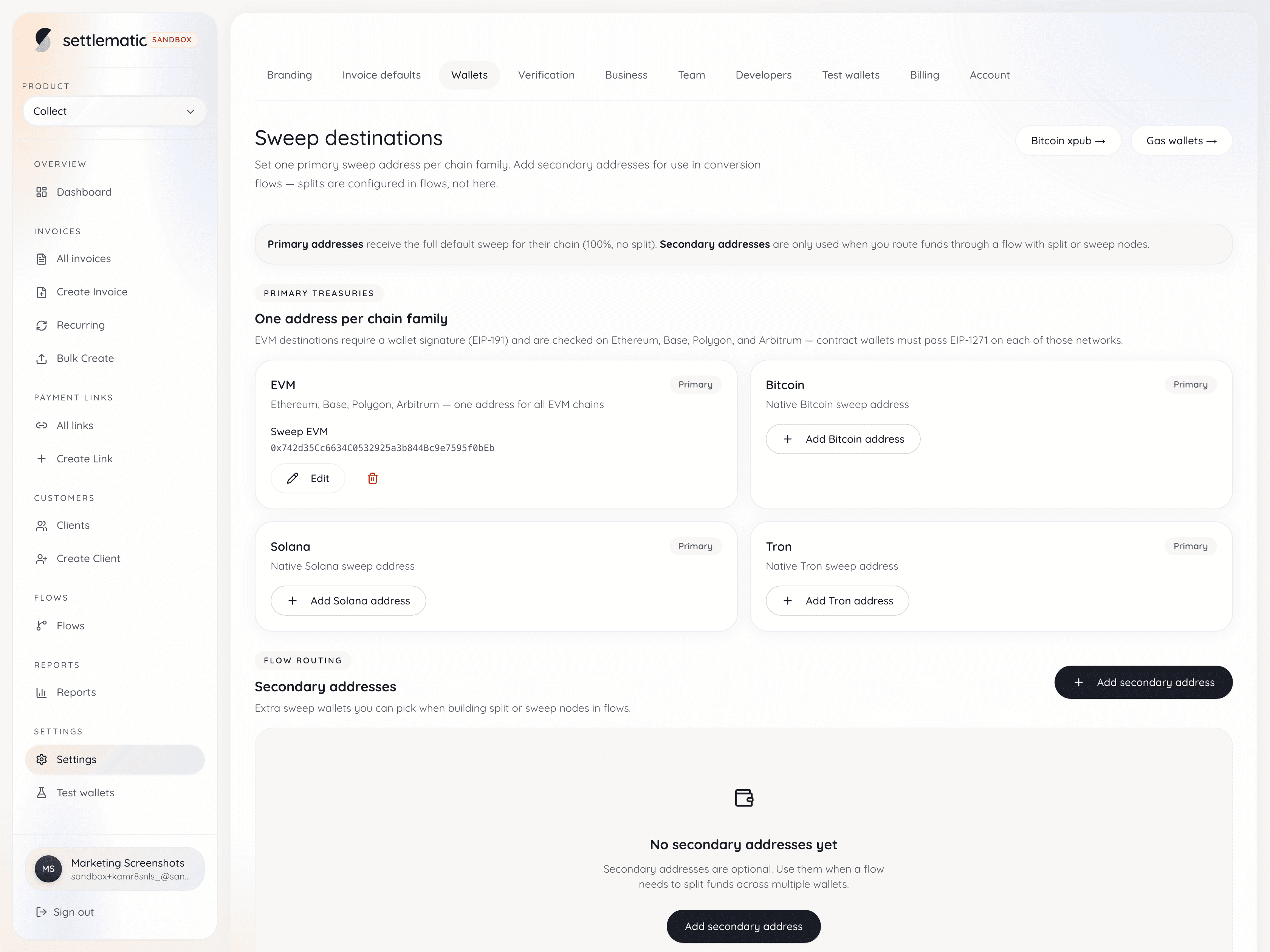
Choosing a crypto payment platform in 2026 is less about which coins you accept and more about who holds the keys when money moves. Regulators in the EU (MiCA), UK (FCA), and US (FinCEN/state MTL regimes) increasingly classify providers by custody and control — not by whether they call themselves "decentralized." For B2B merchants invoicing clients, accepting checkout payments, or running marketplace splits, non-custodial architecture eliminates float risk, payout delays, and the unsecured-creditor position that custodial processors impose.
This guide compares four platforms merchants actually evaluate — Settlematic, BTCPay Server, Request Finance, and Coinbase Commerce — against eight criteria that matter for treasury safety and operational fit. We build Settlematic; we state that upfront. The comparison data is sourced from public documentation and product behavior as of August 2026.
Why non-custodial matters more in 2026 than in 2020
The 2020–2022 cycle taught merchants that custodial convenience has a tail risk. Celsius, BlockFi, FTX, and Voyager all demonstrated the same pattern: funds on a processor balance sheet become general unsecured claims in bankruptcy, regardless of how quickly the platform previously paid out. Chainalysis data from 2025 shows attack value concentrating in centralized services — pooled hot wallets remain high-value targets.
Non-custodial platforms invert the model. Payments settle to addresses derived from your key material or bound to your treasury via immutable contracts. The platform monitors the chain; it does not hold float. If the platform disappears, confirmed payments remain at addresses you can reach. Read custodial vs non-custodial crypto payment processors for case study detail.
For invoicing specifically, non-custodial also simplifies tax and audit: each payment has a tx hash, a bound deposit address, and a timestamp — not an opaque processor ledger entry that may lag on-chain reality by days.
Evaluation criteria: what to score before you sign
Before comparing vendors, define what you are optimizing for. A Bitcoin-only e-commerce store and a USDC-invoicing Web3 agency have different requirements.
| Criterion | Why it matters | Red flag |
|---|---|---|
| Custody model | Determines bankruptcy and hack exposure | "We sweep to your wallet" without key separation |
| Address binding | Proves destination is fixed at issuance | Editable treasury after invoice creation |
| Invoicing depth | Line items, fiat quotes, PDFs, recurring | Checkout-only with no invoice object |
| Chain and asset support | USDC on L2s, EURC, BTC, SOL | Single-chain, single-token |
| Reconciliation | Per-invoice tx mapping, exports, webhooks | Shared wallet with manual memo matching |
| Self-host vs SaaS | Control vs operational burden | Self-host requiring full node ops you cannot staff |
| Compliance tooling | KYB, sanctions, Travel Rule where needed | Compliance via fund freezing (custodial) |
| Pricing model | % of volume vs flat subscription | Hidden spread on conversion |
Score each platform 1–5 per criterion weighted by your use case. Agencies weight invoicing and multi-client exports heavily. E-commerce weights embedded checkout and webhook reliability. Bitcoin merchants weight self-hosting and Lightning support.
Platform comparison at a glance
| Platform | Custody | Best for | Invoicing | Hosted/SaaS | Pricing shape |
|---|---|---|---|---|---|
| Settlematic | Non-custodial | B2B invoicing, gateway checkout, agencies | Full — fiat quotes, recurring, partial pay | SaaS + API | Flat subscription, no % volume |
| BTCPay Server | Non-custodial | Self-hosted Bitcoin/Lightning merchants | Basic invoices, POS | Self-hosted | Free (infra cost) |
| Request Finance | Non-custodial-ish | AP/AR, payroll-style payouts | Strong AP/AR | SaaS | Per-transaction fees |
| Coinbase Commerce | Custodial | Quick setup, fiat off-ramp | Basic | SaaS | % fees + conversion spread |
"Non-custodial-ish" reflects products where settlement paths vary by chain and feature — verify the specific flow you will use. Coinbase Commerce is included because merchants confuse it with self-custody due to Coinbase's retail brand; it is not non-custodial for merchant settlement.
Settlematic: invoicing-first non-custodial settlement
Settlematic Collect targets B2B invoicing: fiat-denominated quotes (USD, EUR, GBP, and more), unique deposit addresses per invoice, automatic on-chain detection, branded payment pages, recurring schedules, partial payment support, and exportable records for accountants. Settlematic Gateway adds embedded checkout, multi-merchant splits, and subscription billing for e-commerce and marketplaces.
Custody architecture. Settlement uses address binding at issuance — BIP-84 xpub derivation on Bitcoin, CREATE2 counterfactual contracts on EVM chains, program-derived patterns on Solana. The platform does not hold private keys to deposit addresses. Sweeps route to merchant-configured treasury wallets with optional split allocations committed before payment. See non-custodial sweeps explained.
Chains and assets. Ethereum, Base, Polygon, Arbitrum, Optimism, Solana, Tron, and Bitcoin. Stablecoins include USDC, USDT, EURC. This covers where B2B stablecoin liquidity actually lives in 2026.
Developer surface. API documentation, signed webhooks, sandbox in the demo, and idempotent event handling for invoice.paid and payment.confirmed. Integrators building agent or ERP workflows can close the loop without polling block explorers.
Security. Security documentation covers factory bytecode integrity, dual-source payment verification, confirmation thresholds, and audit log design. Non-custodial does not mean unregulated — KYB and sanctions tooling exist without custody.
Pricing. Flat monthly subscription without percentage of volume — predictable for agencies with high invoice counts and stablecoin settlement.
Limitations. Not a self-hosted Bitcoin node solution; merchants wanting full infra control may pair Settlematic for stablecoin invoicing with BTCPay for Bitcoin-only self-hosting. Not a fiat off-ramp — you hold crypto in wallets you control.
BTCPay Server: the self-hosted Bitcoin standard
BTCPay Server is open-source, self-hosted payment processing for Bitcoin and Lightning. It is genuinely non-custodial: you run the server, connect your wallet, and payments arrive directly. No platform float.
Strengths. Full control over infrastructure. No per-transaction SaaS fee (you pay server and node costs). Strong Bitcoin and Lightning community. Invoice and POS modes for e-commerce plugins (WooCommerce, Shopify integrations via community tools).
Weaknesses for B2B invoicing. Fiat-quoted professional invoices with line items, client portals, recurring billing, and multi-chain stablecoin support are not BTCPay's core. Reconciliation exports are basic compared to dedicated invoicing platforms. Operational burden is real — you maintain updates, backups, and node connectivity.
Best fit. Bitcoin-forward merchants with DevOps capacity who want zero vendor dependency. Less ideal for agencies invoicing in USD and settling USDC across L2s.
Request Finance: AP/AR for crypto-native finance teams
Request Finance (Request Network) focuses on accounts payable and receivable in crypto — invoices, expenses, payroll-style flows, and integrations with accounting tools. Settlement paths vary; many flows route through non-custodial payment requests, but feature-level custody should be verified per chain and payment method.
Strengths. Mature invoice and bill presentation. Multi-chain support. Strong positioning for finance teams already operating in crypto. Expense and payroll modules for companies with crypto treasuries.
Weaknesses. Per-transaction fee model can compound at volume. Less emphasis on embedded checkout and gateway patterns. Address-binding transparency varies — audit the specific settlement path for your chains.
Best fit. Mid-size crypto-native companies with dedicated finance ops managing AP/AR. Less ideal for freelancers wanting simple Collect-style invoicing without finance-team overhead.
Coinbase Commerce: convenient but custodial
Coinbase Commerce is widely evaluated because of brand recognition and easy onboarding. It is not non-custodial. Customer payments hit Coinbase-controlled addresses; merchants receive payouts on Coinbase's schedule, often with conversion to fiat. You are a creditor to Coinbase for in-flight balances.
Strengths. Fast setup. Fiat off-ramp through Coinbase ecosystem. Familiar to clients who already use Coinbase. Regulatory licensing through Coinbase entities.
Weaknesses for treasury safety. Custodial float. Payout delays. Platform insolvency and freeze risk — distinct from Coinbase retail custody, but structurally similar for merchant balances. Not suitable if your procurement or board requires non-custodial settlement.
Best fit. Small merchants prioritizing fiat conversion speed over custody. Include in comparisons to illustrate what non-custodial avoids, not as a non-custodial recommendation.
Deep dive: custody verification checklist
Regardless of vendor, run this five-step verification before production:
- Create a test invoice. Note the deposit address and quoted treasury binding.
- Attempt to change the treasury destination in the dashboard after issuance. If it changes, binding is cosmetic.
- Pay from an external wallet. Confirm funds arrive at the expected on-chain destination, not an opaque processor address you do not control.
- Review who can sign a sweep from the deposit address. If only the vendor can sign, it is custodial.
- Simulate vendor outage. Can you still reach funds with your own keys or on-chain contract interaction?
Settlematic's demo exists precisely for this validation — testnet end-to-end without mainnet risk. Security docs list factory addresses and derivation schemes for independent audit.
Invoicing vs gateway: which product shape fits
| Use case | Recommended shape | Example platform |
|---|---|---|
| B2B invoices, retainers, milestones | Invoicing / Collect | Settlematic Collect |
| E-commerce checkout, subscriptions | Gateway / embedded | Settlematic Gateway |
| Bitcoin-only online store | Self-hosted POS | BTCPay Server |
| Finance-team AP/AR at scale | AP/AR suite | Request Finance |
| Quick fiat off-ramp, custodial OK | Hosted commerce | Coinbase Commerce |
Many agencies use Collect for client invoices and Gateway for productized service checkout. The custody model should be identical across both — only the presentation layer differs.
Reconciliation and accounting integration
Non-custodial value is lost if reconciliation is manual. Evaluate:
- Per-invoice tx hash in exports and API responses
- Fiat value at settlement captured for tax reporting
- Webhook events with signatures and idempotency keys
- CSV/QuickBooks/Xero export paths
Settlematic fires webhooks on payment detection with confirmed amounts and timestamps — see crypto payment webhooks reconciliation. BTCPay exports payment data but lacks rich B2B invoice metadata. Request Finance integrates with accounting workflows. Coinbase Commerce provides Coinbase-centric reports that may not map cleanly to per-invoice B2B records.
For month-end close, pair platform exports with how to reconcile crypto payments workflows.
Compliance without custody
MiCA, FinCEN, and FCA rules distinguish custody from payment services. Non-custodial invoicing software typically falls outside CASP custody licensing — but merchants remain responsible for tax, AML, and sanctions obligations.
Evaluate whether the platform offers KYB onboarding, sanctions screening, and Travel Rule support without freezing funds it does not custody. Settlematic supports compliance workflows on Gateway for merchants whose banking partners require them — structurally separate from holding keys.
Non-custodial is not anonymous. Professional B2B invoices include seller and buyer identity, supporting audit trails regulators expect.
Pricing and total cost of ownership
| Cost component | Settlematic | BTCPay | Request Finance | Coinbase Commerce |
|---|---|---|---|---|
| Platform fee | Flat monthly | Server + node ops | Per-tx % | % + spread |
| Network fees | On-chain (customer/merchant) | On-chain | On-chain | Often embedded |
| Engineering | Low (SaaS) | High (self-host) | Low | Low |
| Custody risk cost | None (non-custodial) | None | Verify per flow | Float + insolvency |
Total cost of ownership for BTCPay is often underestimated — engineer time for maintenance dominates. Coinbase Commerce's percentage fees compound at volume. Flat subscription models reward high invoice counts.
Migration path from custodial to non-custodial
If you currently use Coinbase Commerce or similar:
- Parallel run — issue new invoices on Settlematic while completing open custodial invoices.
- Update client payment instructions — emphasize direct settlement, branded payment pages.
- Connect webhooks to your fulfillment or ERP stack via developers.
- Train finance on tx-hash-based reconciliation exports.
- Retire custodial checkout once open balances clear.
Expect client education — "pay to this link" replaces "pay to Coinbase." Sophisticated clients often prefer non-custodial settlement once explained.
Recommendation by merchant profile
| Profile | Top pick | Runner-up |
|---|---|---|
| Web3 agency, USD invoices, USDC settlement | Settlematic Collect | Request Finance |
| Freelancer, stablecoin invoicing | Settlematic Collect | — |
| E-commerce, embedded checkout | Settlematic Gateway | BTCPay (BTC only) |
| Self-hosted Bitcoin merchant | BTCPay Server | — |
| Finance team, AP/AR at scale | Request Finance | Settlematic Collect |
| Need fiat off-ramp, custody acceptable | Coinbase Commerce | — |
The best non-custodial crypto payment platform is the one that matches your custody requirements, invoicing depth, chain support, and reconciliation needs — verified with test payments, not marketing copy.
Start with Settlematic Collect for invoicing, Gateway for checkout, the demo for sandbox validation, and security for architecture review before connecting production wallets.
Frequently asked questions
- Is Coinbase Commerce non-custodial?
- No. Coinbase Commerce holds customer payments in Coinbase-controlled wallets and pays merchants on Coinbase's schedule. Brand association with self-custody retail products does not change the merchant settlement model.
- Can I use BTCPay and Settlematic together?
- Yes. Common pattern: BTCPay for self-hosted Bitcoin/Lightning e-commerce; Settlematic for USDC/EURC B2B invoicing across EVM and Solana. Both are non-custodial with different operational profiles.
- What is the best platform for USDC invoicing?
- Settlematic Collect for fiat-quoted USDC invoices with address binding, automatic detection, and accountant-friendly exports. Verify USDC mint addresses per network (native vs bridged) in platform settings.
- Do non-custodial platforms handle VAT on invoices?
- Platforms capture invoice metadata; tax determination remains merchant responsibility. See VAT and GST on crypto invoices for jurisdiction rules.
- How do I verify a platform is truly non-custodial?
- Run the five-step custody verification checklist: test invoice, attempt post-issuance treasury edit, external wallet payment, signing path review, and outage simulation. Documentation in security should list derivation schemes and factory contracts.
- Which platform has the best API for developers?
- Settlematic and Request Finance both offer API-first workflows. Settlematic emphasizes webhook-driven invoice lifecycle and sandbox testing in the demo. Compare developer documentation against your integration requirements.