Custodial vs Non-Custodial Crypto Invoicing: Which Model Fits Your Business?
Compare custodial and non-custodial crypto invoicing on control, compliance, reconciliation, pricing, and failure modes — plus a decision framework for B2B teams.
Do this next
Compare custody models
- Custodial processors hold keys and convert.
- Non-custodial settlement binds addresses to your wallet.
- Use the table below for the attribute-level split.
Custodial crypto invoicing platforms receive your client's payment into their own wallets and pay you out later, taking a percentage and holding counterparty risk. Non-custodial invoicing sends the payment directly to an address bound to your wallet; the platform only detects and reconciles. For B2B invoicing, non-custodial removes the freeze, delay, and insolvency risk.
TL;DR
Custodial crypto invoicing holds or controls funds during settlement — often via per-invoice deposit wallets that sweep to your treasury. Non-custodial invoicing derives unique addresses bound to your wallets at issuance and never signs transactions. Custodial models can feel simpler operationally but add creditor risk and licensing surface; non-custodial models demand better address discipline but keep settlement in wallets you control. This guide compares both on regulation, security, reconciliation, and cost.
The custody question is binary
Every crypto invoicing product answers one question: can the platform move customer funds without the merchant's key? If yes — even for milliseconds during a sweep — you are in custodial territory for practical risk and regulatory analysis. If no, you are using software to observe chain state and update invoice records.
Marketing language blurs the line. "We never store private keys" might still mean the vendor operates hot wallets with HSM-backed signing. "Non-custodial" on a landing page should be verified against architecture, not slogans.
Side-by-side comparison
| Dimension | Custodial invoicing | Non-custodial invoicing |
|---|---|---|
| Funds location during settlement | Platform-controlled wallets | Merchant-controlled wallets |
| Per-invoice addresses | Yes (platform keys) | Yes (merchant-bound derivation) |
| Platform outage impact | May block sweeps / access | Issued addresses still valid on-chain |
| Licensing exposure | Higher (custody / transmission) | Lower (software / indexing) |
| Reconciliation | Easy (internal ledger) | Requires address binding + indexers |
| Typical pricing | % of volume common | Flat SaaS more common |
| Enterprise procurement | Scrutiny on counterparty risk | Scrutiny on process maturity |
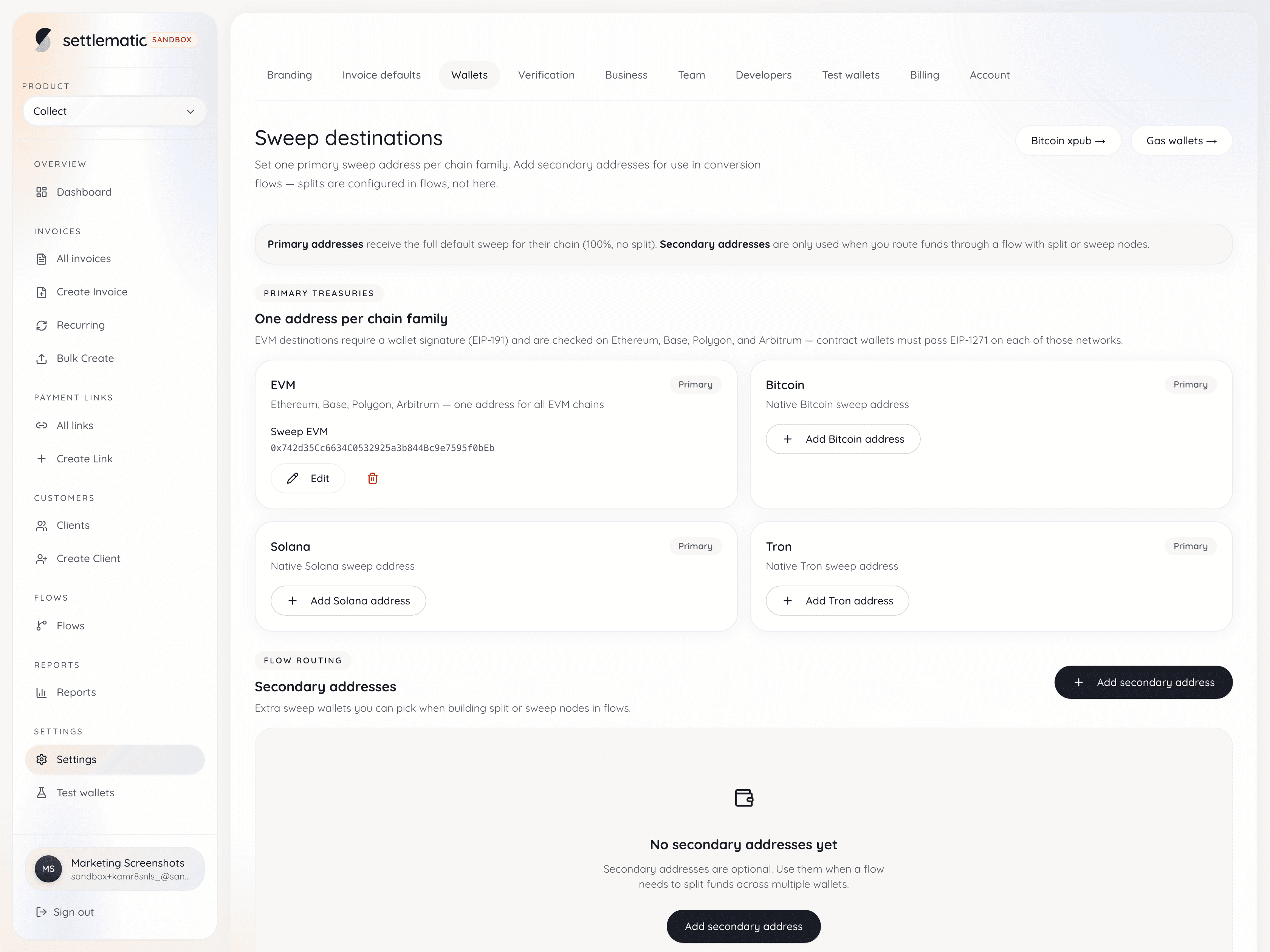
Settlematic is explicitly non-custodial: BIP-84 on Bitcoin and CREATE2 on EVM bind deposit addresses to merchant treasuries at issuance. See what makes Settlematic different.
How custodial invoicing works
The custodial pattern is seductive because it mirrors card processing:
- Platform generates a deposit wallet per invoice (or per customer)
- Payer sends crypto to that wallet
- Platform detects confirmation and credits an internal balance
- Platform sweeps to merchant on schedule or threshold
Reconciliation is trivial inside the vendor's database. You also inherit platform credit risk: if the vendor is hacked, insolvent, or freezes payouts, your receivable may not become spendable crypto on schedule.
How non-custodial invoicing works
Non-custodial products separate observation from control:
- Merchant configures settlement wallets (xpub, factory, treasury addresses)
- Each invoice receives a derived deposit address bound to that configuration
- Payer sends crypto directly to the bound address
- Platform indexers match txs to invoices; webhooks notify ERP
No sweep step exists because funds never sat in a vendor wallet. Deep dive: invoice-scoped wallet addresses explained.
Regulatory and compliance framing
EU MiCA and US state money-transmitter regimes focus on safekeeping and control of customer assets. Custodial invoicing vendors may need CASP or MTL coverage depending on structure. Non-custodial invoicing tools that only derive watch-only addresses and publish payment instructions often classify as software — though merchants remain responsible for tax, sanctions, and AML policies on their own flows.
KYB features (supported in Settlematic) help B2B merchants demonstrate counterparty diligence without converting the platform into a bank.
Security and failure modes
| Risk | Custodial | Non-custodial |
|---|---|---|
| Vendor hot-wallet hack | Customer funds at risk pre-sweep | No vendor hot wallet in path |
| Vendor bankruptcy | Unclear payout queue | On-chain funds already at merchant |
| Wrong-network payment | Vendor may offer recovery ops | Merchant / payer must bridge or refund manually |
| Key loss | Platform ops issue | Merchant ops issue |
Neither model removes payer error. Both benefit from clear hosted pay pages and asset/network restrictions per invoice.
Reconciliation at scale
Shared static addresses fail beyond a few invoices per month. Both models therefore use unique destinations — the difference is who owns the keys to those destinations.
Custodial: keys belong to vendor; you trust their ledger. Non-custodial: keys belong to you; you trust their indexer accuracy. Settlematic mitigates indexer risk with dual-source verification and per-chain finality thresholds.
Agencies reconciling retainers across dozens of clients should read best crypto invoicing for agencies.
Pricing incentives misalign
Custodial processors often charge basis points on volume because float and compliance costs scale with throughput. Non-custodial SaaS like Settlematic uses flat subscription pricing — better alignment for high-ticket B2B. Compare pricing.
A $100k USDC invoice at 1% costs $1,000 in platform fees alone. Flat pricing removes that marginal tax as you grow.
Operational simplicity vs structural safety
Custodial feels simpler when:
- Your team refuses to manage xpubs or factory configs
- You want the vendor to handle wrong-chain support tickets
- You treat crypto as just another payout rail
Non-custodial wins when:
- Legal asks "who holds customer funds?"
- Treasury already uses multisig or institutional custody
- Invoice sizes make % fees painful
- You want crypto-native settlement without reintroducing intermediaries
Hybrid myths
Some products advertise "self-custody" while retaining unilateral sweep rights in Terms of Service. Read the technical settlement path, not the hero image. Ask vendors: show a sequence diagram from payer wallet to merchant wallet with every hop labeled.
Decision framework
Answer these five questions:
- Volume and ticket size — High ACV B2B favors flat non-custodial pricing.
- Treasury maturity — Do you already control multisig treasuries?
- Regulatory counsel guidance — Which model fits your licenses?
- ERP integration — Do you need webhooks and fiat-quoted invoices?
- Chain coverage — USDC/USDT on Ethereum, Polygon, BSC, Solana, Tron, plus BTC?
If non-custodial fits, evaluate Settlematic Collect and book demo. For vendor landscape, see best crypto invoicing platforms 2026.
International billing considerations
Cross-border fiat wires are slow and FX-heavy. Crypto settlement helps speed but does not remove tax reporting. How to bill international clients in crypto covers rate locks and functional currency accounting.
Smart payment terms in either model
Early payment discounts and late fees should be machine-readable, not buried in PDF footers. Settlematic smart invoices work in the non-custodial model without custodial escrow — see smart invoices guide.
Bottom line
Choose custodial if you consciously accept counterparty risk for marginal operational convenience. Choose non-custodial if settlement sovereignty and flat pricing matter more than having the vendor sweep on your behalf. Settlematic Collect | pricing | demo
Extended analysis: operational depth (1)
| Review checkpoint | Pass criteria |
|---|---|
| Custody | Vendor cannot sign merchant settlement txs |
| Addresses | Unique per invoice, never reused |
| Pricing | No uncapped % of volume on large tickets |
| Chains | Matches payer withdrawal options |
| Terms | Discounts/late fees on pay page if needed |
Extended analysis: operational depth (2)
| Review checkpoint | Pass criteria |
|---|---|
| Custody | Vendor cannot sign merchant settlement txs |
| Addresses | Unique per invoice, never reused |
| Pricing | No uncapped % of volume on large tickets |
| Chains | Matches payer withdrawal options |
| Terms | Discounts/late fees on pay page if needed |
Frequently Asked Questions
Is non-custodial invoicing less secure?
It shifts security responsibility to merchant wallet practices while removing vendor hot-wallet concentration risk. For many B2B teams that is a net improvement.
Can custodial invoicing be cheaper?
Low-volume micro-invoices sometimes look cheaper on %-fee tiers until you annualize volume. Model your expected ticket sizes.
Does Settlematic ever hold funds?
No. Settlement is address-bound to merchant-controlled wallets; the platform indexes chain events only.
What about USDC specifically?
See best USDC invoicing tools for B2B.
Do enterprise buyers care?
Increasingly yes — procurement questionnaires ask about custody and key control.
Can I switch from custodial to non-custodial?
Yes with migration planning: update pay links, configure xpub/factory, parallel-run one billing cycle.