How to Accept Solana USDC Invoices
Learn how to accept Solana USDC invoice payments — wallet setup, SPL token verification, sub-second finality, fee economics, and non-custodial settlement with Settlematic Collect.
Do this next
Create a crypto invoice
- Quote the invoice in fiat.
- Client pays USDC, USDT, or EURC.
- Funds settle to a wallet you already control.
TL;DR
Accepting Solana USDC invoices means issuing fiat-quoted invoices with SPL USDC as the settlement asset, binding a unique Solana deposit address per invoice, and detecting payment after Solana finality (~1 second). Solana offers the lowest fees and fastest confirmation of major USDC networks — ideal for freelancer and B2B cross-border billing. Configure Solana settlement in Settlematic Collect, verify the SPL mint address, and test in the demo before mainnet.
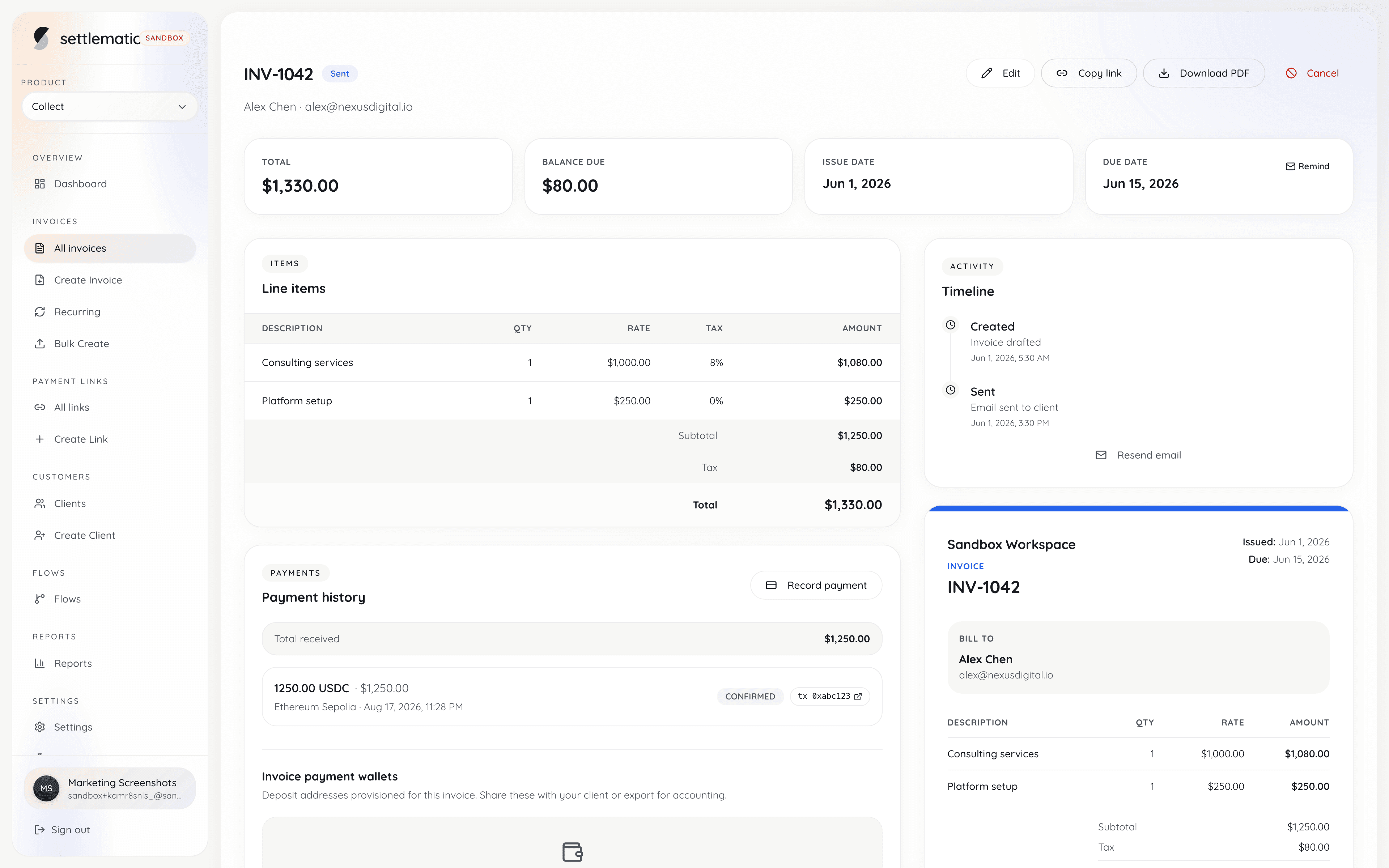
Solana processed a growing share of stablecoin transfer volume in 2025–2026 because USDC on Solana combines sub-cent fees with sub-second finality. For invoice use cases — where a client pays once per project or month — that economics beats Ethereum L1 by orders of magnitude. This guide covers why Solana USDC fits invoicing, how to set it up safely, and how to avoid the SPL token mistakes that cause lost reconciliation time (not lost funds, but lost afternoons).
Why Solana USDC for invoices
| Factor | Solana USDC | Ethereum L1 USDC | Base USDC |
|---|---|---|---|
| Typical transfer fee | $0.001–$0.01 | $1–$15+ | $0.01–$0.05 |
| Time to finality | ~1 second | ~12–15 minutes | ~2 seconds |
| Ecosystem | Phantom, Solflare, exchange withdrawals | MetaMask, all major exchanges | Coinbase-native |
| Invoice fit | Excellent | Poor except high-value | Excellent |
For a $3,000 design invoice, a $8 Ethereum gas fee is absurd. On Solana, the fee is a rounding error. That asymmetry drives freelancer and remote-team adoption — see best crypto invoicing for freelancers.
Cross-border B2B payers increasingly hold USDC on Solana in treasury wallets, especially teams already paying contractors on-chain weekly.
SPL USDC: the token you actually receive
Solana USDC is an SPL token — not the same contract address format as EVM USDC. Critical details:
| Item | Value |
|---|---|
| Token | USD Coin (USDC) |
| Standard | SPL Token |
| Official mint (mainnet) | EPjFWdd5AufqSSqeM2qN1xzybapC8G4wEGGkZwyTDt1v |
| Decimals | 6 |
Your invoicing platform must verify incoming transfers against this mint — not just any token named "USDC." Fake SPL tokens with similar names exist. Professional invoicers filter by mint address at detection time.
Settlematic Collect validates SPL mint on automatic payment detection — never mark an invoice paid on wrong-token transfer.
Non-custodial Solana invoice flow
- You create a USD-quoted invoice in Collect.
- Platform derives a unique Solana deposit address bound to your settlement pubkey at issuance (address-bound settlement).
- Client opens payment link; sends SPL USDC from Phantom, Solflare, or exchange withdrawal.
- Detection layer confirms amount + mint + destination.
- Invoice marks paid; SPL USDC sits in the deposit-associated account until swept to your main wallet (implementation varies — some platforms credit directly to your registered settlement ATA).
Funds never sit in a Settlematic custodial pool. You hold keys to settlement destinations you configure.
Step-by-step: accept your first Solana USDC invoice payment
Step 1: Configure Solana settlement wallet
Use a Solana wallet you control (Phantom, Solflare, hardware wallet via Solana app). Register your pubkey as settlement destination in Collect settings.
Security: Use a dedicated business wallet. Do not reuse the pubkey you use for memecoin trading.
Verify the pubkey on a hardware device if available — clipboard malware swaps addresses.
Step 2: Enable Solana USDC on invoice template
When creating invoices, select:
- Display currency: USD (or EUR)
- Settlement: USDC
- Network: Solana
Optionally enable Base or Polygon as backup networks for clients who cannot use Solana.
Step 3: Create and send invoice
Add line items, client details, due date. Send PDF + payment link. The payment page shows:
- Amount in USDC (6 decimals)
- Solana network badge
- Unique deposit address OR deep link to Phantom
- QR code for mobile payers
Step 4: Client payment instructions
Share with clients who are new to Solana:
> Open the payment link. Connect Phantom or paste the deposit address into your wallet's Send USDC flow. Select Solana network — not Ethereum. Confirm the token shows as USDC (Circle). Send exact amount shown.
Exchange users (Coinbase, Binance): withdraw USDC to the invoice address with Solana selected as network. Wrong network selection is the #1 failure mode.
Step 5: Confirm detection
Dashboard updates to paid within seconds of on-chain confirmation. Enable email notification or invoice.paid webhook for automation.
Step 6: Reconcile and export
Download tx signature (Solana's equivalent of tx hash) for accounting. Signature format: base58 string ~88 characters.
Solana vs EVM invoicing: operational differences
| Topic | Solana | EVM (Base, Polygon) |
|---|---|---|
| Address format | Base58 pubkey | 0x hex |
| Tx identifier | Signature | Tx hash |
| Account model | Associated Token Account (ATA) | Direct ERC-20 transfer |
| Memo field | Limited memo program | calldata / events |
| Explorer | solscan.io, explorer.solana.com | etherscan.io, basescan.org |
Your accountant does not need to understand account models — exports should normalize to invoice ID, amount, timestamp, and explorer link.
Fee economics for invoice payers
| Payer type | Typical experience |
|---|---|
| Self-custody Phantom user | ~0.000005 SOL fee + USDC transfer |
| Coinbase withdrawal | Exchange fee schedule + Solana network |
| Corporate treasury (Squads multisig) | Small SOL fee from fee payer |
Unlike Ethereum, payers need a tiny SOL balance for transaction fees even when paying USDC. Warn clients: "Keep ~0.01 SOL for network fees."
Some invoicing checkout flows sponsor fees — confirm whether your payer or platform pays. Settlematic's model keeps on-chain fees with the payer, standard for non-custodial invoicing.
Wrong-network and wrong-token recovery
| Mistake | Outcome |
|---|---|
| USDC sent on Ethereum to Solana address | Funds not received — may be unrecoverable if address formats incompatible |
| Random SPL "USDC" fake token | Invoice stays unpaid — detection rejects wrong mint |
| Underpayment | Partial status — client tops up |
| Payment to old invoice address | Manual reconciliation — train clients to use current link |
Prevention beats recovery: clear payment page UX and client onboarding email. See what is a crypto invoice for field requirements.
Solana finality and when invoices mark paid
Solana achieves practical finality quickly — most merchants accept single confirmation for invoice amounts under high six figures. For enterprise policies requiring more depth, configure confirmation thresholds.
Read on-chain payment confirmation for network-by-network guidance.
Detection systems use RPC + indexer redundancy — dual-source verification prevents false positives from reorgs (rare on Solana but architecturally worth handling).
Integrating Solana USDC invoices into your stack
Developers can create Solana-enabled invoices via API:
Full patterns in crypto invoicing API webhooks. Test against sandbox before production.
Tax and accounting notes
SPL USDC is USD-pegged — most jurisdictions treat receipt as USD income at face value, subject to FX rules if functional currency differs. Document:
- Invoice fiat amount
- USDC received
- Transaction signature
- Timestamp (UTC)
Report crypto income at tax time covers annual aggregation.
Security checklist for Solana USDC invoicing
- [ ] Verify official USDC mint on every payment detection path
- [ ] Non-custodial address binding at invoice creation
- [ ] 2FA on invoicing dashboard
- [ ] Hardware wallet for accumulated balances
- [ ] Never share seed phrase — legitimate invoices never ask for it
- [ ] Review is crypto invoicing safe
When not to use Solana
- Client treasury policy forbids Solana (use Base/Polygon backup)
- Invoice amount below $5 where client onboarding cost exceeds benefit — batch monthly instead
- Legal restrictions on stablecoin rails in client's jurisdiction — consult counsel
Offer multi-network invoices — Solana primary, EVM backup — to maximize successful payment without excluding anyone.
Solana invoice performance benchmarks
Indicative metrics from production B2B invoicing workloads:
| Metric | Solana USDC | Ethereum L1 USDC |
|---|---|---|
| Median detection latency | <15 seconds | 8–20 minutes |
| Payer all-in cost | <$0.05 | $2–$20 |
| Wrong-network rate (with clear UX) | <2% | <3% |
| Support tickets per 100 invoices | 1–3 | 4–8 |
Numbers vary by client crypto literacy — first invoice to new client always generates more support than invoice #10.
Corporate treasury integration on Solana
Enterprise payers using Fireblocks, Squads, or Anchorage:
- Treasury creates payment from approved invoice link
- Policy engine validates destination against invoice PDF amount
- Multisig collects signatures
- Broadcast within payment window
- AP archives signature in ERP memo field
Solana speed means treasury can pay same day invoice arrives — cash flow win for vendors on Net-30 terms who receive Day-1 payment.
Seasonal and volume spikes
Freelancers billing Q4 project rush benefit from Solana fee stability — Ethereum L1 gas spikes during NFT mints do not affect Solana USDC transfer costs materially. Agencies issuing 50+ milestone invoices in December should standardize Solana to avoid support overload from gas confusion on L1.
Comparing Solana to Base for US clients
| Factor | Solana | Base |
|---|---|---|
| Coinbase ecosystem | Good | Excellent |
| Raw speed | Faster | Very fast |
| Corporate familiarity (2026) | Rising | High |
| Recommendation | Default global | Default US Coinbase-heavy clients |
Offer both on same invoice — client self-selects.
Solana mobile payer experience
Mobile payments dominate freelancer invoicing in 2026 — clients approve USDC sends from phone between meetings:
- Tap payment link in email on iOS/Android
- Deep link opens Phantom/Solflare with pre-filled address and amount
- Biometric confirm
- Invoice marks paid before laptop is opened
Merchants should test mobile flow in demo before sending first Solana invoice to mobile-first clients. QR codes on PDF invoices help desktop-to-mobile handoff when AP opens PDF on laptop but pays from phone wallet.
Exchange withdrawal workflows for AP teams
Most B2B Solana USDC payments originate from centralized exchange withdrawals, not self-custody wallets. Finance teams at mid-market companies follow a repeatable pattern: receive invoice PDF, match to PO in NetSuite, obtain treasury approval, initiate USDC withdrawal from Coinbase Prime or Kraken, select Solana as network, paste deposit address from hosted payment page, confirm amount, wait for exchange processing (often 10–60 minutes), then mark vendor paid in ERP when webhook or dashboard confirms receipt.
Your onboarding materials should mirror the exchange UI your clients actually use. A generic "send USDC on Solana" instruction fails when Binance labels the network "SOL" and Coinbase labels it "Solana" in different menu positions. Screenshot-based guides reduce first-payment failure rates from industry averages of 8–12% to under 3% for repeat clients.
| Exchange | USDC withdrawal label | Typical fee (2026) | Notes |
|---|---|---|---|
| Coinbase | Solana | Free–$1 | Base also available; watch default |
| Kraken | Solana | ~$1 | Second confirmation modal critical |
| Binance | SOL network | Variable by region | EU/US defaults differ |
| Crypto.com | Cronos/Solana | Low | Confirm Solana not Cronos |
Require clients to paste the address from the live payment link, not from a forwarded email thread where address substitution phishing occurs. Hosted payment pages with chain-locked QR codes eliminate most copy-paste errors.
Solana USDC invoicing and accounting integration
Solana payments export differently than EVM chains — transaction signatures are base58 strings, not 0x hashes — but accounting systems care about normalized fields, not chain trivia. Configure Settlematic Collect exports to include network: solana, tx_signature, and token_mint columns so QuickBooks and Xero imports match your EVM payment rows without custom scripts per chain.
Cash-basis freelancers recognize revenue at paid_at timestamp in export. Accrual-basis agencies clear AR when signature confirms on Solana — typically same calendar day as client initiated withdrawal because Solana finality is sub-second. Month-end close for Solana-heavy books completes faster than wire-based AR because there is no "payment in transit" limbo spanning three business days.
Accountants unfamiliar with Solana should spot-check signatures on solscan.io — paste signature, verify amount, mint (EPjFWdd5AufqSSqeM2qN1xzybapC8G4wEGGkZwyTDt1v), and destination match export row. One 10-minute training session per accounting hire prevents month-end confusion. Share crypto invoicing for accountants during client onboarding.
Long-term operational playbook for Solana invoice volume
Teams processing 50+ Solana USDC invoices monthly should standardize beyond ad hoc setup:
- Network policy document — Solana primary, Base backup, no Ethereum L1 under $25k (fee economics).
- Client tiering — Crypto-native clients get Solana-only invoices; enterprise clients get multi-network checkout with Solana recommended.
- Support macros — Pre-written responses for "need SOL for fees," "wrong network," and "exchange pending" reduce ticket handle time.
- Quarterly mint verification — Circle publishes canonical USDC mint addresses; confirm detection layer still whitelists current mainnet mint after any upgrade.
- Treasury sweep cadence — Weekly sweep from invoice-derived addresses to cold multisig; document in security review.
Volume discounts on Settlematic pricing often beat engineering time spent building custom Solana indexers. Measure wrong-chain rate monthly; if above 2% after Q1, invest in client training webinars rather than more chains.
Solana vs traditional rails for invoice settlement
| Factor | Solana USDC invoice | International wire | ACH (US domestic) |
|---|---|---|---|
| Settlement time | Seconds | 2–5 business days | 1–3 business days |
| Payer cost | <$0.05 typical | $25–$50+ | Free–$3 |
| Receiver cost | None (non-custodial) | Intermediary fees possible | None |
| Cutoff times | 24/7 | Banking hours | Banking hours |
| Reconciliation | Tx signature + invoice ID | Wire reference (often vague) | ACH trace ID |
| Chargeback risk | None (final settlement) | Wire recall rare | ACH reversal possible |
Solana wins on speed and global availability; wires win when client policy forbids crypto entirely. Offer both on contract — many clients choose Solana after one successful payment.
Solana USDC is the fastest, cheapest major network for stablecoin invoicing in 2026. Configure Solana settlement in Settlematic Collect, validate the SPL mint, educate clients on network selection, and let automatic detection close invoices in seconds. Start in the demo, review pricing, and add Solana alongside your existing USD-quoted crypto invoices.
Frequently asked questions
- Is Solana USDC the same as Ethereum USDC?
- Same issuer (Circle), different chain and token standard. They are not fungible across chains without bridging — client must pay on Solana.
- Which Solana wallet should clients use?
- Phantom and Solflare are most common. Any SPL-compatible wallet works. Exchange direct withdrawal also works if network is set to Solana.
- How fast do Solana USDC invoice payments confirm?
- Typically under 2 seconds for dashboard status update after client broadcast. Faster than manual wire confirmation by days.
- Can I accept EURC on Solana?
- EURC availability varies by network. Polygon carries EURC for EU-focused invoicing; check supported assets in Collect settings.
- Do I need SOL in my merchant wallet?
- Your settlement wallet needs minimal SOL for account rent and any sweep transactions. Client pays their own tx fees when sending USDC.
- What explorer link do I give my accountant?
- Solscan or Solana Explorer transaction link using the payment signature. Export CSV from Collect includes normalized fields.
- Can I set up recurring Solana USDC invoices?
- Yes — recurring crypto invoices generate new Solana deposit addresses each cycle.