Accept Crypto Ecommerce: Shopify, WooCommerce & Checkout Guide
Accept crypto in your ecommerce store on Shopify or WooCommerce. Non-custodial checkout settles USDC/USDT to your wallet with no percentage take-rate.
Do this next
Accept crypto for your own sales
- Tax the supply in local currency at the tax point.
- Licensing usually follows custody, not invoicing.
- Keep a per-invoice fiat figure at settlement.
TL;DR
Ecommerce stores accept crypto by embedding a non-custodial checkout that quotes a stablecoin amount at the moment of purchase and settles USDC or USDT directly to the merchant wallet on-chain. Settlematic binds each checkout deposit address to your settlement wallet at issuance, fires a webhook on confirmation, and charges a flat monthly subscription with no percentage of volume. There is no pooled balance, no payout delay, and no chargeback window.
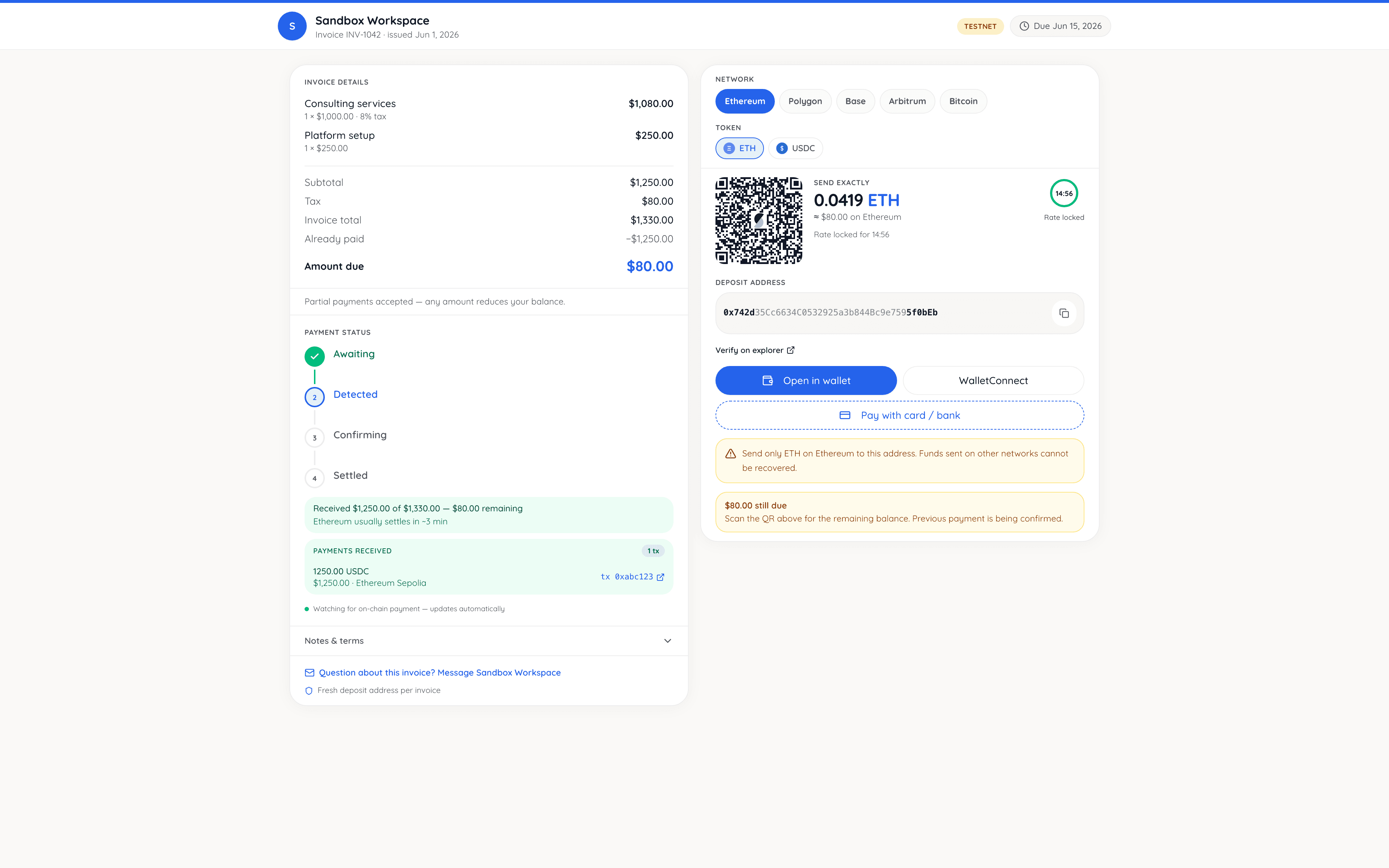
Ecommerce stores accept crypto by embedding a non-custodial checkout that quotes a stablecoin amount at the moment of purchase and settles USDC or USDT directly to the merchant wallet on-chain. Settlematic binds each checkout deposit address to your settlement wallet at issuance, fires a webhook on confirmation, and charges a flat monthly subscription with no percentage of volume. There is no pooled balance, no payout delay, and no chargeback window.
Why ecommerce stores add crypto at checkout
Card decline rates on international ecommerce orders routinely exceed 10% because of issuer fraud filters, cross-border banking restrictions, and currency controls. Each declined order is lost revenue plus the customer-acquisition cost that produced it. Crypto checkout sidesteps the card network entirely: the customer sends a stablecoin from any wallet, it confirms on-chain, and the order is paid.
For stores selling digital goods, software, or cross-border physical products, crypto also removes chargeback exposure. On-chain settlement is final, so there is no 90-day dispute window where a buyer can reverse a completed order. The trade is that refunds become a manual outbound transfer, which matters for stores with high return rates.
How non-custodial crypto checkout works
A non-custodial checkout does not collect the customer's payment into a processor balance. Instead, each checkout session generates a deposit address cryptographically bound to your settlement wallet at issuance. The customer pays that address; the on-chain payment is the settlement. Settlematic watches the chain for confirmation, reconciles the payment to the order, and fires a webhook so your store can release fulfilment. It never holds private keys that could redirect an address once issued.
The checkout quotes the crypto amount at the moment the customer opens the payment page, with a rate-validity countdown so the customer knows how long the quoted amount holds. Fiat-quoted pricing means your store lists products in USD, EUR, or GBP and the customer pays the equivalent stablecoin, so your catalog and ledger stay in your reporting currency. The full integration pattern is in our how to accept crypto payments on your website guide.
Shopify and WooCommerce integration
Settlematic Gateway exposes a checkout API and webhook endpoint rather than a hosted plugin, which keeps the integration portable across platforms. The connection pattern for both Shopify and WooCommerce is documented on our integrations page.
- Shopify: add a custom payment option at checkout that redirects to a Settlematic hosted pay page, or embed the checkout in a storefront page for headless builds.
- WooCommerce: register a custom gateway that calls the checkout API on order creation and listens for the payment.confirmed webhook to mark the order paid.
- Both: subscribe to payment.detected and payment.confirmed webhooks to update order status and trigger fulfilment without polling the chain.
- Both: use the free sandbox on testnet to validate the full flow before accepting real funds.
Custodial gateway vs non-custodial checkout for ecommerce
| Dimension | Custodial crypto gateway | Settlematic Gateway (non-custodial) |
|---|---|---|
| Fund custody | Processor holds payment until payout | Settles on-chain to your wallet; no pooled balance |
| Pricing | 1-2% of volume plus per-transaction fee | Flat subscription from $49/mo on Pro; 0% of volume |
| Payout timing | Daily batch, then 1-3 business days to bank | On-chain confirmation; no payout step |
| Chargeback risk | Card-style dispute window on some rails | Zero; on-chain settlement is final |
| Refund handling | Built-in reversal | Manual outbound transfer from your wallet |
| Fiat off-ramp | Often built into the processor | You off-ramp separately; not built in |
| Supported assets | Often 15+ coins incl. BTC, ETH, LTC, XRP | USDC, USDT, EURC, ETH, BTC on 6 networks |
Where a custodial gateway is the better choice
Non-custodial checkout is not the right fit for every ecommerce store. There are three cases where a custodial processor is the more practical option, and we say so plainly:
- You need automatic fiat in a bank account. Settlematic settles in stablecoins to your wallet; converting to fiat and moving it to a bank is your responsibility. If your finance team will not hold USDC, a custodial gateway with built-in fiat payout removes that operational burden.
- You need broad coin coverage. If your customers pay in assets beyond USDC, USDT, EURC, ETH, and BTC, a multi-coin custodial gateway serves them better than Settlematic's stablecoin-plus-Bitcoin focus.
- You have high return rates. On-chain payments are final, so refunds are a manual outbound transfer. Consumer stores with meaningful return rates may prefer a processor with built-in dispute and refund machinery.
Pricing and settlement timing
Settlematic charges a flat monthly subscription with no percentage of volume. Gateway on the Pro plan starts at $49/month, with a 7-day Pro trial and a free sandbox. Network fees are paid on-chain by the customer. Because the on-chain payment is the settlement, there is no batch window, no minimum payout, and no business-day dependency; a payment that confirms on a Friday evening settles on Friday evening.
Getting started with crypto checkout
Embedding crypto checkout does not require a custom smart contract or a treasury overhaul. Configure your settlement wallet, generate a checkout session from your store's order flow, and subscribe to the payment.confirmed webhook. The free sandbox lets you run the full checkout on testnet before going live.
Review flat-rate plans on pricing, or book a live checkout walkthrough at /demo to see a non-custodial ecommerce payment settle on-chain to your own wallet.
Sources
Frequently asked questions
- How does an ecommerce store accept crypto payments?
- Embed a non-custodial checkout in your store. When a customer reaches payment, the checkout quotes a stablecoin amount at the current rate, shows a QR code or address, and settles USDC or USDT on-chain to your wallet. A webhook on confirmation tells your store to mark the order paid and release fulfilment.
- Can I accept crypto on Shopify without a custodial processor?
- Yes. Settlematic Gateway embeds a non-custodial checkout that binds each order's deposit address to your settlement wallet at issuance. Funds settle on-chain directly to you, with no pooled balance held by the processor and no percentage of volume taken.
- Does a WooCommerce store need a plugin to accept crypto?
- You integrate via the checkout API and webhook endpoint rather than a hosted plugin. Settlematic fires a signed webhook on payment confirmation that your WooCommerce backend uses to mark the order paid. See the integrations page for the connection pattern.
- What does it cost to accept crypto in an ecommerce store?
- Settlematic charges a flat monthly subscription, with Gateway on Pro from $49/month, and takes zero percentage of payment volume. Network fees are paid on-chain by the customer. There is no per-transaction processor fee on top of the subscription.
- Can ecommerce customers get refunds in crypto?
- On-chain payments are final, so refunds are a manual outbound transfer from your wallet rather than an automated reversal. Stores with high return rates should keep a card or fiat option for refund-heavy scenarios and use crypto for the rest.