Non-Custodial Crypto Payment Gateway: A 2026 Buyer's Guide
What a non-custodial crypto payment gateway is, how it differs from custodial processors, and how to pick one — with a sourced NOWPayments, Coinbase, Settlematic table.
Do this next
Create a crypto invoice
- Quote the invoice in fiat.
- Client pays USDC, USDT, or EURC.
- Funds settle to a wallet you already control.
A non-custodial crypto payment gateway is one where customers pay to an address bound to your own wallet, so the gateway never holds, pools, or forwards your funds. Settlematic works this way for USDC, USDT, EURC, ETH, and BTC across six networks, charging a flat subscription instead of a percentage of volume.
TL;DR
A non-custodial crypto payment gateway lets customers pay you in crypto while funds settle directly to a wallet you control — the gateway never holds your money, so it can't freeze, redirect, or lose it. You trade built-in fiat off-ramps for self-custody, finality, and flat fees instead of a percentage of volume.
A non-custodial crypto payment gateway lets your customers pay in crypto while the funds settle directly to a wallet you control. The gateway never takes possession of your money — it watches the blockchain, confirms the payment, and notifies your systems, but it cannot hold, freeze, redirect, or lose your revenue. You gain self-custody, on-chain finality, and usually flat or low fees; you give up the built-in fiat off-ramp that custodial processors provide.
We build Settlematic, a non-custodial gateway, so treat this as an informed but interested guide. Every competitor figure below is sourced to that competitor's own documentation, with links, and last verified on 7 September 2026. Where a custodial or higher-coverage competitor is the better fit, we say so.
What is a non-custodial crypto payment gateway?
"Custody" means holding crypto-assets or the means of access to them — the private keys. A custodial gateway receives your customer's payment into a wallet the gateway controls, records a balance on its internal ledger, and later settles that balance to your bank account or wallet on a cycle it defines. A non-custodial gateway does the opposite: the payment is routed to an address that resolves to your wallet, so at no point does the provider control the keys or hold a balance on your behalf.
The practical test is simple. Ask: if the provider went bankrupt or froze your account tonight, where is my money? With a custodial processor, unsettled funds sit on the provider's ledger and become a claim in its insolvency. With a non-custodial gateway, the funds are already in your wallet — the provider's failure is an integration outage, not a loss of assets. For the deeper argument, see what non-custodial really means for crypto payments.
How does it differ from a custodial processor?
There are two architectural families, and most of the trade-offs flow from which one a provider chose.
- Custodial (BitPay, the new Coinbase Business): the provider receives, holds, and often converts the crypto, then pays you out. This enables built-in bank off-ramps, refunds, and dispute machinery — at the cost of a holding window, possible freezes, and a percentage take-rate.
- Non-custodial (NOWPayments' default mode, Settlematic): the provider detects and reconciles payments but never holds them. Funds land in your wallet on confirmation. You get finality and lower/flat fees, but off-ramping to fiat and issuing refunds are your responsibility.
Some providers blur the line. NOWPayments, for instance, describes both a non-custodial default and an optional custodial mode, so "which provider" is not the same question as "which custody model" — you have to check the mode you'll actually run in.
A note on Coinbase Commerce in 2026
If you are researching this now, know that the landscape shifted. The original self-custodial Coinbase Commerce — funds to a wallet you controlled, ~10 assets, roughly 1% per transaction — has been sunset for most markets, with merchants directed to migrate by 31 March 2026. Its replacement, Coinbase Business, is explicitly custodial: Coinbase states it "holds your funds securely on your behalf," supports USDC only (USDT added in 2026), and is available only to legal entities in the United States and Singapore. So the best-known "non-custodial" name in the space is now a US/Singapore custodial product. We cover the migration options in our Coinbase Commerce alternative guide.
How do you choose a non-custodial gateway? A buyer's checklist
Work through these in order — the first two eliminate most of the field for any given business.
- Custody, verified: read the provider's own docs, not a review site. Confirm funds settle to a wallet you control and that the provider states it does not hold keys. If there is an "optional custody" mode, confirm which one is on by default.
- Fiat off-ramp: do you need money in a bank automatically? If yes, a pure non-custodial gateway will not do it for you — you off-ramp separately via an exchange or OTC desk. If you are comfortable holding stablecoins, this is a non-issue.
- Assets and chains: match the coins and networks your customers actually use. Breadth (300+ coins) matters for consumer e-commerce; a focused stablecoin set matters more for B2B invoicing.
- Fee shape: percentage-of-volume vs flat subscription. Percentage scales with your revenue; flat does not. Model your real monthly volume, not the headline rate.
- Settlement address integrity: can the deposit address be changed after an invoice is issued? A gateway that binds the address to your wallet at issuance removes a class of redirect/tampering risk.
- Compliance surface: KYB/KYC onboarding, Travel Rule support, and jurisdiction fit. Non-custodial narrows but does not remove your obligations.
- Developer experience: webhooks, reconciliation, a sandbox to test end-to-end before you commit real money.
Comparison: NOWPayments vs Coinbase vs Settlematic
| Dimension | NOWPayments | Coinbase (Business) | Settlematic |
|---|---|---|---|
| Custody model | Non-custodial by default; optional custodial mode | Custodial — holds funds on your behalf | Non-custodial — addresses bound to your wallets at issuance |
| Fees | 0.5% base (+0.5% with auto-conversion, ~1% total) | 1% per transaction (migrating merchants) | Flat subscription; no % of volume — Collect from $20/mo, Gateway from $49/mo |
| Coins / assets | 300+ cryptocurrencies | USDC (USDT added 2026) | USDC, USDT, EURC, ETH, BTC |
| Settlement | To your wallet (non-custodial mode); instant on confirmation | Custodial balance; built-in bank off-ramp | On-chain to your wallet; no payout step |
| Fiat off-ramp | Via third-party partners (extra fees, KYC) | Built in (US/SG) | Not built in — you off-ramp separately |
| Availability | Broad, offshore entity | US + Singapore legal entities only | Global; sandbox immediately |
Read the fee row carefully. NOWPayments' 0.5% is genuinely low for single-currency payments, but if you accept many coins and auto-convert to a stablecoin, the effective rate climbs toward 1%. Coinbase Business's 1% is flat as a percentage but comes with custody. Settlematic's subscription does not move with volume at all — which is cheaper only once your volume clears the crossover point (see the math in our BitPay comparison).
Where a custodial or higher-coverage gateway wins
Non-custodial is not universally better. Choose a custodial or broader-coin provider when:
- You must have fiat in a bank automatically and cannot operate an off-ramp yourself — a custodial platform with a built-in bank rail (BitPay, Coinbase Business where eligible) removes that operational burden.
- Your customers pay in a long tail of coins — NOWPayments' 300+ asset coverage beats any focused stablecoin gateway for consumer checkout.
- You run consumer e-commerce with meaningful refund and dispute volume — custodial processors have built-in refund machinery; on-chain non-custodial payments are final, so refunds are manual outbound transfers.
- Your monthly volume is very small — at low volume, a 0.5-1% take-rate can cost less than a flat subscription.
How Settlematic implements non-custodial settlement
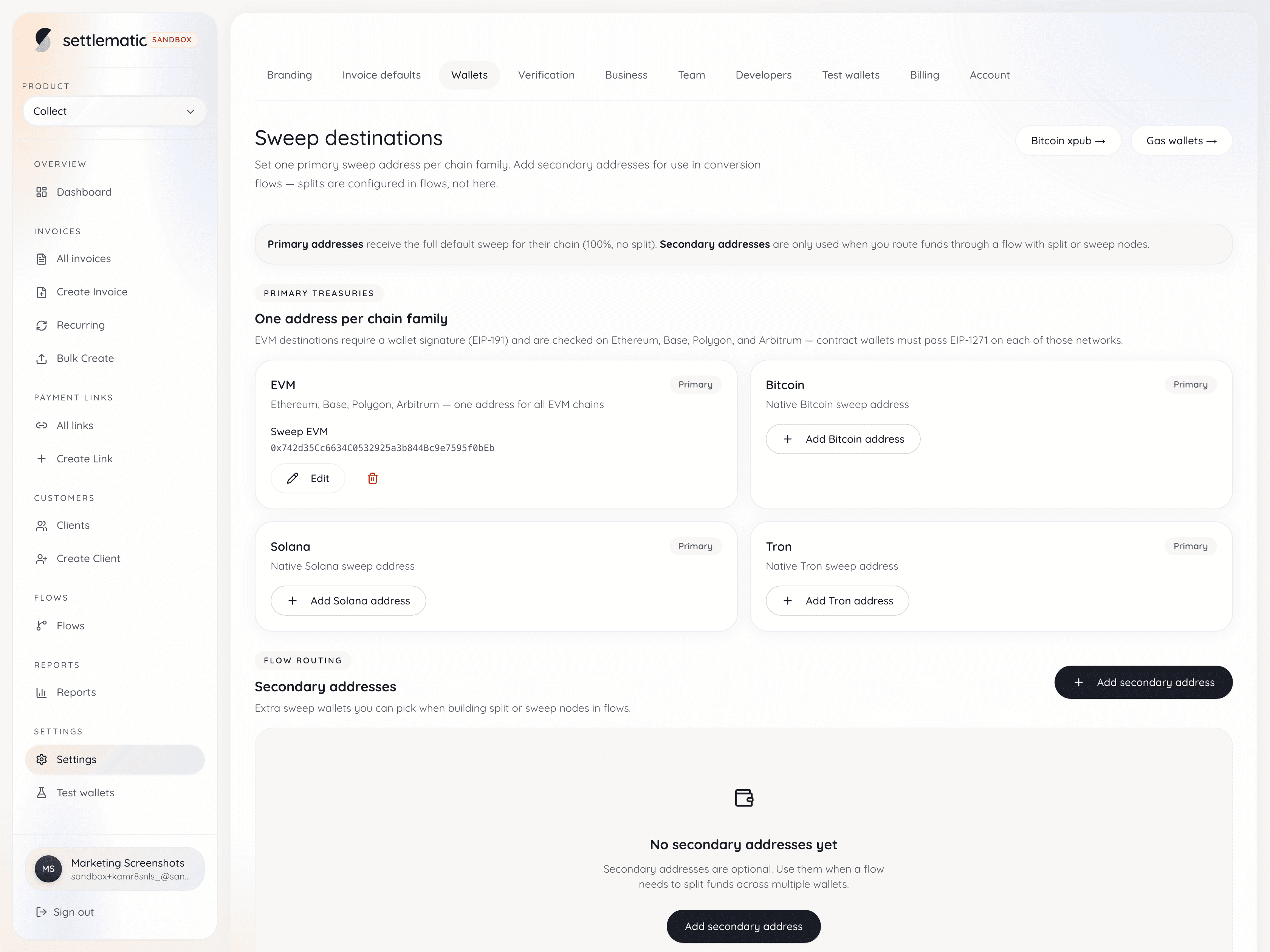
Settlematic is a true non-custodial gateway. Every invoice or checkout session generates a deposit address cryptographically bound at issuance to a settlement wallet you control — cold storage, an operating wallet, or a multisig. We never hold keys and cannot redirect an address once issued; we detect the on-chain confirmation, reconcile it, and fire your webhook. We settle USDC, USDT, EURC, ETH, and BTC across Ethereum, Polygon, BSC, Solana, Tron, and Bitcoin, and we bill in fiat (USD/EUR/GBP) with the customer paying crypto quoted at send-time. See the payment gateway product for embedded checkout, subscriptions, and multi-merchant splits, and our best crypto payment gateway roundup for how the field compares.
Pricing is a flat subscription with no percentage of volume: Collect from $20/month, Gateway on Pro from $49/month, with a 7-day Pro trial and a free sandbox. Network fees are paid on-chain by the sender, as with any wallet-to-wallet transfer.
The bottom line
A non-custodial crypto payment gateway is the right default when you want settled funds to be yours the moment they confirm — no holding window, no freeze risk, no take-rate that scales with revenue. It is the wrong default when you need automatic fiat in a bank, broad coin coverage, or built-in refunds, in which case a custodial processor earns its cut.
The honest recommendation: verify custody in the provider's own docs, model fees against your real volume, and test end to end before committing. Run a real invoice in the free Settlematic sandbox with no card required, and compare the settlement experience against your current setup.
Competitor figures sourced from Coinbase and NOWPayments' own documentation, verified 7 September 2026. Fees and product availability change — check each provider's pricing page for current terms. Settlematic is not affiliated with Coinbase, NOWPayments, or BitPay.
Sources
Frequently asked questions
- What is a non-custodial crypto payment gateway?
- It is a payment gateway that accepts crypto on your behalf but never takes possession of the funds. Payments settle to a wallet whose private keys you hold, so the provider cannot hold, freeze, or redirect your revenue — it only detects payments on-chain and notifies your systems.
- How is non-custodial different from a custodial processor?
- A custodial processor (like BitPay or the new Coinbase Business) receives the crypto into wallets it controls, holds a ledger balance, and pays you out on a settlement cycle. A non-custodial gateway routes funds straight to your own wallet with no intermediary balance and no payout step.
- Are non-custodial gateways cheaper?
- Usually above low volume. Custodial processors charge roughly 1-2% of volume; non-custodial providers charge 0.5-1% or, like Settlematic, a flat monthly subscription with no percentage of volume. Below a few thousand dollars a month, percentage pricing can be competitive.
- Can I get fiat in my bank with a non-custodial gateway?
- Not automatically. Non-custodial gateways settle crypto (often stablecoins) to your wallet; converting to fiat and moving it to a bank is a separate step you handle. Custodial platforms that hold your funds can offer built-in bank off-ramps in exchange for that custody.
- Is non-custodial the same as unregulated?
- No. Custody is what triggers the heaviest licensing (own-funds, segregation), but AML, KYB/KYC, and Travel Rule obligations still attach to payment services regardless of custody model.