Tokenized Invoice Solutions in 2026: DeFi, NFTs, and Practical B2B Billing
Tokenized invoice solutions in 2026: on-chain invoice NFTs, DeFi factoring, ERC-20 payment rails, and when traditional non-custodial billing fits B2B better.
Do this next
Create a crypto invoice
- Quote the invoice in fiat.
- Client pays USDC, USDT, or EURC.
- Funds settle to a wallet you already control.
TL;DR
Tokenized invoice can mean DeFi factoring, NFT receivables, or standard crypto invoicing. Most B2B teams need taxed fiat quotes with on-chain settlement, not on-chain invoice NFTs.
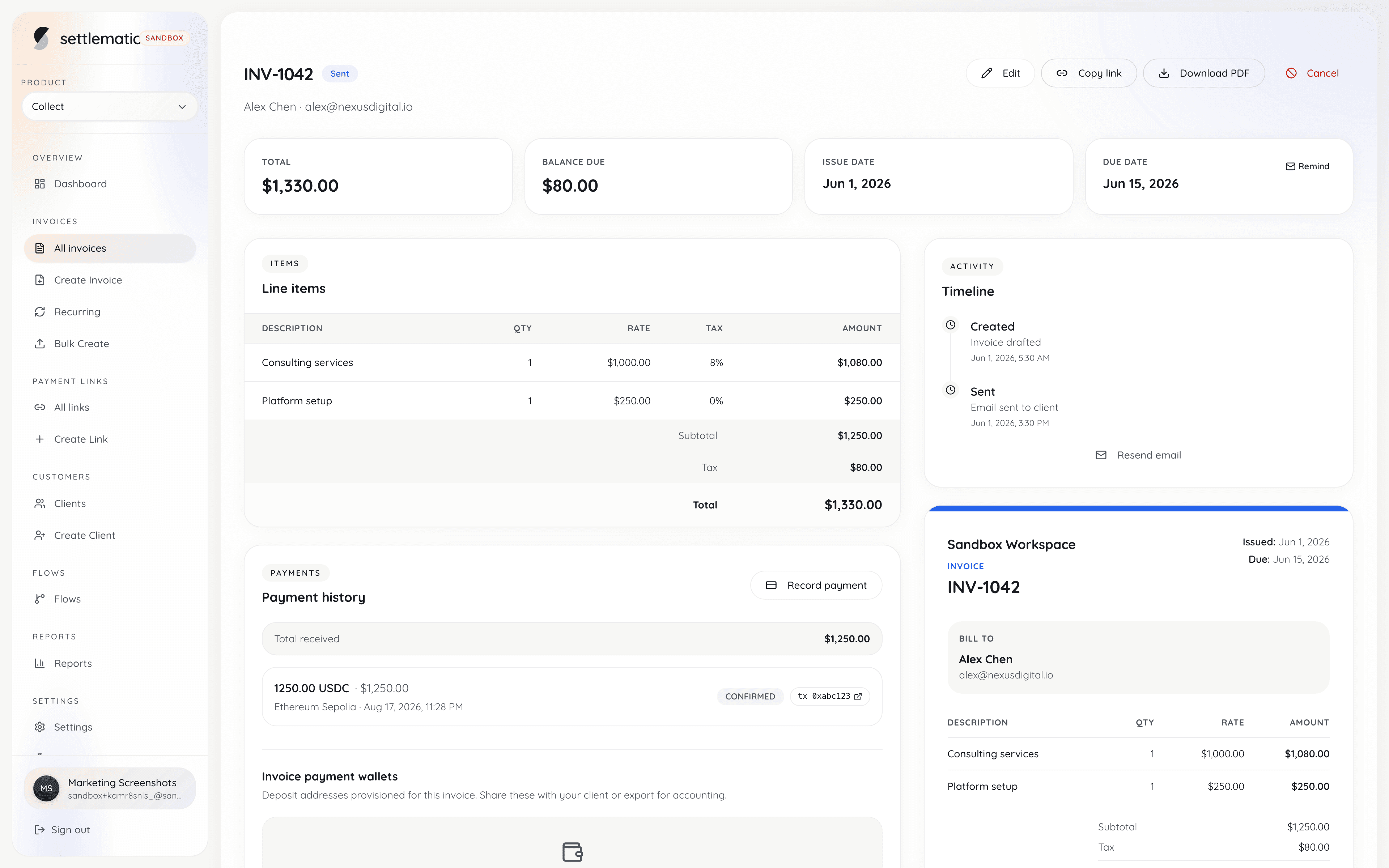
Tokenized invoice solutions are financial instruments and software systems that encode accounts receivable—unpaid or paid invoices—as blockchain tokens, typically NFTs (ERC-721/1155) or specialized ERC-20 representations, optionally integrated with DeFi protocols for factoring, collateralized lending, and secondary market trading of invoice claims. In 2026, the space spans experimental protocols promising instant liquidity on receivables to pragmatic hybrids where invoice metadata lives on-chain while settlement still flows through stablecoin transfers familiar to corporate treasuries.
The Tokenization Spectrum
Not all "tokenized invoices" mean the same thing:
| Model | On-chain artifact | Payment flow | Primary user |
|---|---|---|---|
| Invoice NFT metadata | NFT minted per invoice | Separate USDC transfer | Web3-native B2B |
| Payable NFT | NFT burned on payment | Atomic pay + settle | Smart contract savvy payers |
| ERC-20 receivable token | Fungible claim on pool | DeFi secondary market | Trade finance funds |
| RWAs (Real World Assets) | Tokenized invoice in regulated vault | Off-chain legal + on-chain token | Institutional |
| Non-tokenized crypto invoice | None; DB + unique address | Direct stablecoin | Mainstream B2B |
Settlematic occupies the last row—non-custodial, non-tokenized—by design for exchange-compatible payments and accounting simplicity. This guide explains when to graduate toward tokenization.
Why Tokenize Invoices?
Liquidity and factoring
Traditional factoring: sell receivables to factor at discount for immediate cash. Tokenized invoices could trade on-chain—buyers bid on invoice NFTs representing $100,000 payment from creditworthy obligor due in 60 days.
DeFi protocols (2024-2026 experiments) attempt automated factoring pools. Yields and risks mirror tradfi factoring plus smart contract and oracle risk.
Programmable payment terms
Smart contracts encode:
- Early payment discounts (2/10 net 30 on-chain)
- Late payment penalties accruing per block
- Escrow release on delivery confirmation oracle
Useful for supply chain finance; overkill for consulting retainers.
Composability
Tokenized receivable as collateral in lending protocols—borrow against unpaid invoice NFT. Crypto-native distributors with long payment cycles explore this.
Transparency and audit
Immutable on-chain invoice hash proves issuance date and terms—dual-record with PDF for legal enforceability.
DeFi Invoice Protocols: 2026 Landscape
The DeFi invoice sector remains fragmented. Categories:
Factoring pools. Liquidity providers fund pools purchasing invoice tokens at discount. Protocols vary in credit assessment—some use on-chain reputation, others require off-chain KYC for obligors.
NFT invoice marketplaces. Mint invoice as NFT; buyer pays via contract function burning NFT or transferring payment token. Limited CEX payer compatibility—exchange withdrawals cannot call arbitrary contracts.
RWA platforms under MiCA. EU-regulated tokenization of real-world receivables with prospectus and CASP involvement—institutional scale, not solo freelancer.
Payment-router hybrids. Invoice record off-chain; settlement on-chain with event emission—Settlematic model without token mint cost.
Evaluate protocols on: obligor default handling, legal enforceability in your jurisdiction, gas costs, and whether your clients can actually pay via required mechanism.
NFT Invoices: Technical Pattern
Typical mint flow:
- Merchant calls mintInvoice(invoiceId, amount, dueDate, payer) on factory contract
- NFT minted to merchant wallet representing receivable
- Payer calls payInvoice(tokenId) with USDC approval
- Contract splits USDC to merchant; NFT burned or marked paid
Advantages:
- Atomic payment + status update
- On-chain provenance
Disadvantages:
- Payer must interact with contract (excludes most CEX payers)
- Gas costs on Ethereum mainnet
- Legal standing of NFT vs signed PDF invoice unsettled in many courts
- Recovery from wrong-chain payments harder—see recover-wrong-chain-crypto-invoice-payment
Comparison: Tokenized vs Settlematic Non-Custodial
| Factor | Tokenized invoice NFT | Settlematic non-custodial |
|---|---|---|
| CEX payer support | Poor | Excellent |
| QuickBooks export | Complex; custom fields | CSV/API per export guide |
| Gas cost per invoice | Mint + pay gas | Address derivation only |
| Factoring liquidity | Potential on-chain | Tradfi factoring off-platform |
| Wrong-chain recovery | Contract-dependent | Key-based EVM recovery |
| MiCA/regulatory | Token issuance may trigger rules | Invoicing software posture |
| Client UX | Wallet + contract | Hosted payment page |
For US and EU client billing, non-custodial hosted pages win on payer compatibility.
When Tokenization Makes Sense
Crypto-native supply chains
Vendor and buyer both use multisig treasuries; payments already contract-based. NFT invoice fits existing workflow.
High-value trade finance
$500k+ invoices with institutional factor participation; legal wrappers and regulated RWA platforms justify tokenization overhead.
Protocol-to-protocol billing
DAO paying service provider DAO; on-chain governance approves invoice NFT payment.
Embedded finance products
Your platform issues tokenized receivables to investors— you are building fintech, not invoicing for services.
When to Avoid Tokenization
- Clients pay from Coinbase/Kraken corporate accounts
- Finance team uses QuickBooks/Xero without blockchain expertise
- Invoice volume high, values moderate—gas and complexity dominate
- Regulatory uncertainty in your industry (healthcare, government contractors)
- You need custom branding and PDF AP workflows today
Hybrid Architectures
Pragmatic 2026 pattern:
- Off-chain invoice of record — PDF, legal terms, VAT lines in Settlematic
- On-chain payment — USDC to unique address; webhook confirms
- Optional anchor hash — Store invoice PDF hash on-chain for audit without NFT mint per invoice
Anchoring provides tamper evidence without NFT gas or CEX incompatibility.
Solana and Low-Cost Tokenization
Solana's low fees enable cheaper NFT invoice experiments. Metaplex standards support compressed NFTs reducing mint cost. Solana Pay links offer middle ground—deep link payment without full invoice NFT.
Solana settlement aligns with Settlematic multi-chain support; tokenization layer remains optional add-on from third-party protocols.
MiCA and Securities Considerations
EU MiCA classifies crypto-assets and regulates token offerings. Tokenized receivables may constitute transferable securities or asset-referenced tokens depending on structure—legal analysis required before minting invoice tokens to tradeable markets.
Non-custodial invoicing without transferable invoice tokens typically avoids issuing regulated crypto-assets; you receive payment, not sell invoice claims to public.
US SEC considerations similarly caution on fractionalized receivable tokens marketed as investments.
Consult securities counsel before DeFi factoring products targeting US/EU retail liquidity providers.
Integration With Accounting
Tokenized invoices challenge GAAP recognition:
- When is revenue recognized—at mint, at sale to factor, at payment?
- How to mark fair value of retained invoice token?
- Impairment if obligor defaults
Traditional export to QuickBooks per export-crypto-invoice-data-quickbooks-xero assumes fiat-stable payment events—not NFT transfers.
Enterprise tokenization projects need parallel sub-ledger tracking token lifecycle.
DeFi Risks
| Risk | Mitigation |
|---|---|
| Smart contract exploit | Audits, insurance, limits |
| Oracle manipulation | Multiple data sources |
| Obligor default | Credit analysis off-chain |
| Liquidity crunch in factor pool | Diversified pools |
| Regulatory enforcement | Jurisdiction-specific structure |
B2B service businesses rarely need these risk surfaces for simple invoice collection.
Webhooks and Automation
Tokenized protocols emit on-chain events; indexers translate to webhooks similarly to Settlematic—see webhook-patterns-crypto-billing. Subgraph vs platform-native webhooks differs in reliability; dual-source verification still recommended.
Future Outlook: 2026-2028
Trends:
- RWA institutionalization — Regulated invoice tokenization for supply chain giants
- Account abstraction — ERC-4337 smart wallets improving contract payment UX marginally
- Stablecoin ubiquity — USDC on L2/Solana reduces need for exotic settlement
- AI + MCP billing — Settlematic MCP automates creation; tokenization remains niche
Prediction: tokenized invoices grow in trade finance vertical; mainstream B2B stays stablecoin + non-custodial address invoicing.
Choosing Your Stack
Decision matrix:
Getting Started
- Default: Settlematic Collect for non-tokenized billing
- Pilot tokenization: One crypto-native client, legal review, testnet only
- Scale: Only if liquidity benefit exceeds ops + legal cost
Review pricing; demo for hybrid architecture consulting.
Regulatory Landscape Update: MiCA and US SEC in 2026
MiCA fully applicable across EU member states by 2026 creates clearer—but stricter—boundaries for tokenized receivables marketed to retail liquidity providers. Issuing transferable invoice tokens to the public may trigger prospectus requirements under MiCA Title II. Professional investors and qualified investors exemptions exist but require legal structuring. US SEC continues enforcement against unregistered securities offerings in DeFi factoring pools—Safe Harbor proposals remain guidance, not safe harbor in practice. Merchants tokenizing invoices for trade finance should budget $50k–$200k legal for cross-border structure before first mainnet mint. Non-tokenized Settlematic Collect invoicing avoids this regulatory surface for standard B2B services revenue.
Technical Standards: ERC-721 vs ERC-1155 vs Soulbound
Invoice NFT implementers choose standards:
- ERC-721: One unique token per invoice; clear ownership; higher gas per mint on Ethereum
- ERC-1155: Batch mint capability; semi-fungible invoice series; complex metadata
- Soulbound (SBT): Non-transferable invoice receipt; prevents secondary factoring market—defeats liquidity purpose
ERC-6551 token-bound accounts (2024–2026 experiments) give NFTs own wallet addresses—invoice NFT could theoretically receive payment directly, merging tokenization with payment address. Immature for enterprise AP workflows; watch for 2027–2028 maturity.
Oracle and Credit Risk in DeFi Factoring
DeFi factoring pools price invoice tokens using oracles reporting obligor creditworthiness—often centralized APIs signing attestations on-chain. Oracle manipulation or stale credit data causes pools to buy worthless receivables. Traditional factors perform human underwriting; DeFi automates at speed with model risk. Merchants selling invoice NFTs at discount should compare effective APR to Tradfi factoring (typically 1–5% per month including fees)—DeFi yields during bull markets looked attractive; bear market defaults exposed protocol insolvencies 2024–2025. Due diligence on protocol TVL, audit history, and legal recourse against defaulting obligor (usually none on-chain) before participation.
Environmental and Reputational Considerations
Enterprise ESG policies occasionally flag proof-of-work chains for invoice settlement—less relevant as Ethereum post-merge and Solana POS dominate B2B stablecoin flows. Tokenization on energy-intensive chains may face procurement objections; document chain choice in RFP responses. Reputational risk from association with DeFi protocols suffering hacks—enterprise may prefer non-tokenized Settlematic invoicing over experimental protocol partnerships.
Pilot Program Design for Tokenization Curious Teams
If exploring tokenization despite mainstream recommendation for non-tokenized billing:
- Scope: Single crypto-native client, <$25k invoice, testnet only month 1
- Legal: Opinion letter on securities and MiCA treatment before mainnet
- Accounting: Parallel books—tokenized sub-ledger plus traditional PDF invoice of record
- Exit criteria: Abort if CEX payer cannot complete; abort if gas >1% invoice value
- Success criteria: Liquidity benefit quantified vs export/reconcile overhead
Most pilots conclude non-tokenized Settlematic workflow is optimal for payer compatibility.
Interoperability With Traditional Factoring
Merchants using traditional factors (BlueVine, Fundbox, altLINE) for fiat invoices sometimes ask whether tokenized on-chain factoring replaces or complements Tradfi. Hybrid model: factor fiat invoices; use Settlematic non-tokenized crypto invoices for crypto-paying clients without selling receivable—faster settlement eliminates factoring need for that segment. Selling tokenized crypto invoice to DeFi pool while also factoring fiat invoice from same client creates double-financing risk and legal complexity—avoid without counsel. Tradfi factors accept PDF and UCC filing; DeFi pools accept wallet signature—different operational muscle.
For the vast majority of Settlematic merchants billing US and EU clients in USDC, the practical 2026 answer is clear: professional PDF invoices, hosted payment pages, direct wallet settlement, and QuickBooks export—not invoice NFTs. Tokenization remains a specialized tool for trade finance innovators, not the default B2B billing stack.
Legal enforceability: token vs PDF in disputes
Courts globally still anchor B2B payment disputes in signed contracts, PDF invoices, email threads, and delivery records — not NFT metadata. A tokenized invoice may supplement evidence (proving issuance timestamp on-chain) but rarely replaces statutory invoice requirements for VAT jurisdictions. EU B2B reverse charge documentation needs VAT IDs, line items, and sequential invoice numbers on PDF — minting an NFT does not satisfy Hungarian NAV or German Finanzamt requirements without parallel PDF.
Before tokenizing, obtain jurisdiction-specific legal opinion on whether NFT transfer constitutes assignment of receivable under local commercial law. Some civil law systems require written assignment notice to debtor — on-chain transfer alone may not notify obligor effectively. Hybrid model (PDF invoice of record + optional hash anchor) preserves legal clarity while gaining tamper evidence.
Gas economics at scale: when tokenization fails the math
Minting ERC-721 invoice NFTs on Ethereum mainnet at $15–50 gas per mint destroys economics for high-volume moderate-value invoicing. A consultancy issuing 200 invoices monthly at $3,000 average faces $3,000–10,000 monthly mint gas alone — before client payment gas. L2 minting reduces cost but reintroduces CEX payer friction if clients cannot interact with L2 contracts. Compressed NFTs on Solana lower mint cost but require wallet-native payers.
Calculate total cost of tokenization: mint gas + payment interaction gas + legal review + accounting sub-ledger + client support for wallet errors. Compare to Settlematic non-tokenized per-invoice address derivation cost (negligible gas, paid by client on transfer). Unless factoring liquidity benefit exceeds total cost, tokenization is engineering exercise not business improvement.
Enterprise RFP responses: tokenization vs practical billing
Enterprise RFPs increasingly ask about "blockchain invoicing" without distinguishing tokenization from stablecoin settlement. Respond accurately: Settlematic provides non-custodial stablecoin invoicing with on-chain payment verification — not tradeable invoice token issuance. If prospect explicitly requires on-chain receivable tokenization for supply chain finance program, partner with regulated RWA platform or decline if outside competency — misrepresenting tokenization capability fails procurement audit later.
Include architecture diagram in RFP appendix showing PDF invoice → unique deposit address → on-chain USDC → webhook → ERP. Procurement teams confuse "crypto invoicing" with "invoice NFT marketplace" — educate without dismissing their tokenization interest if genuine trade finance use case exists.
Frequently asked questions
- Are invoice NFTs legally enforceable?
- Varies by jurisdiction; PDF + contract usually enforceable; NFT supplements evidence—not replacement for legal advice.
- Can I tokenize only some invoices?
- Yes—hybrid model common; segregate accounting treatment.
- Does Settlematic mint invoice NFTs?
- Core product focuses non-custodial stablecoin invoicing without per-invoice NFT gas; explore partners for tokenization layer.
- What about Ethereum mainnet gas?
- Prohibitive for high-volume NFT mints; use L2 or Solana for tokenization experiments.
- How does tokenization interact with VAT?
- VAT determined on supply; token transfer does not replace invoice VAT documentation for EU B2B.
- Is DeFi factoring regulated?
- Often yes under securities, lending, or MiCA CASP regimes—investigate before participating as factor or issuer.