Recurring Crypto Billing & Subscriptions: Complete Guide
Automate recurring crypto billing and subscription invoices with non-custodial settlement, automated scheduled notifications, and fiat-quoted stablecoins.
Do this next
Create a crypto invoice
- Quote the invoice in fiat.
- Client pays USDC, USDT, or EURC.
- Funds settle to a wallet you already control.
Recurring crypto billing works by sending scheduled fiat-quoted payment links each cycle (blockchains are push-based, not card-on-file). Use [Collect](/products/collect) for invoice subscriptions or [Gateway](/products/gateway) for product checkout plans with webhook automation.
TL;DR
Recurring crypto billing allows businesses to bill subscription customers in stablecoins on scheduled intervals. Since blockchain transactions are push-based, recurring billing works by generating automated, scheduled fiat-quoted invoices with payment links sent to subscribers. Payments land in non-custodial wallets with instant webhook reconciliation and zero percentage take-rates.
Recurring crypto billing allows businesses to bill subscription customers in stablecoins on scheduled intervals. Since blockchain transactions are push-based, recurring billing works by generating automated, scheduled fiat-quoted invoices with payment links sent to subscribers. Payments land in non-custodial wallets with instant webhook reconciliation and zero percentage take-rates.
For software-as-a-service (SaaS) providers, Web3 platforms, agency retainers, and digital membership communities, recurring revenue is the lifeblood of business operations. While traditional credit card subscription systems rely on auto-debit authorizations, public blockchains operate fundamentally as push-based networks where users must sign each transaction.
The Web3 subscription challenge: Push vs. pull architecture
On traditional credit card rails (like Stripe or Recurly), customers authorize a merchant to pull funds from their account on a monthly schedule. On public blockchains, smart contracts cannot arbitrarily pull tokens from a user's wallet without an explicit, cryptographically signed approval.
To overcome this architectural constraint, modern recurring crypto billing platforms utilize scheduled automated invoicing workflows:
- 1. Scheduled invoice dispatch: The billing engine automatically generates a fiat-quoted invoice on the subscriber's recurring billing date.
- 2. One-click payment link delivery: The subscriber receives an automated email or Web3 app notification containing a hosted payment link.
- 3. Wallet payment authorization: The subscriber opens the link, connects their wallet, and approves the push transaction in seconds.
- 4. Real-time webhook provision: The billing engine detects on-chain confirmation, fires a webhook to your app, and extends the user's subscription access.
Why stablecoins are essential for subscription billing
Pricing a monthly software subscription at 0.01 BTC or 0.05 ETH creates unpredictable Monthly Recurring Revenue (MRR) fluctuations. When crypto prices drop 20%, your monthly subscription revenue drops 20% in dollar terms.
By denominating subscription tiers in fiat currencies (e.g., $49/month or €99/month) and collecting settlement in stablecoins like USDC or USDT, businesses maintain steady MRR while offering subscribers seamless crypto payments.
For more details on SaaS subscription strategies, see our dedicated guide on crypto payments for SaaS and how to accept USDC payments.
Subscription billing models compared
| Metric | Traditional Card Billing | Custodial Crypto Gateways | Settlematic Non-Custodial |
|---|---|---|---|
| Transaction fees | 2.9% + $0.30 per charge | 1.0% to 2.0% per charge | 0% volume take-rate (flat subscription) |
| Mechanism | Automated pull auto-debit | Push invoice or custodial wallet balance | Automated scheduled push invoice |
| Payout timing | 2 - 7 business days | Batch payouts (1-3 days) | Instant on-chain wallet clearance |
| Cross-border fees | Additional 1.5% FX charge | Crypto-to-fiat conversion margins | 0% cross-border surcharge |
| Custody risk | Processor holds merchant balance | Processor holds crypto funds | Zero custody (direct to wallet) |
How Settlematic handles recurring crypto billing
Settlematic provides a complete recurring billing infrastructure through Settlematic Collect:
- Flexible billing intervals: Configure weekly, monthly, quarterly, or annual recurring schedules.
- Fiat-quoted price locking: Lock exact stablecoin quotes at the time of invoice dispatch to eliminate exchange rate volatility.
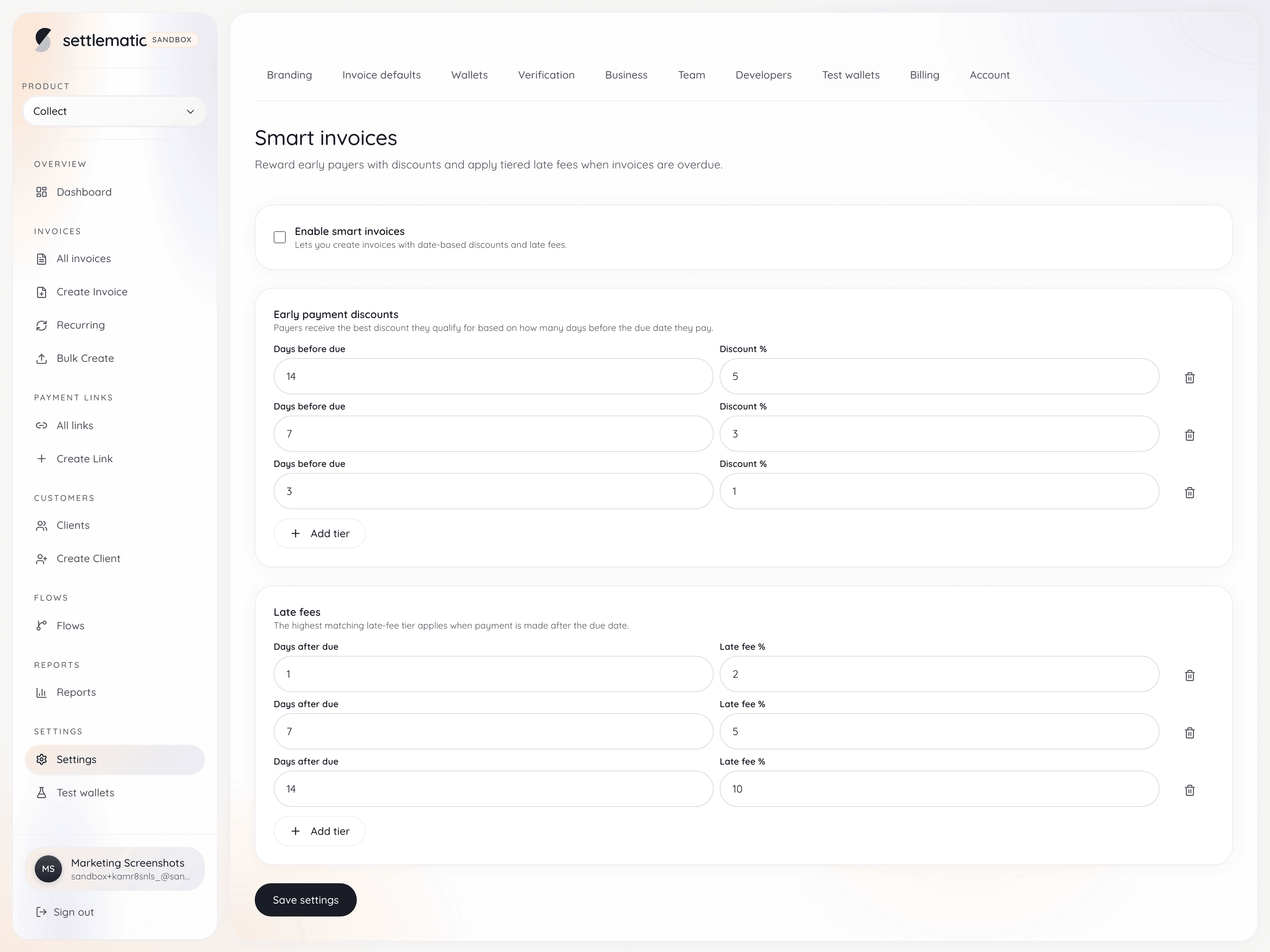
- Automated dunning & reminders: Send automated pre-due notifications and customizable dunning sequences for unpaid subscription links.
- Developer webhooks & API: Integrate subscription event webhooks (`invoice.created`, `invoice.paid`, `invoice.overdue`) directly into your SaaS billing engine.
Implementation workflow for SaaS and agency retainers
Implementing recurring crypto billing requires four setup steps:
- Step 1: Set up subscription plans in Settlematic or via API, specifying plan names, fiat billing amounts, and recurrence rules.
- Step 2: Add your corporate settlement wallet addresses (e.g. Polygon, Solana, or Ethereum multisig addresses).
- Step 3: Connect subscriber emails or account IDs to trigger scheduled billing dispatches.
- Step 4: Configure webhook endpoints in your application to listen for confirmed on-chain payments and grant user access.
To learn how agencies structure retainer billing, see our guide to [crypto invoicing for agencies](/blog/best-crypto-invoicing-for-agencies) and fiat-quoted mechanics.
Honest limitations of Web3 subscription billing
While non-custodial recurring crypto billing eliminates processor transaction fees, businesses must navigate two specific operational friction points:
- Manual approval required: Because payments are push-based, subscribers must click payment links and sign transactions manually each cycle. Inactive users may churn faster than on passive card auto-debit plans.
- Gas fee responsibility: Subscribers must hold a small amount of native gas tokens (e.g., SOL, MATIC, or ETH) in their wallet to approve monthly transfers.
Launch recurring crypto billing today
Scale your recurring stablecoin revenue with zero percentage fees and non-custodial treasury security. Review our flat monthly pricing or test recurring billing features in the free sandbox demo.
Sources
Frequently asked questions
- How do recurring subscriptions work in crypto without automatic debit permission?
- Because native blockchain transactions are push-based (requiring user private key signatures for every transfer), recurring crypto billing relies on automated scheduled invoices. The platform sends a fiat-quoted payment link to the subscriber on each billing cycle, allowing them to authorize payment with one click.
- Can subscribers pay recurring crypto invoices in stablecoins like USDC or USDT?
- Yes. Subscriptions can be quoted in USD or EUR and settled in USDC or USDT across fast networks like Solana, Polygon, Base, or Arbitrum, protecting SaaS platforms and agencies from price volatility.
- How does Settlematic notify my application when a subscription payment succeeds?
- Settlematic monitors incoming on-chain transactions and dispatches instant webhooks to your application backend. Upon payment confirmation, your webhook handler updates the user's active subscription status automatically.
- What happens if a customer misses a scheduled recurring crypto payment?
- Settlematic sends configurable automated email reminders and payment link notifications. If payment is not detected on-chain within your grace period, webhooks notify your platform to trigger automated subscription dunning or account suspension workflows.
- Are there percentage transaction fees on recurring crypto subscription billing?
- No. Settlematic charges a flat monthly subscription starting at $20/month with zero percentage fees or revenue share, significantly undercutting traditional subscription billing gateways that charge 2.9% + 30¢ per charge.