Are Crypto Payment Gateways Safe? How to Evaluate One
Crypto payment gateways can be safe — but safety depends on custody, not brand. Here is how to evaluate freeze, bankruptcy, and hack risk, with a checklist.
Do this next
Create a crypto invoice
- Quote the invoice in fiat.
- Client pays USDC, USDT, or EURC.
- Funds settle to a wallet you already control.
Crypto payment gateways are as safe as their custody model. Custodial gateways hold your funds in a pooled balance — safe until the operator fails, freezes accounts, or is hacked. Non-custodial gateways like Settlematic never hold funds; payments go to addresses bound to your wallet, so the remaining risks are your own key management and chain confirmation policy.
TL;DR
Crypto payment gateways can be safe, but safety depends almost entirely on custody. A gateway that holds your funds exposes you to freezes, hacks, and bankruptcy; a non-custodial gateway that settles to a wallet you control removes most of that risk. Evaluate custody, key control, security posture, and track record before you commit.
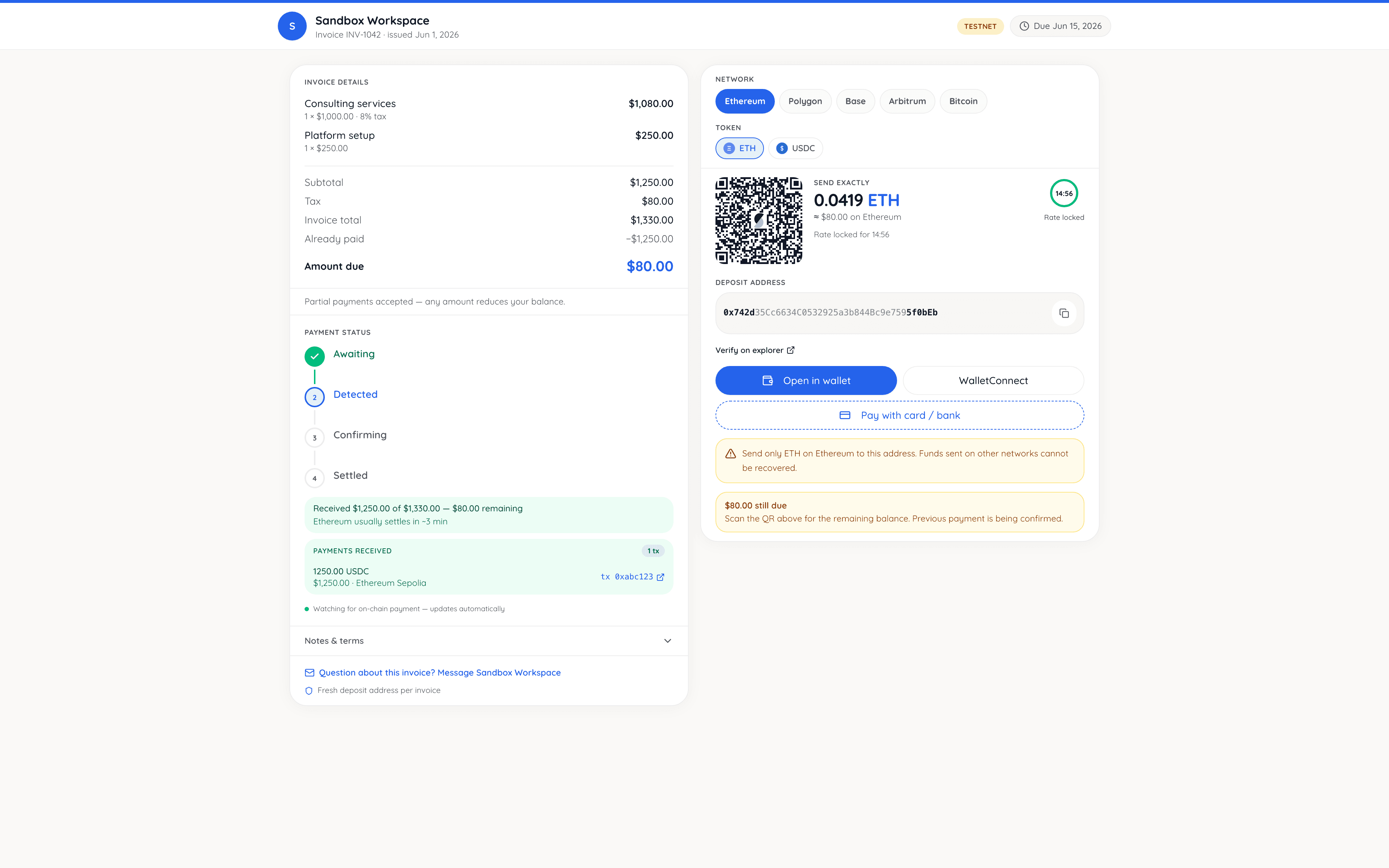
Crypto payment gateways can be safe, but their safety depends almost entirely on one thing: custody. A gateway that holds your funds exposes you to account freezes, reserve holds, hot-wallet hacks, and the provider's bankruptcy. A non-custodial gateway that settles directly to a wallet you control removes most of that risk, because a provider that never holds your money cannot lose it. Brand and age matter far less than whether anyone can touch your revenue between the customer paying and you receiving.
We build Settlematic, a non-custodial gateway, so read this as informed but interested. The evaluation framework below applies to any provider, including us, and every external claim is sourced.
What could actually go wrong?
"Safe" is vague. Break it into the specific failure modes a gateway can expose you to, because different models expose you to different ones:
- Freeze/hold risk: the provider suspends your account or holds settlements. Only possible if the provider controls the funds. BitPay, for example, documents a settlement-hold mechanism removable only by a BitPay agent, per its Merchant Terms of Use.
- Bankruptcy risk: the provider fails while holding your balance, and your revenue becomes a claim against the estate rather than an asset you own.
- Custodial hack risk: the provider's hot wallet or ledger is compromised. Your funds are only at risk here if they sit with the provider.
- Integration/security risk: spoofed webhooks, unverified payment confirmations, or leaked API keys. This exists in every model, including non-custodial — it is your responsibility to mitigate.
- Chargeback/fraud confusion: on-chain payments are final, which removes chargeback fraud but means overpayment and refund handling must be designed deliberately.
Notice that the first three failure modes require the provider to control your funds. Eliminate custody and you eliminate the majority of catastrophic, total-loss scenarios, leaving only operational risks you can control yourself.
The bankruptcy lesson merchants keep re-learning
In the Celsius bankruptcy, the court ruled on 4 January 2023 that assets held in interest-bearing Earn accounts had, under the terms of use, become property of the bankruptcy estate — leaving those customers as general unsecured creditors, per the court's memorandum opinion. Assets in the segregated Custody program were treated as customer property instead.
FTX is the other cautionary tale. Even where recoveries eventually exceeded 100% of allowed claims, those claims were valued at petition-date dollar values from November 2022 — when Bitcoin traded near $16,000 — not at the current value of the crypto customers actually held. A creditor repaid "105%" of a claim fixed at 2022 prices did not get their appreciated Bitcoin back. The full merchant breakdown is in FTX and Celsius lessons for merchants.
The takeaway for anyone choosing a gateway: if a provider holds your revenue, you are one insolvency away from being a line item in a claims table. Non-custodial settlement means there is no balance to freeze and nothing to claw into an estate.
How to evaluate a gateway's safety
Run every candidate through the same questions, in order of how much they matter:
| Question | Why it matters | Safer answer |
|---|---|---|
| Does it hold my funds? | Determines freeze, hack, and bankruptcy exposure | No — settles to a wallet I control |
| Who controls the private keys? | Whoever holds keys controls the funds | I do; provider never holds keys |
| Can a deposit address be redirected? | In-path software can reroute funds | No — address bound at issuance |
| Is there a settlement delay or reserve? | Delays and reserves are custody in disguise | None — on-chain confirmation is settlement |
| Security certifications? | Signals mature security practices | SOC 2 or equivalent, in progress or complete |
| Testnet/sandbox available? | Lets you verify before live funds | Yes, free sandbox |
| Webhook signature verification? | Prevents spoofed payment events | Signed webhooks, documented verification |
| Track record and jurisdiction? | Longevity and regulatory posture | Clear entity, disclosed jurisdiction |
The first three rows carry the most weight. A gateway can be young and still structurally safe if it never touches your funds; a gateway can be a decade old and still expose you to a freeze because it holds your balance by design.
A practical merchant safety checklist
Before you send a single live payment through any gateway, work through this:
- Read the terms of use for "ledger", "balance", "reserve", "settlement cycle", and "hold" — these words reveal custody.
- Confirm settlement goes to an address you control, and test it on-chain before going live.
- Verify the provider cannot redirect a deposit address once issued.
- Enable and test webhook signature verification; never trust an unsigned payment event.
- Run the full flow in a testnet sandbox first, including underpayment and overpayment cases.
- Store settlement in cold storage or multisig, not a hot operating wallet, once amounts grow. See crypto payment security best practices.
- Check the provider's legal entity, jurisdiction, and security certifications.
- Rotate and scope API keys; never embed them client-side.
Where a custodial gateway can still be the safer practical choice
Being fair: non-custodial shifts security responsibility to you, and that is not always the safer real-world outcome. If your team cannot securely manage keys, a reputable custodial processor with SOC 2, insurance, and mature operations may protect your funds better than a self-managed wallet with weak key hygiene. Custody risk is real, but so is the risk of losing keys you were not equipped to hold. Choose non-custodial when you can operate a wallet responsibly; choose custodial when you genuinely cannot and need the provider to absorb that.
How Settlematic reduces the risk surface
Settlematic is non-custodial by construction: deposit addresses are bound at issuance to a wallet you control, so we cannot freeze, redirect, or hold funds, and there is no balance to lose in a hack or bankruptcy. We support signed webhooks, a free testnet sandbox, and KYB/KYC onboarding, with SOC 2 in progress. The architecture is detailed on our security page. What we do not do is remove your responsibility to manage keys well — that part is on you.
The best way to judge any gateway's safety is to test it. Run a real payment through the free sandbox, watch where the funds settle, and confirm no third party sits between the customer and your wallet.
External claims sourced from public court records, FTX estate announcements, and provider documentation, verified 7 September 2026. Trademarks belong to their respective owners.
Sources
Frequently asked questions
- Are crypto payment gateways safe to use?
- They can be, but safety varies enormously by custody model. Non-custodial gateways that settle directly to a wallet you control are structurally safer than custodial processors that hold your funds, because a provider that never holds your money cannot freeze it, lose it in a hack, or trap it in bankruptcy.
- What is the biggest risk with a crypto payment gateway?
- Custody risk. If the gateway holds your funds — even briefly — you are exposed to account freezes, reserve holds, hot-wallet hacks, and the provider's insolvency. The Celsius and FTX bankruptcies showed that held balances can become general unsecured claims.
- How do I know if a gateway holds my funds?
- Read the terms of use for words like ledger, balance, settlement cycle, reserve, or hold. If the provider pays you out on a schedule rather than settling instantly to your wallet, it holds your funds and is custodial.
- Is a non-custodial gateway completely risk-free?
- No. You take on wallet and key-management responsibility, refunds are manual, and you must verify webhook signatures and reconcile on-chain. Non-custodial removes intermediary custody risk but shifts operational security to you.
- What should I check before trusting a gateway?
- Custody model, who controls the private keys, security certifications like SOC 2, whether it supports a testnet sandbox, webhook signature verification, and the provider's track record and jurisdiction. Use the checklist in this article.